In the competitive landscape of content-driven commercial websites, the pressure to deliver Minimum Viable Products (MVPs) rapidly while maintaining operational reliability is intense. Organizations often face conflicting priorities: accelerating time-to-market, ensuring security and auditability, and establishing a foundation for steady organic traffic growth. Release engineering, when executed without strategic foresight, can become a bottleneck or a source of operational risk, especially under budget constraints.
This narrative explores the intersection of release engineering and operational reliability through the lens of product strategy. It frames the problem as a decision-making challenge where engineering choices directly influence business outcomes such as qualified lead generation and conversion rates. The goal is to establish a release runbook tailored for content-driven commercial websites that balances these constraints and delivers measurable ROI.

Constraints: Security, Auditability, and Budget Limitations
Budget constraints impose strict limits on tooling, personnel, and time, often forcing trade-offs between automation depth and manual oversight. However, security and auditability requirements cannot be compromised, especially for commercial websites handling sensitive user data or regulated content. These constraints manifest in several ways:
- Limited automation budget: Full CI/CD pipelines with extensive automated testing may be partially implemented or deferred.
- Compliance mandates: Release processes must produce verifiable audit trails and enforce role-based access controls.
- Operational risk tolerance: MVP launches must minimize downtime and rollback risks despite limited staging environments.
These constraints necessitate a release engineering approach that is lean yet robust, emphasizing process discipline and incremental automation aligned with business priorities.
Architecture: Designing a Release Engineering Framework for Reliability and Auditability
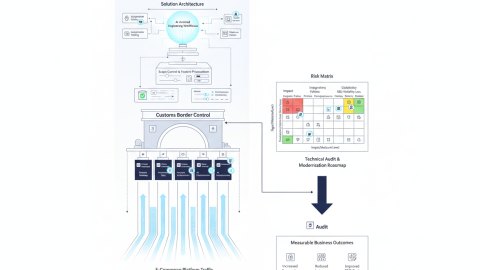
Architecting a release process under these constraints requires a modular, layered approach that integrates AI-assisted engineering workflows to optimize resource allocation and error detection. The architecture must support:
- Incremental delivery: Feature toggles and canary releases enable staged rollouts, reducing blast radius.
- Audit logging: Immutable logs of deployment actions, approvals, and environment changes ensure traceability.
- Security gates: Automated checks for code quality, vulnerability scanning, and access control enforcement.
- Observability integration: Monitoring and alerting systems that provide real-time feedback on release health.
AI-assisted workflows can be embedded to analyze commit patterns, predict risky changes, and recommend rollback triggers, thus enhancing operational reliability without inflating manual overhead.
For practical integration, this architecture aligns with proven product delivery frameworks such as those outlined in our MVP Delivery Architecture Blueprint for B2B SaaS and Internal Tooling, which emphasize risk reduction through incremental releases and observability.
Implementation Steps: Building the Release Runbook
Translating architecture into practice involves a phased rollout of capabilities, each reinforcing operational reliability and audit readiness:
1. Define Release Policies and Roles
Establish clear policies governing who can initiate releases, approve changes, and perform rollbacks. Role-based access control (RBAC) must be enforced at the tooling and environment levels to prevent unauthorized actions. Document these policies in a centralized release runbook accessible to all stakeholders.
2. Implement Incremental Automation with AI Assistance
Start with automating critical gates such as static code analysis and vulnerability scanning. Integrate AI tools that analyze commit histories and flag anomalies or high-risk changes. This step balances automation benefits with budget realities by focusing on high-impact areas.
3. Establish Immutable Audit Trails
Configure deployment pipelines and infrastructure to log every action immutably. Use cryptographic hashes or append-only logs to ensure tamper resistance. This audit trail supports compliance and facilitates post-release investigations.
4. Integrate Observability and Alerting
Embed monitoring hooks into the release pipeline and production environment. Define key performance indicators (KPIs) such as deployment success rate, rollback frequency, and mean time to recovery (MTTR). Use these metrics to trigger automated alerts and inform continuous improvement.
5. Conduct Controlled Rollouts and Rollbacks
Leverage feature toggles and canary deployments to limit exposure of new releases. Define rollback criteria based on observability data and automate rollback procedures where feasible. This approach minimizes downtime and protects user experience.
6. Continuous Review and Runbook Updates
After each release, conduct retrospectives focusing on release process adherence, incident occurrences, and audit findings. Update the runbook to incorporate lessons learned, evolving security requirements, and new automation capabilities.
This stepwise implementation aligns with the principles discussed in our Observability-Driven Incident Prevention and Resilience Architecture blog, emphasizing iterative maturity and measurable outcomes.
Pitfalls: Common Anti-Patterns and How to Avoid Them
Several pitfalls can undermine release engineering and operational reliability efforts, especially under budget constraints:
- Over-automation without governance: Automating without clear policies can lead to uncontrolled releases and security gaps.
- Ignoring audit requirements: Skipping audit trail implementation compromises compliance and complicates incident response.
- Monolithic releases: Large, infrequent releases increase risk and complicate rollback strategies.
- Neglecting observability: Lack of real-time monitoring delays detection of release-induced issues.
- Underestimating human factors: Insufficient training or unclear roles lead to process deviations and errors.
Mitigating these anti-patterns requires disciplined process design, continuous training, and leveraging AI-assisted workflows to augment human decision-making without replacing it.
Outcomes: Measurable Business Impact and Strategic Advantages
Implementing a release engineering and operational reliability framework as described yields tangible benefits aligned with product strategy goals:
- Reduced release failures: Incremental rollouts and automated gates lower the incidence of production incidents.
- Improved compliance posture: Immutable audit trails and RBAC satisfy security and regulatory requirements.
- Faster recovery times: Observability-driven alerts and automated rollbacks minimize downtime.
- Steady organic traffic growth: Reliable releases reduce SEO-impacting outages, supporting sustained lead generation.
- Optimized resource allocation: AI-assisted workflows focus engineering efforts on high-risk areas, maximizing ROI under budget constraints.
These outcomes contribute directly to increasing qualified leads and conversion rates by ensuring the website remains performant, secure, and compliant throughout MVP launch and beyond.
Practical Mini-Case: Launching a Content Hub with AI-Assisted Release Controls
A mid-sized B2B company planned to launch a content hub as part of their commercial website MVP. Facing a tight budget and strict audit requirements, they implemented a release runbook incorporating AI-assisted commit analysis and automated security gates. By deploying feature toggles and canary releases, they limited exposure of new content features. Observability dashboards tracked KPIs such as page load times and error rates, triggering automated rollback when anomalies appeared.
The result was a smooth launch with zero downtime, full audit trail compliance, and a 15% increase in organic traffic within three months. This success validated the product strategy of investing selectively in AI-assisted workflows to maximize release reliability under constraints.
Conclusion and Next Steps
Release engineering and operational reliability are critical pillars for successful MVP launches of content-driven commercial websites, especially under budget and compliance constraints. By adopting a product strategy mindset that balances automation, governance, and observability, organizations can build resilient release processes that drive measurable business outcomes.
To explore how AI-assisted engineering workflow design can optimize your release processes and operational reliability, visit our services page. For further insights on workflow automation and release risk reduction, consider our detailed guides on Workflow Automation for Marketing and Lead Generation and B2B Product Delivery in Multi-System Organizations.
Related reads
Relevant offers
If this article matches your task, here are two offers you can use to move from insight to implementation without extra discovery.
1C exchange and catalog pipeline rollout for 1C-Bitrix
1C exchange becomes a staging pipeline with publish flow, logs, retries, guided configuration and quality control.
Antifraud rules for checkout and payment forms
I deploy a practical antifraud layer in checkout to reduce disputed payments and manual review overhead.