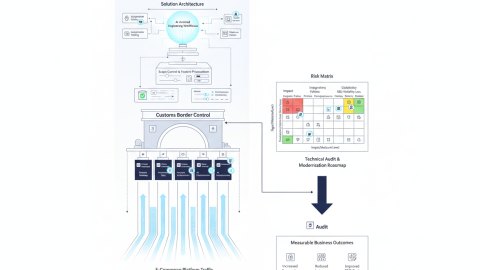
Imagine a mid-sized SaaS vendor tasked with delivering an internal tooling MVP to streamline sales operations. The clock is ticking, the budget is tight, and the existing monolithic backend is riddled with legacy dependencies. Early sprints reveal frequent integration failures, unpredictable regressions, and deployment rollbacks. This scenario is all too common in B2B SaaS projects where legacy code and complex API ecosystems collide with aggressive delivery timelines.
The first step in mitigating these risks is a thorough technical audit focused on the integration architecture and API strategy. This audit must identify:

- Legacy coupling points: Which modules or services tightly bind the MVP features to outdated code?
- API surface complexity: How many internal and external APIs are involved, and what are their stability and versioning policies?
- Deployment and rollback mechanisms: Are there automated rollback procedures and can deployments be staged or canaried?
- Testing coverage and automation: What is the state of integration and end-to-end tests, especially around critical API contracts?
- Monitoring and observability: Are there early warning indicators for integration failures or performance regressions?
In our case, the audit revealed a monolith with intertwined business logic, a fragile API gateway lacking version control, and minimal automated rollback capabilities. Integration tests covered only 40% of API endpoints, and monitoring was limited to basic uptime checks.
Priorities: Defining the Risk Reduction and Delivery Acceleration Focus
With audit insights in hand, the next step is to prioritize remediation efforts that maximize risk reduction and delivery velocity. For legacy-constrained MVPs, the following priorities emerge:
- Decouple MVP features from legacy modules: Introduce API facades or adapters to isolate new functionality from unstable legacy code.
- Implement API versioning and contract governance: Ensure backward compatibility and controlled rollout of API changes.
- Automate deployment with rollback safety: Use feature flags and staged releases to minimize blast radius.
- Expand integration test coverage: Focus on critical API paths and edge cases that historically cause regressions.
- Enhance observability: Add detailed metrics and alerting for API latency, error rates, and data inconsistencies.
These priorities align with the goal of reducing incidents and regressions during MVP delivery, while respecting time and budget constraints.
Quick Wins: Tactical Steps to Stabilize MVP Delivery Immediately
Some remediation actions can be implemented rapidly to stabilize the delivery pipeline and reduce immediate risks:
- Introduce API facade layers: Wrap legacy APIs with lightweight adapters that expose stable interfaces for MVP features. This reduces direct dependency on legacy internals and allows incremental refactoring.
- Establish semantic versioning for APIs: Even a simple versioning scheme enables parallel support for old and new clients, preventing breaking changes during MVP rollout.
- Enable feature flags: Toggle MVP features on/off in production without redeploying, facilitating safer releases and quick rollback.
- Expand smoke tests: Automate basic end-to-end tests that verify critical user flows immediately after deployment.
- Set up lightweight monitoring dashboards: Track API error rates and response times to detect regressions early.
In our case, these quick wins reduced rollback frequency by 30% within the first two sprints and improved developer confidence in pushing changes.
Deep Fixes: Architectural and Process Improvements for Sustainable MVP Delivery
Beyond quick wins, deeper architectural and process changes are essential for long-term stability and scalability:
1. Modularize Legacy Code with API Gateways and Microservices
Refactor tightly coupled legacy modules into smaller, independently deployable services behind an API gateway. This modularization isolates failures and enables parallel development. The API gateway enforces contract validation and throttling, reducing integration errors.
2. Implement Contract-First API Development
Define API contracts upfront using interface definition languages. Generate mocks and tests from contracts to ensure alignment between frontend and backend teams. This reduces integration mismatches and accelerates parallel development.
3. Automate Continuous Integration and Deployment (CI/CD) with Quality Gates
Integrate automated tests, static analysis, and security scans into CI/CD pipelines. Enforce quality gates that block deployments if critical tests fail or code coverage drops. This prevents regressions from reaching production.
4. Establish Canary and Blue-Green Deployment Strategies
Deploy MVP releases to a subset of users or parallel environments before full rollout. Monitor key metrics and rollback automatically if anomalies are detected. This approach minimizes user impact and accelerates feedback loops.
5. Enhance Observability with Distributed Tracing and Alerting
Implement distributed tracing to follow API calls across services and identify bottlenecks or failures. Configure alerts for SLA violations and error spikes to enable rapid incident response.
These deep fixes require upfront investment but yield measurable improvements. In our example, modularization and CI/CD automation reduced incident rates by 50% and cut deployment times by 40% over three months.
Quality Control: Ensuring Reliable MVP Delivery and Migration
Quality control is the final pillar to sustain risk reduction and delivery speed. Key practices include:
- Comprehensive integration test suites: Cover all critical API endpoints and edge cases. Use contract testing to verify API compliance.
- Release readiness checklists: Validate environment configurations, data migrations, and rollback plans before each release.
- Post-release monitoring and incident reviews: Analyze failures to identify root causes and prevent recurrence.
- Documentation and knowledge sharing: Maintain up-to-date API specs, deployment runbooks, and troubleshooting guides accessible to all team members.
By embedding these quality controls into the delivery lifecycle, teams can confidently ship MVPs with fewer regressions and smoother migrations.
Case Summary and Measurable Outcomes
Our case study of a B2B SaaS internal tooling MVP under legacy constraints demonstrates that a focused audit and remediation roadmap centered on integration architecture and API strategy can transform delivery outcomes. Key results included:
- 30% reduction in rollback frequency after quick wins implementation
- 50% decrease in incidents and regressions following deep architectural fixes
- 40% faster deployment cycles enabled by CI/CD automation and feature flags
- Improved developer confidence and stakeholder satisfaction through enhanced observability and quality controls
These outcomes translate directly into accelerated time-to-market, controlled budget consumption, and a more resilient MVP platform.
Conclusion: Architecting MVP Delivery for Legacy-Constrained B2B SaaS
Delivering MVPs under time and budget constraints in legacy-constrained B2B SaaS environments demands a pragmatic, developer-friendly approach. Starting with a detailed audit, prioritizing risk reduction through API decoupling and versioning, executing quick wins, and investing in deep architectural improvements creates a foundation for reliable releases and smooth migrations.
Embedding quality control and observability ensures continuous improvement and incident prevention. This blueprint not only mitigates risks but also empowers engineering teams to deliver business value faster and with confidence.
For teams facing similar challenges, exploring integration architecture and API strategy services can provide tailored guidance and implementation support. Visit our services page to learn how we help B2B SaaS and internal tooling projects achieve secure, scalable, and budget-conscious MVP delivery.
Related Resources
- B2B Product Delivery in Multi-System Organizations with Legacy Constraints: A Release and Migration Risk Reduction Implementation Plan
- Workflow Automation for Marketing and Lead Generation: SEO-Safe Redesign and Migration Acceptance Checklist
- Explore Our Project Portfolio
Related reads
Relevant offers
If this article matches your task, here are two offers you can use to move from insight to implementation without extra discovery.
AI document extraction pipeline
I build an AI pipeline that extracts structured data from files, requests and attachments without manual copy-paste.
AI assistant for presale
I deploy AI workflows that accelerate first-pass estimation and standardize presale artifacts.