In the contemporary digital commerce landscape, e-commerce platforms frequently evolve beyond standard SaaS capabilities through custom integrations—ranging from specialized payment gateways to proprietary inventory management systems. While these integrations enable competitive differentiation, they exponentially increase architectural complexity and operational risk.
Engineering teams tasked with scaling these platforms often face limited bandwidth, necessitating a rigorous approach to solution architecture that balances feature delivery with system stability and performance. The challenge is not merely technical but strategic: how to architect a growing digital product that accommodates bespoke integrations without compromising delivery timelines, budget constraints, or organic search visibility.
Symptoms: Manifestations of Architectural Strain and Delivery Bottlenecks
Symptoms of architectural strain in growing e-commerce platforms typically include:
- Integration Failures: Frequent breakdowns in data synchronization between custom modules and core platform components.
- Performance Degradation: Increased latency and page load times adversely affecting user experience and SEO rankings.
- Release Delays: Prolonged MVP delivery cycles due to unanticipated integration complexities and quality gate failures.
- Operational Blind Spots: Insufficient observability leading to delayed incident detection and resolution.
- SEO Visibility Loss: Organic traffic declines caused by architectural changes that inadvertently disrupt crawlability or indexing.
These symptoms often culminate in missed business KPIs, eroded customer trust, and increased technical debt.
Root Causes: Underlying Factors Driving Risk and Complexity
Analyzing these symptoms reveals several root causes intrinsic to the solution architecture and delivery process:
- Scope Creep in MVP Delivery: Ambiguous or expanding feature requirements inflate integration complexity beyond initial estimates, overwhelming limited engineering resources.
- Lack of Integration Governance: Absence of standardized API contracts, versioning policies, and error handling protocols leads to fragile interdependencies.
- Insufficient AI-Assisted Workflow Adoption: Manual engineering workflows fail to scale with complexity, resulting in quality gate lapses and delayed feedback loops.
- Inadequate Observability and Monitoring: Limited instrumentation impedes proactive incident management and root cause analysis.
- SEO-Unaware Architectural Changes: Integration and deployment decisions made without SEO considerations cause unintended crawlability and indexing issues.
Addressing these root causes requires a deliberate solution architecture that integrates risk management, AI-assisted engineering workflows, and scope control mechanisms.
Solution: A Risk Matrix-Driven MVP Delivery Architecture with AI-Assisted Engineering Workflows
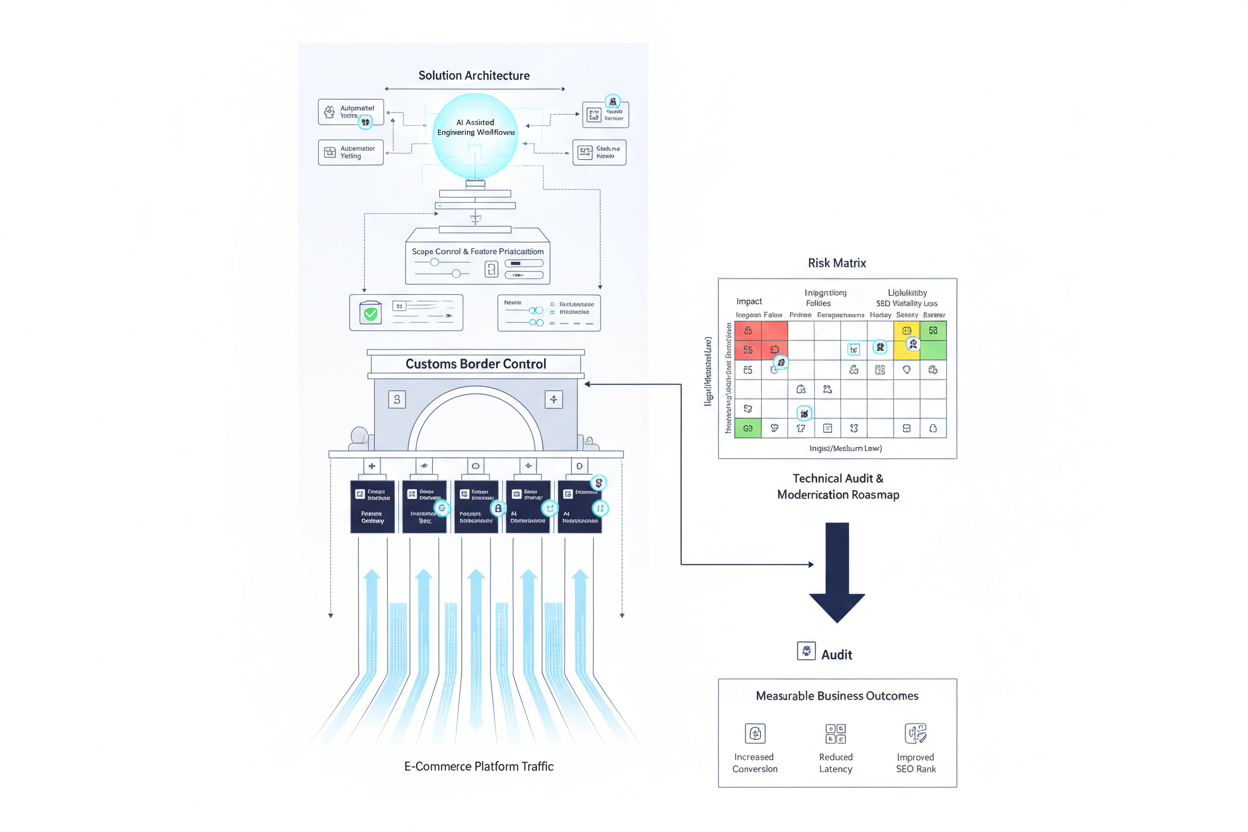
The proposed solution architecture centers on a risk matrix framework that categorizes integration risks by impact and likelihood, guiding scope prioritization and engineering focus. This framework is operationalized through AI-assisted engineering workflows that automate quality gates, enforce contract compliance, and accelerate feedback cycles.
1. Defining the Risk Matrix for Custom Integrations
Each custom integration is evaluated across dimensions such as data criticality, failure impact on user experience, and operational complexity. For example, payment gateway integrations score high on impact and require stringent quality controls, whereas auxiliary analytics connectors may be lower risk.
This risk matrix informs MVP scope control by prioritizing high-impact, low-complexity integrations for initial delivery, deferring or modularizing higher-risk components.
2. Embedding AI-Assisted Engineering Workflows
AI-driven tools are integrated into CI/CD pipelines to perform automated code reviews, contract validation, and anomaly detection. These workflows reduce manual overhead, enabling limited engineering teams to maintain high-quality standards and accelerate release cadence.
For instance, AI can flag deviations from API contracts early, preventing integration failures that would otherwise surface late in the release cycle.
3. Scope Control and Incremental Delivery
Scope control is enforced through modular architecture patterns and feature toggles, allowing incremental rollout of integrations. This approach minimizes blast radius and facilitates rapid rollback if issues arise.
Decisions on scope inclusion are data-driven, balancing business value against integration risk as defined by the risk matrix.
4. Observability and SEO-Aware Architecture
Comprehensive observability is implemented with service-level dashboards and alerting tailored to integration health metrics. Additionally, architectural decisions incorporate SEO impact assessments to safeguard organic visibility during MVP delivery.
Rollout Plan: Phased Implementation with Measurable KPIs
The rollout plan follows a phased approach aligned with the risk matrix and engineering capacity:
- Phase 1 - Audit and Risk Assessment: Conduct a technical audit to map existing integrations, evaluate risks, and baseline performance and SEO metrics. This phase establishes the modernization roadmap.
- Phase 2 - AI Workflow Integration: Deploy AI-assisted engineering tools within CI/CD pipelines to automate quality gates and contract validations.
- Phase 3 - Modular MVP Delivery: Implement prioritized integrations incrementally with feature toggles and monitoring, ensuring minimal disruption.
- Phase 4 - Observability and SEO Safeguards: Enhance monitoring dashboards and integrate SEO impact checks into deployment workflows.
- Phase 5 - Continuous Improvement: Use KPIs such as integration failure rates, release cycle times, and organic traffic trends to refine architecture and workflows.
This phased plan enables controlled growth, risk mitigation, and measurable business outcomes.
Checklist: Ensuring Robust Architecture and Delivery Quality
Before and during rollout, the following checklist guides engineering and product teams:
- Have all custom integrations been classified in a risk matrix with clear prioritization?
- Are AI-assisted workflows integrated into CI/CD pipelines for automated quality gates?
- Is MVP scope controlled through modular architecture and feature toggles?
- Are API contracts standardized, versioned, and enforced programmatically?
- Is observability comprehensive, covering integration health and performance metrics?
- Are SEO impact assessments embedded in architectural and deployment decisions?
- Is there a rollback plan for each integration deployment to minimize user impact?
- Are KPIs defined and monitored to measure integration reliability, release velocity, and organic visibility?
Mini-Case: Accelerating MVP Delivery for a Custom Payment Integration
A mid-sized e-commerce platform faced repeated delays delivering a custom payment gateway integration due to manual testing bottlenecks and unclear API contracts. Applying the risk matrix, the integration was classified as high impact and medium complexity.
AI-assisted workflows were introduced to automate contract validation and regression testing, reducing manual QA effort by 40%. Modular delivery with feature toggles allowed staged rollout, minimizing customer disruption. Observability dashboards tracked transaction success rates and latency, enabling rapid incident response.
Within three months, the integration was live with stable performance, and organic traffic improved as SEO-safe deployment practices prevented crawlability issues. This case exemplifies how scientific risk-driven architecture and AI-assisted workflows yield measurable delivery acceleration and quality improvements.
Conclusion and Call to Action
Growing e-commerce platforms with custom integrations demand a disciplined, scientific approach to solution architecture that balances risk, scope, and engineering capacity. Employing a risk matrix to guide MVP delivery, embedding AI-assisted engineering workflows, and enforcing scope control are critical to achieving reliable, scalable outcomes.
For organizations seeking to modernize their digital products with measurable KPIs and controlled risk, technical audits and modernization roadmaps are indispensable. Our technical audit and modernization services provide tailored assessments and actionable plans to optimize your architecture and delivery processes.
Explore related insights on MVP delivery architecture under budget constraints, architecture refactors before traffic growth, and AI-assisted engineering workflows for SEO-safe redesigns to deepen your understanding of scalable solution architecture.
Related reads
Relevant offers
If this article matches your task, here are two offers you can use to move from insight to implementation without extra discovery.