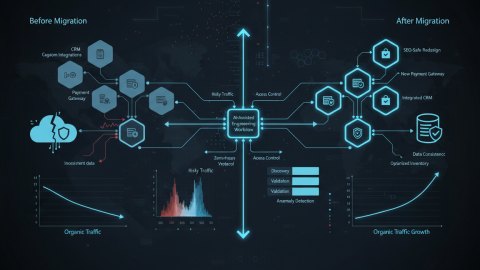
Digital agencies and service businesses face a unique confluence of pressures when executing website redesigns and migrations. The imperative to maintain or improve SEO rankings while upgrading architecture and content delivery systems demands precision engineering workflows. Yet, the complexity of multi-system integrations, legacy constraints, and security mandates often leads to fragile processes vulnerable to silent failures.
AI-assisted engineering workflows promise automation and enhanced decision-making, but without stringent quality gates, they risk introducing undetected regressions or security gaps. From a zero-trust standpoint, no automated output should be implicitly trusted; every artifact, from code commits to deployment manifests, must pass through layered verification to prevent cascading failures that degrade SEO performance or expose audit liabilities.

Symptoms: Identifying Failure Modes in AI-Driven Engineering Pipelines
Common symptoms signaling weaknesses in AI-assisted workflows include unexpected SEO ranking drops post-migration, inconsistent content indexing, and audit trail gaps that complicate compliance verification. These symptoms often manifest as:
- Unexplained crawl errors and broken link reports despite successful deployment.
- Delayed detection of security vulnerabilities introduced during automated refactoring or content generation.
- Inadequate rollback mechanisms leading to prolonged downtime or partial feature exposure.
- Opaque AI decision logs that hinder root cause analysis during incident response.
These issues underscore the necessity for a zero-trust approach where every AI-generated artifact is treated as potentially untrustworthy until validated by human or automated quality gates.
Root Causes: Why AI-Assisted Workflows Fail Without Rigorous Quality Gates
At the core, failures arise from over-reliance on AI outputs without comprehensive validation frameworks. Key root causes include:
- Insufficient observability: AI models often operate as black boxes, producing outputs without traceable decision paths, complicating audit and compliance efforts.
- Inadequate integration testing: Automated workflows may pass unit tests but fail to account for complex SEO dependencies such as canonical tags, structured data, or URL rewriting rules.
- Security blind spots: AI-driven code generation or refactoring can inadvertently introduce vulnerabilities if security gates are not embedded in the pipeline.
- Static quality gates: Rigid, threshold-based gates fail to adapt to evolving SEO algorithms or business priorities, leading to false positives or negatives.
Understanding these root causes guides the design of resilient workflows that balance AI efficiency with zero-trust rigor.
Solution: Designing AI-Assisted Engineering Workflows with Zero-Trust Quality Gates
Implementing AI-assisted workflows under a zero-trust model requires a layered architecture of quality gates that enforce security, auditability, and SEO compliance at every stage. The solution involves:
1. Modular AI Integration with Explainability
Decompose AI tasks into discrete modules—content generation, code refactoring, SEO metadata optimization—each with transparent logging of decision criteria. This modularity enables targeted validation and faster root cause analysis.
2. Multi-Level Quality Gates
Establish quality gates at code commit, build, staging, and pre-production stages. Each gate should include:
- Static analysis: Security linting, SEO metadata validation, and schema compliance checks.
- Dynamic testing: Integration tests simulating search engine crawlers, link integrity verification, and performance benchmarks.
- Audit trail enforcement: Immutable logging of AI decisions, test results, and manual approvals to satisfy compliance requirements.
3. Adaptive Thresholds and Continuous Feedback
Incorporate feedback loops from SEO monitoring tools and security scanners to dynamically adjust quality gate thresholds. This adaptive approach prevents stale criteria from blocking valid deployments or allowing regressions.
4. Human-in-the-Loop Controls
Despite AI automation, critical decisions—such as final approval for production rollout—must involve human oversight. This mitigates risks from AI model drift or unexpected edge cases.
5. Rollback and Incident Response Automation
Integrate automated rollback triggers based on post-deployment SEO performance metrics and security alerts. Coupled with incident response playbooks, this ensures rapid recovery from undetected failures.
Rollout Plan: Phased Implementation for Risk Mitigation and Measurable Outcomes
Adopting AI-assisted workflows with zero-trust quality gates requires a staged rollout to balance innovation with operational stability:
- Pilot Phase: Select a low-risk project segment to implement modular AI tasks and initial quality gates. Measure baseline SEO and security KPIs.
- Validation Phase: Expand coverage to critical workflows, integrate adaptive thresholds, and establish human-in-the-loop checkpoints. Conduct controlled migrations with rollback drills.
- Full Deployment: Apply the framework across all redesign and migration projects. Continuously monitor KPIs such as crawl error rates, page load times, and audit compliance scores.
- Optimization Phase: Use collected data to refine AI models, quality gate parameters, and incident response protocols for sustained reliability.
This phased approach reduces risk exposure and builds stakeholder confidence through measurable improvements.
Checklist: Ensuring Robust AI-Assisted Engineering Workflows and Quality Gates
Before embarking on an SEO-safe redesign or migration, verify the following:
- Are AI modules decomposed with transparent logging and explainability?
- Do quality gates cover static analysis, dynamic testing, and audit trail enforcement at multiple pipeline stages?
- Is there a mechanism for adaptive threshold tuning based on real-world SEO and security feedback?
- Are human-in-the-loop controls integrated for critical deployment decisions?
- Is rollback automation linked to post-deployment monitoring for rapid incident response?
- Are KPIs defined and tracked for SEO performance, security compliance, and deployment reliability?
- Is the rollout plan phased with pilot, validation, full deployment, and optimization stages?
Mini-Case: AI-Assisted Migration for a Service Business Website
A mid-sized digital agency undertook a redesign and migration of a client’s service business website with strict SEO and security requirements. Initial AI-assisted content generation and code refactoring introduced subtle canonical tag misconfigurations, causing a 15% drop in organic traffic within two weeks post-launch.
Applying a zero-trust framework, the agency implemented multi-level quality gates including crawler simulation tests and immutable audit logs. Human reviewers validated AI outputs before production deployment. Adaptive thresholds were set to flag any deviation in SEO metrics within 24 hours post-release, triggering automated rollback if necessary.
Within three months, the agency restored and improved SEO rankings beyond baseline, reduced security incidents by 40%, and achieved full audit compliance. This case underscores the criticality of zero-trust quality gates in AI-assisted workflows.
Conclusion and Next Steps
AI-assisted engineering workflows offer transformative potential for SEO-safe redesign and migration projects in digital agencies and service businesses. However, without a zero-trust quality gate architecture, these workflows risk undermining security, auditability, and SEO performance.
By adopting modular AI integration, multi-level adaptive quality gates, human oversight, and phased rollout plans, organizations can achieve measurable improvements in reliability and compliance. For a comprehensive approach to solution architecture and delivery planning tailored to your business constraints, explore our detailed services offerings.
Further insights on related topics can be found in our blog articles on Technical SEO Audit and Integration Plan for Operations-Heavy Businesses and MVP Delivery Architecture Blueprint for B2B SaaS and Internal Tooling. For a practical framework on release risk reduction, see our MVP Delivery Architecture Blueprint for Operations-Heavy Fintech Businesses.
Related reads
Relevant offers
If this article matches your task, here are two offers you can use to move from insight to implementation without extra discovery.
Sales SLA dashboard and analytics
I build a sales management dashboard so SLA and processing quality are visible without manual reporting.
Catalog structure module rollout for 1C-Bitrix
Governed section and property structure instead of navigating a chaotic catalog tree and ad hoc edits by hand.