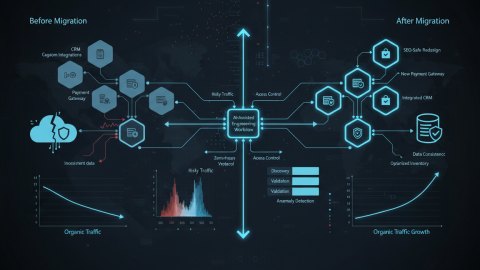
Imagine an e-commerce operation as a sprawling factory floor where raw leads enter through multiple gates—social media, paid ads, organic search, and direct outreach. Each gate feeds into a distinct conveyor belt (CRM or lead-source system), often operating in silos. The challenge is to synchronize these belts into a single, efficient assembly line that minimizes lead acquisition costs and maximizes conversion rates.
AI-assisted engineering and design workflows act as the factory’s intelligent control system, dynamically routing, validating, and optimizing lead data flows. This approach is not merely about automation; it is about embedding decision intelligence into the operational fabric, enabling clear, data-driven decisions with measurable KPIs.

Preparation: Assessing Fragmented Data Sources and Defining Objectives
Before deploying AI-assisted workflows, the foundational step is a thorough assessment of existing CRM and lead-source integrations. Fragmented data sources often resemble a patchwork quilt—functional but inconsistent in quality and format. This inconsistency leads to inflated acquisition costs due to duplicated efforts, lost leads, and poor targeting.
Key preparatory actions include:
- Data Source Inventory: Catalog all lead sources and CRM systems, noting data formats, update frequencies, and integration points.
- Data Quality Audit: Evaluate completeness, accuracy, and latency of lead data streams to identify bottlenecks and error-prone segments.
- Business Outcome Alignment: Define measurable KPIs such as cost per acquisition (CPA), lead conversion rate, and lead velocity to anchor engineering decisions.
This phase sets the stage for AI-assisted design by clarifying constraints and aligning technical goals with business imperatives.
Execution: Designing AI-Driven Workflow Automation and Bot Orchestration
With preparation complete, the engineering team embarks on designing AI-assisted workflows that act as the factory’s nervous system—intelligent, adaptive, and resilient. The design must accommodate fragmented data while ensuring seamless lead flow into CRM systems.
Step 1: Data Normalization and Enrichment
AI models preprocess incoming lead data to normalize formats and enrich records with contextual metadata. This step is akin to standardizing raw materials before assembly, ensuring compatibility and reducing downstream errors.
Step 2: Intelligent Routing and Prioritization
Using predictive analytics, AI bots evaluate lead quality and source reliability in real-time, dynamically routing leads to the most appropriate CRM channels or sales teams. This prioritization reduces wasted effort on low-value leads and accelerates high-potential conversions.
Step 3: Automated Validation and Error Handling
AI-driven validation bots continuously monitor data integrity, flagging anomalies such as duplicate entries or missing fields. Automated remediation workflows either correct errors or escalate issues, maintaining data hygiene without manual intervention.
Step 4: Integration with Existing Systems
Engineering decisions here focus on API orchestration, webhook configurations, and event-driven triggers to ensure real-time synchronization across platforms. The architecture must be modular and scalable to accommodate evolving lead sources and CRM upgrades.
This execution phase demands rigorous engineering discipline and iterative testing to balance automation benefits against operational risks.
Validation: Ensuring Workflow Accuracy and Business Impact
Validation is the quality control checkpoint where engineering meets business accountability. The goal is to verify that AI-assisted workflows not only function correctly but also deliver on KPIs.
Validation strategies include:
- End-to-End Testing: Simulate lead flows from source to CRM ingestion, verifying data integrity and routing accuracy.
- Performance Benchmarking: Measure lead processing latency and error rates against predefined thresholds.
- KPI Tracking: Monitor acquisition costs, conversion rates, and lead velocity pre- and post-implementation to quantify ROI.
For example, a mid-sized e-commerce platform implemented AI-assisted lead routing and observed a 15% reduction in CPA within three months, demonstrating the tangible impact of engineering rigor combined with AI intelligence.
Monitoring: Sustaining Workflow Efficiency and Continuous Improvement
Post-deployment, continuous monitoring ensures workflows adapt to changing lead patterns and system updates. This phase resembles a control room staffed with AI-powered dashboards and alerting bots that detect anomalies and performance degradation.
Effective monitoring includes:
- Real-Time Analytics: Dashboards display lead flow metrics, error rates, and system health indicators.
- Automated Alerts: Threshold breaches trigger notifications for rapid incident response.
- Feedback Loops: Insights from monitoring inform iterative workflow refinements and AI model retraining.
Engineering teams should establish governance protocols to review monitoring data regularly, ensuring sustained alignment with business goals.
Next Steps: Scaling AI-Assisted Workflows for Broader E-Commerce Ecosystems
Having established a robust AI-assisted workflow for CRM and lead-source integration, the natural progression is scaling these capabilities across broader e-commerce operations. This includes extending automation to order processing, inventory management, and customer support bots, creating a cohesive, intelligent operational ecosystem.
Key considerations for scaling include:
- Modular Architecture: Design workflows as composable services to facilitate incremental expansion.
- Cross-Functional Collaboration: Engage stakeholders from marketing, sales, and IT to align automation objectives.
- Compliance and Security: Ensure data governance policies are embedded within AI workflows to maintain regulatory adherence.
For a deeper dive into workflow automation and bot orchestration strategies, explore our services page. Additionally, our playbook on optimizing bots for sales support offers complementary insights into performance recovery and operational resilience. To understand broader architectural considerations, review our governance-driven architecture refactor guide.
Checklist: Implementing AI-Assisted CRM and Lead-Source Integration Workflows
- Inventory all lead sources and CRM endpoints with data format specifications.
- Conduct a data quality audit focusing on completeness and latency.
- Define KPIs aligned with acquisition cost reduction and lead conversion.
- Design AI models for data normalization, enrichment, and routing.
- Develop automated validation bots for error detection and remediation.
- Integrate workflows via APIs and event-driven triggers ensuring real-time sync.
- Perform end-to-end testing and benchmark performance metrics.
- Deploy monitoring dashboards with alerting and feedback mechanisms.
- Establish governance routines for continuous workflow optimization.
- Plan for modular scaling across e-commerce operational domains.
Anti-Patterns to Avoid
Engineering AI-assisted workflows is fraught with pitfalls that can undermine ROI and operational stability. Avoid these common anti-patterns:
- Over-Automation Without Oversight: Fully automated workflows without human-in-the-loop checkpoints risk propagating errors and missing contextual nuances.
- Ignoring Data Quality at Source: Relying solely on AI to fix poor data inflows leads to brittle systems and inflated error rates.
- Monolithic Integration Designs: Building tightly coupled workflows impedes scalability and complicates maintenance.
- Neglecting KPI Alignment: Engineering efforts disconnected from measurable business outcomes fail to justify investment.
By adhering to evidence-based engineering principles and maintaining a clear focus on business impact, organizations can harness AI-assisted workflows to transform fragmented e-commerce operations into streamlined, cost-effective engines of growth.
Operationalizing AI-Assisted Workflows: Concrete Implementation Examples
To illustrate the practical application of AI-assisted engineering in e-commerce CRM and lead-source integration, consider a scenario where an online retailer faced inconsistent lead data formats from multiple marketing channels. Initially, leads arrived with varying field names, incomplete contact information, and inconsistent timestamp formats, causing delays and manual corrections in the sales funnel.
The engineering team implemented a multi-stage AI pipeline beginning with a normalization module that mapped disparate field names to a unified schema using trained entity recognition models. This was followed by an enrichment layer that appended geolocation and behavioral metadata derived from browsing patterns. Intelligent routing algorithms then prioritized leads based on predicted purchase intent scores, dynamically assigning them to specialized sales teams.
Automated validation bots monitored the pipeline, detecting anomalies such as sudden drops in lead volume or spikes in duplicate entries. When anomalies occurred, remediation workflows either corrected data inconsistencies or triggered alerts for human review. This approach reduced manual intervention by over 60%, accelerated lead response times by 30%, and improved conversion rates by 12% within six months.
Key to this success was the iterative refinement of AI models based on feedback loops from monitoring dashboards, ensuring adaptability to evolving marketing campaigns and customer behaviors.
Decision Rationale: Balancing Automation with Human Oversight
While AI-driven automation offers significant efficiency gains, engineering teams must carefully calibrate the degree of automation to maintain operational resilience. Over-reliance on fully autonomous workflows can obscure contextual nuances that only human agents can interpret, such as sudden market shifts or nuanced customer objections.
In practice, this means embedding human-in-the-loop checkpoints at critical junctures—such as lead qualification thresholds or error escalations—where AI confidence scores fall below predefined limits. This hybrid approach mitigates risks of erroneous lead assignments and preserves customer experience quality.
Moreover, transparent logging and explainability mechanisms within AI components enable auditability and foster trust among stakeholders. Engineering decisions should prioritize modularity to allow rapid insertion of manual review steps without disrupting end-to-end automation.
Trade-Offs and Risk Management in AI Workflow Deployment
Deploying AI-assisted workflows involves navigating trade-offs between speed, accuracy, and complexity. For example, aggressive lead prioritization algorithms may accelerate high-value conversions but risk overlooking niche segments with longer sales cycles. Similarly, extensive data enrichment enhances lead profiles but increases processing latency and resource consumption.
Risk management strategies include phased rollouts starting with low-impact lead sources, enabling controlled experimentation and performance tuning. Engineering teams should implement feature toggles to enable or disable specific AI modules dynamically, facilitating rapid rollback in case of unexpected behavior.
Robust error handling frameworks must anticipate failure modes such as API timeouts, data schema changes, or model drift. Automated fallback procedures—like queuing leads for manual processing—ensure continuity of operations during transient disruptions.
Rollout Scenarios: From Pilot to Enterprise-Wide Adoption
Successful AI-assisted workflow adoption typically follows a staged progression. Initial pilots focus on a subset of lead sources and CRM endpoints, emphasizing measurable KPIs such as lead throughput and error reduction. This phase prioritizes rapid feedback cycles and close collaboration between engineering, sales, and marketing teams.
Upon validating pilot outcomes, organizations can expand scope by integrating additional lead channels, incorporating more sophisticated AI models, and extending automation to downstream processes like customer segmentation and personalized outreach. Throughout scaling, maintaining modular architecture and standardized interfaces is critical to avoid integration bottlenecks.
Enterprise-wide adoption requires embedding AI workflows within broader digital transformation initiatives, aligning with data governance frameworks, and ensuring compliance with privacy regulations. Continuous training programs for operational teams foster adoption and enable proactive issue resolution.
Quality Control Reasoning: Ensuring Sustainable Business Value
Quality control in AI-assisted workflows transcends traditional software testing by incorporating ongoing validation of model performance and business impact. Engineering teams should establish comprehensive metrics that capture both technical accuracy—such as data completeness and routing precision—and business outcomes like customer acquisition cost and lifetime value.
Regular audits of AI decision logic help detect biases or drift that could degrade lead quality or introduce unfair prioritization. Incorporating synthetic test cases simulating edge conditions ensures robustness against unexpected data patterns.
Furthermore, embedding continuous integration and deployment pipelines with automated testing safeguards against regressions during iterative model updates. This disciplined approach balances innovation velocity with operational stability, maximizing return on AI investments.
Conclusion: Embedding AI-Assisted Engineering as a Strategic Capability
Integrating AI-assisted workflows into e-commerce CRM and lead-source operations is not merely a technical upgrade but a strategic enabler of competitive differentiation. By systematically addressing fragmented data, automating intelligent routing, and instituting rigorous validation and monitoring, organizations can unlock significant efficiency gains and revenue growth.
Engineering teams play a pivotal role in architecting resilient, scalable, and transparent AI systems that align with evolving business objectives. Through careful planning, iterative refinement, and cross-functional collaboration, AI-assisted workflows become a foundational capability driving agile, data-driven e-commerce ecosystems.
For organizations embarking on this journey, leveraging structured playbooks and governance frameworks ensures disciplined execution and sustainable impact.
Related reads
Relevant offers
If this article matches your task, here are two offers you can use to move from insight to implementation without extra discovery.
Traffic analytics module rollout for 1C-Bitrix
Transparent visit, bot, GEO and suspicious-IP analytics inside Bitrix with a clear foundation for future risk workflows.
Lead scoring in CRM
I configure lead scoring so the sales team works high-value inbound leads first.