Sales support and internal business operations are two crucial frontiers for automation bots in B2B environments. Bots can handle repetitive qualification tasks, route leads intelligently, trigger business process automations, and provide interactive support for sales teams and internal operational staff. The ultimate benefit: better lead quality, faster processing, and resource savings—critical when budgets and time-to-market are tight.
This article dives into a tactical, technical operations playbook to release and migrate bots safely for marketing and lead generation contexts that also encompass internal operations tasks. Grounded in architectural rigor, we focus on concrete engineering decisions, operational validations, and risk mitigation steps essential to preserving conversion outcomes.
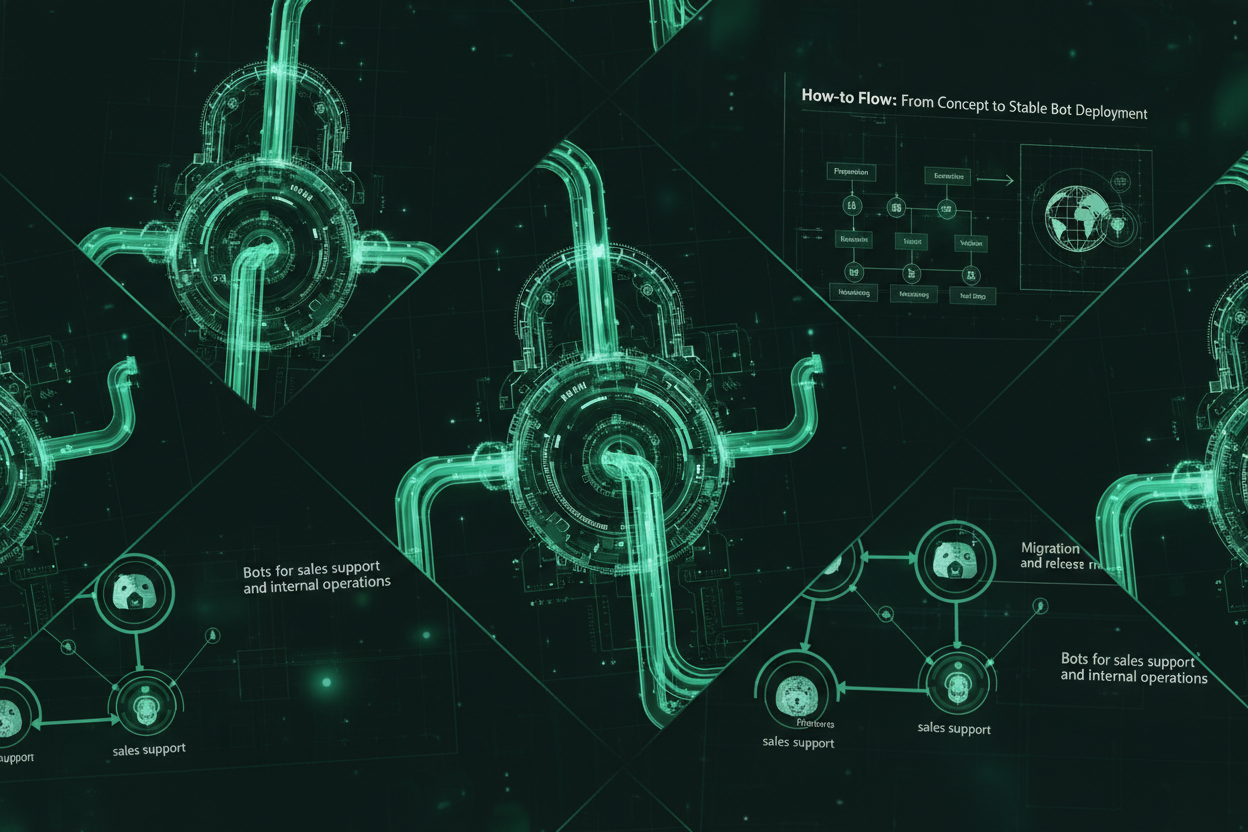
How-to Flow: From Concept to Stable Bot Deployment
The end-to-end flow follows a structured release playbook:
- Preparation: Design, architecture, and constraint analysis
- Execution: Development, integration, and rollout
- Validation: Functional, performance, and data quality checks
- Monitoring: Post-release observability and anomaly detection
- Next Steps: Continuous improvement and scale-out considerations
Preparation: Architecting Bots for Risk-Reduced Marketing and Lead Generation
1. Define Bot Scope with Clear Domain Boundaries
- Separate bot tasks between sales support (e.g., lead qualification conversations, FAQ responses) and internal ops automation (e.g., status updates, task notifications).
- Map bot responsibilities to bounded contexts to avoid integration complexity. This minimizes domain coupling and promotes independent deployment cycles.
2. Establish Data Integration Patterns
- Identify CRM, marketing automation, and ERP systems that the bots will interact with.
- Prefer event-driven integrations with message queues or webhooks to decouple bot logic from backend systems and buffer spikes in traffic.
- Evaluate RESTful APIs vs. webhook callbacks for synchronous vs. asynchronous patterns, balancing responsiveness and reliability.
3. Security and Access Control
- Configure strict role-based access control (RBAC) for bots interacting with sensitive sales or operational data.
- Implement secret and configuration management to safeguard API keys and credentials.
- Audit bot telemetry to catch unauthorized or abnormal actions early.
4. Migration and Release Risk Analysis
- Perform impact assessments on existing manual processes and legacy automation components before bot deployment.
- Create rollback strategies with canary releases or dark launches inside segmented customer or internal operation groups.
- Design for gradual onboarding of bots, allowing fallback to manual or human-in-the-loop modes when escalation is needed.
Execution: Implementation and Rollout Practices with Engineering Precision
1. Build Modular, Testable Bot Components
- Develop bots as microservices or serverless functions isolated by domain tasks to simplify testing and deployment.
- Implement feature toggles to activate or deactivate capabilities without redeploying code.
- Create detailed unit and integration tests covering conversation flows, API interactions, and failure cases.
2. Integration Testing in a Staging Environment
- Simulate full data flows including CRM sync and message queues to validate end-to-end lead qualification scenarios.
- Monitor response latencies and error rates. Evaluate bots’ handling of system timeouts or backend failures.
- Validate security posture — test with least privilege credentials to ensure minimal access rights are sufficient.
3. Staged Rollout Strategy
- Deploy bots initially to limited sales or internal ops teams to gather operational feedback and detect early regressions.
- Use real traffic simulators or shadow modes to measure impact on lead qualification rates before full production activation.
- Update documentation and train internal users to set proper expectations on bot capabilities and limitations.
Validation: Essential Bot Release and Functionality Checklist
1. Functional Coverage
- Verify each sales or ops scenario automation is covered by bot workflows.
- Check fallback paths to human intervention if bots encounter unknown queries or exceptions.
2. Performance Metrics
- Measure latency including end-user perceived response times in chat or notification interfaces.
- Assess throughput under realistic peak workloads.
- Track failed transaction rates and retry mechanisms.
3. Data Quality and Integrity
- Confirm CRM entries created or updated by bots are accurate, complete, and timestamped correctly.
- Audit logs for message consistency and correlation across all integrated systems.
- Reconcile triggered workflows with manual reports to catch missing or duplicate leads.
4. Risk Mitigation Verification
- Verify emergency rollback procedures execute cleanly without data loss.
- Ensure alerting systems detect abnormal bot behavior and trigger human escalation promptly.
Monitoring: Observability and Incident Response for Continuous Stability
1. Implement Comprehensive Telemetry
- Log all incoming requests, outgoing API calls, and state transitions of bot conversational workflows.
- Employ distributed tracing where feasible to analyze latency bottlenecks across service boundaries.
2. Set Real-Time Alerts
- Configure threshold-based alerts for error spikes, latency degradation, and unusual lead flow patterns.
- Use anomaly detection to preempt operational disruptions impacting lead generation quality.
3. Incident Response Runbook
- Define clear procedures for diagnosing and isolating chatbot failures or integration breakages.
- Include escalation paths to engineering and business stakeholders for swift remediation.
4. User Feedback Loops
- Collect sales and ops team feedback on bot usability and lead qualification accuracy for iterative improvement.
Next Steps: Continuous Optimization and Scaling
- Regularly review bot performance vis-à-vis lead conversion metrics to justify further investments.
- Leverage A/B testing frameworks to experiment with bot conversation improvements or new automation use cases.
- Plan phased scale-out to cover additional sales segments and internal ops workflows.
- Audit integration patterns periodically to streamline API usage and reduce latency.
- Enhance security posture as bot capabilities and data sensitivities evolve.
Common Anti-Patterns to Avoid
- Monolithic bot designs: Complicates releases and debugging.
- Over-automation without fallback: Leads to unresolvable dead ends and poor lead experience.
- Insufficient integration testing: Risks latent data mismatches or race conditions.
- Lack of observability: Delays detection of outages and increases operational risk.
- Ignoring security controls: Opens attack surface and compromises enterprise data integrity.
Result Verification Checklist for High-Impact Bot Deployments
- All sales support queries are routed and qualified with correct business rules.
- Internal operation tasks triggered by bots match expected workflows without manual intervention.
- Bot-generated CRM records have 99.9% data accuracy on required fields.
- Latency and throughput meet SLA targets under peak system load.
- Errors and retries remain below defined thresholds.
- Rollback procedures have been tested and executed successfully.
- Monitoring dashboards display actionable metrics and alert thresholds.
- Business teams report improved lead quality and faster operational turnaround.
Further Reading and Resources
- CMS, CRM, and ERP Integration Patterns Audit and Remediation Guide for B2B Portals and Account Areas — insight on integrating complex backend systems for marketing bots.
- ML-Ready Architecture for SEO Content Generation — techniques complementary to bot-driven content qualification.
- Security Control Uplift in Cloud-Native Automation Stacks — best practices to safeguard bot ecosystems.
Driving sales support and internal operations with bots requires not only sound technical foundation but also rigorous operational discipline and risk management. By following this detailed playbook, your engineering and operations teams can maximize lead quality improvements and operational efficiencies while navigating tight budgets and compressed timelines.
Ready to advance your automation initiatives with a scalable, secure, and observable bot architecture? Explore our full range of expert consulting and implementation services designed for B2B marketing and lead generation teams at /services/.
Rollout: Controlled Deployment for Risk Mitigation
1. Pilot Deployment with Select Users
- Identify a small, representative group of users in sales and internal operations aligned with the bot’s domain scope.
- Deploy bots in a non-intrusive way, such as readonly or notification-only modes, to observe user interactions without impacting existing workflows.
- Collect qualitative and quantitative feedback through surveys, usage logs, and support tickets to detect friction points early.
2. Gradual Traffic Expansion Using Canary Releases
- Incrementally increase bot exposure by routing a small percentage of actual traffic to the new bot workflows.
- Monitor KPIs closely, including lead conversion uplift, error rates, and user satisfaction scores at each release increment.
- Implement automated rollback triggers in case predefined safety thresholds are breached to prevent widespread impact.
3. Full Production Cutover with Backout Plan
- Coordinate cutover timing with business stakeholders, preferably during low activity periods to minimize disruption.
- Execute automated scripts or deployment pipelines to switch traffic fully to the bot-driven modes.
- Maintain an immediate backout plan with versioned artifacts and data snapshots allowing rapid reversion if serious issues arise.
- Communicate release status transparently within the organization, highlighting known limitations and support channels.
QA Controls: Rigorous Testing Beyond Code
1. Scenario-Based Test Suites
- Develop comprehensive test scenarios simulating realistic sales and internal operations conversations, including common edge cases.
- Automate scenario execution within continuous integration pipelines to detect regressions early and ensure coverage consistency.
- Include negative test cases verifying fallback to humans in cases of unrecognized inputs or system errors.
2. Synthetic Data Generation and Validation
- Create anonymized or synthetic datasets representing typical CRM leads and internal task records for use in testing environments.
- Validate bots’ ability to correctly parse, enrich, and update lead data without data leakage or corruption.
3. Security Testing and Compliance Verification
- Conduct penetration testing focused on APIs, authentication mechanisms, and data storage accessed by bots.
- Audit bot output against data privacy and compliance requirements, especially for personally identifiable information (PII) and regulatory constraints.
- Penetration testing and code reviews should be integrated into release cycles to maintain security posture.
4. Usability and Accessibility Validation
- Perform user acceptance testing with real sales and internal ops users to confirm ease of interaction and helpfulness of bot interfaces.
- Ensure compliance with accessibility standards to accommodate operators with disabilities, such as keyboard navigation and screen reader support.
Monitoring: Operational Excellence for Bot Stability
5. Dashboarding and Reporting
- Build customizable dashboards aggregating key operational metrics including lead conversion rate, bot response time, error counts, and fallback incidences.
- Implement role-based views so engineers, product managers, and business analysts receive relevant insights tailored to their needs.
- Schedule periodic automated reports to stakeholders summarizing bot health, user engagement, and issue trends.
6. Capacity Planning and Resource Allocation
- Continuously assess compute and network resource consumption under varying loads to anticipate scaling needs.
- Leverage historical telemetry metrics to forecast peak usage periods and provision infrastructure accordingly.
- Embed alerting for resource bottlenecks such as memory leaks, thread exhaustion, or message queue backlog to avoid degradation.
Risk Handling: Proactive and Reactive Strategies
1. Operational Risk Identification and Prioritization
- Catalog all technical and business risks related to bot deployment, including system failures, data loss, incorrect lead qualification, and user dissatisfaction.
- Use impact-probability matrices to prioritize risks and focus attention on highest-impact scenarios.
- Assign risk owners accountable for monitoring and mitigating each item throughout the bot lifecycle.
2. Automated Safety Nets and Circuit Breakers
- Implement automated circuit breakers that detect fault patterns (e.g., repeated errors, failing downstream dependencies) and temporarily disable affected bot capabilities to prevent cascading failures.
- Integrate with alerting systems so operations teams are notified instantly to investigate and resolve root causes.
3. Rollback and Recovery Procedures
- Develop fully documented rollback procedures, including scripts to revert code deploys and restore data to a known good state.
- Test rollback plans regularly in staging environments to ensure they are effective and procedures are clear for on-call teams.
- Maintain backup snapshots of critical databases and configuration states aligned with each bot release.
4. Communication and Escalation Protocols
- Establish structured communication channels for incident reporting, including dedicated chat groups, incident management tools, and notification trees.
- Define escalation rules based on incident severity, duration, and impact to ensure timely involvement of subject matter experts and leadership.
- Post-incident reviews and blameless retrospectives to extract lessons learned and improve processes.
Implementation Examples: Practical Bot Deployment
Case Study: Lead Qualification Bot for B2B SaaS Sales
In this scenario, the bot was designed to pre-screen inbound leads by collecting company size, industry segment, and use case details via website chat integration. The bot components were developed as serverless functions communicating asynchronously with the CRM through secure APIs.
- Feature toggles allowed gradual activation of lead qualification questions while monitoring lead drop-off rates.
- Integration tests used synthetic lead data with edge cases such as partial responses to validate fallback behaviors.
- Monitoring dashboards surfaced lead qualification funnel metrics and error spikes aiding rapid troubleshooting.
- Rollback plans enabled reverting to manual lead capture within minutes if data inconsistencies were detected post-release.
Case Study: Internal Operations Bot for Expense Report Automation
This bot automated expense report submission for sales teams by extracting required fields from receipts via OCR and initiating workflows in internal finance systems.
- Microservice design separated receipt parsing, data enrichment, and workflow triggering to facilitate independent updates.
- Security testing validated least privilege principles securing financial data against unauthorized access.
- Incident runbooks were created for handling OCR errors and backend system unavailability, including immediate fallbacks to manual processing.
- User feedback loops collected from finance team reduced error rates by refining document recognition models in subsequent releases.
Related reads
Relevant offers
If this article matches your task, here are two offers you can use to move from insight to implementation without extra discovery.