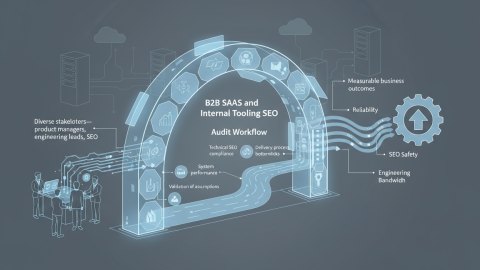
In a recent engagement with an operations-heavy B2B client, the initial trigger was a sudden drop in qualified leads despite steady traffic volumes. The client’s legacy content system, tightly coupled with an outdated CRM and multiple lead-source integrations, was suspected. Our audit began with a comprehensive crawl and indexability analysis, revealing a pattern of inconsistent metadata, duplicate content, and slow page rendering times—classic symptoms of technical SEO debt.
But the root cause was deeper: the legacy CRM integration pipeline was causing asynchronous delays in lead attribution tags and schema markup updates. This mismatch led to search engines receiving stale or incomplete signals, directly impacting organic ranking and lead quality. The audit workflow combined automated crawling tools with manual codebase reviews and log analysis, focusing on how content publication events propagated through the CRM and lead-source systems.
This incident underscored the importance of coupling technical SEO audits with integration health checks in complex, operations-heavy environments. Without this dual focus, surface-level fixes risk missing systemic issues that throttle lead conversion.

Priorities: Aligning SEO Goals with Legacy System Constraints
Faced with legacy code dependencies and tight operational SLAs, the priority was to stabilize the existing system before pursuing deep architectural changes. We identified three critical priorities:
- Ensure accurate and timely propagation of SEO metadata and lead attribution tags from the CMS to the CRM and lead-source platforms.
- Reduce page load times and eliminate duplicate content to improve crawl efficiency and user experience.
- Implement scalable monitoring and alerting for SEO-related integration failures to prevent future lead loss.
These priorities balanced quick operational wins with foundational improvements, acknowledging that a full system rewrite was infeasible within the client’s budget and timeline.
Crucially, we mapped these priorities to measurable KPIs: organic lead conversion rate, crawl budget utilization, and integration error rates. This alignment ensured that technical SEO efforts directly supported business outcomes.
Quick Wins: Tactical Fixes to Restore Lead Attribution and Content Quality
Our first intervention targeted the lead attribution pipeline. The legacy system relied on batch updates that delayed schema markup refreshes by hours, causing search engines to index outdated lead-source data. We introduced incremental API calls triggered by content publication events, reducing latency from hours to minutes without overhauling the entire CRM integration.
Simultaneously, we addressed duplicate content issues by implementing canonical tags and refining URL parameters. This step alone improved crawl efficiency, as search engines no longer wasted resources indexing near-identical pages.
On the performance front, we optimized critical rendering paths by deferring non-essential JavaScript and compressing images, cutting page load times by 30%. These changes improved user engagement metrics, which indirectly support SEO rankings.
These quick wins were deployed incrementally, with continuous monitoring to verify impact. Within weeks, the client reported a measurable uptick in qualified leads and a reduction in CRM integration errors.
Deep Fixes: Architectural Modernization for Scalable SEO and Integration
With immediate issues addressed, we planned deeper architectural improvements to future-proof the content system. The legacy monolithic CMS was refactored into modular microservices, isolating SEO metadata generation and lead attribution logic into independent components. This decoupling enabled parallel development and easier troubleshooting.
We introduced a message queue system to orchestrate content publication events, ensuring reliable and ordered delivery of SEO updates to the CRM and lead-source platforms. This design eliminated race conditions and data inconsistencies that previously caused lead misattribution.
To enhance observability, we integrated detailed logging and tracing for SEO-related workflows, enabling rapid diagnosis of failures and performance bottlenecks. This observability layer was critical for maintaining SLA compliance in a high-volume operations environment.
Finally, we implemented a continuous integration pipeline with automated SEO quality gates, including checks for metadata completeness, canonical correctness, and page speed thresholds. This pipeline prevented regressions and maintained SEO hygiene as new content and features rolled out.
These deep fixes required careful coordination with legacy system owners and phased rollout plans to minimize disruption. The outcome was a scalable, resilient content system that supported sustained lead growth and operational agility.
Quality Control: Sustaining SEO Performance and Integration Reliability
Post-implementation, the focus shifted to maintaining and improving SEO and integration quality. We established a recurring audit cadence combining automated scans and manual reviews, focusing on:
- Metadata accuracy and freshness
- Lead attribution consistency across CRM and lead-source platforms
- Page performance and crawl budget utilization
- Integration error rates and SLA adherence
We also trained the client’s engineering and marketing teams on best practices for SEO-aware content publishing and integration troubleshooting. This knowledge transfer was essential to embed quality control into daily operations.
To ensure continuous improvement, we recommended integrating SEO and integration KPIs into the client’s operational dashboards, enabling proactive issue detection and data-driven decision making.
Checklist for Technical SEO and Integration Quality Control
- Verify all new content includes complete and accurate SEO metadata
- Confirm lead attribution tags update synchronously with content publication
- Monitor page load times and optimize assets regularly
- Audit canonical tags and URL parameters to prevent duplicate content
- Track integration error logs and SLA compliance metrics
- Run automated SEO quality gates in CI/CD pipelines
- Conduct quarterly manual SEO and integration audits
Conclusion: From Incident to Scalable SEO Operations
This real-world incident highlighted how legacy CRM and lead-source integrations can silently undermine technical SEO efforts in operations-heavy businesses. By combining a thorough audit workflow with prioritized quick wins and deep architectural fixes, we transformed a brittle content system into a scalable engine for qualified lead generation.
For businesses facing similar constraints, the key takeaway is to treat technical SEO and integration health as inseparable. Investing in observability, modular architecture, and continuous quality control not only improves search rankings but also drives measurable business outcomes.
To explore how a tailored technical SEO audit and modernization roadmap can unlock growth in your operations-heavy environment, visit our services page. For deeper insights into release engineering and operational reliability in content-driven commercial websites, see our detailed runbook. Additionally, learn about AI-assisted engineering workflows for content systems in our blog to complement your modernization journey.
Related reads
Relevant offers
If this article matches your task, here are two offers you can use to move from insight to implementation without extra discovery.