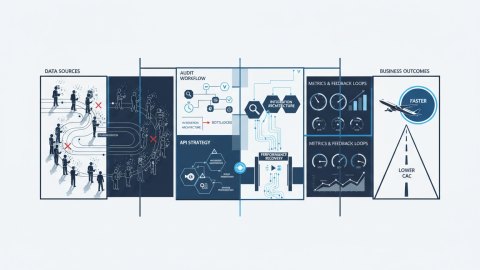
In the competitive landscape of e-commerce, the ability to deliver fast, reliable, and secure user experiences directly impacts acquisition costs and customer retention. When platforms incorporate custom CRM and lead-source integrations, the complexity of rendering strategies and performance engineering escalates. The challenge lies in optimizing these integrations without overwhelming limited engineering resources, while ensuring scalability and operational security.
This article unfolds a pragmatic acceptance checklist and remediation roadmap designed for technical teams evaluating or replatforming e-commerce systems. The goal is to enable measurable performance improvements that align with business growth objectives and risk mitigation.

Preparation: Diagnosing Performance and Rendering Bottlenecks in Custom Integration Contexts
Before embarking on remediation, a thorough audit of the current platform’s performance profile is essential. Custom CRM and lead-source forms often introduce asynchronous data flows and third-party dependencies that can degrade rendering speed and increase time-to-interactive (TTI).
Key diagnostic steps include:
- Profiling critical rendering paths: Identify how form scripts and data bindings affect the main thread and render-blocking resources.
- Measuring network latency and payload size: Evaluate the impact of API calls to CRM endpoints and lead-source tracking services on page load.
- Assessing JavaScript execution and hydration: Determine if client-side rendering (CSR) or server-side rendering (SSR) strategies are causing delays or excessive CPU usage.
- Reviewing caching and CDN configurations: Check if dynamic form content is properly cached or if cache misses lead to redundant data fetching.
These diagnostics reveal the root causes of slowdowns and inform the prioritization of remediation efforts. For example, excessive synchronous API calls during initial page load may warrant architectural changes to defer or batch requests.
Execution: Implementing a Balanced Rendering Strategy for Growth and Security
With diagnostics in hand, the next phase involves selecting and implementing rendering strategies that harmonize performance with integration complexity. The tradeoff between CSR and SSR is central here:
- Server-Side Rendering (SSR): Improves initial load times and SEO by delivering fully rendered HTML, but may increase server load and complicate dynamic form interactions.
- Client-Side Rendering (CSR): Offers rich interactivity and decouples UI from backend latency, yet risks slower TTI and higher CPU consumption on low-end devices.
A hybrid approach, often called hydration or partial hydration, can mitigate these tradeoffs by rendering static content server-side while deferring interactive form components to client-side scripts. This approach reduces perceived latency and preserves SEO benefits.
Practical implementation steps include:
- Modularizing form components to load asynchronously after the main content.
- Implementing lazy loading for non-critical scripts related to CRM and lead-source integrations.
- Optimizing API interactions by consolidating requests and employing retry policies to handle transient failures without blocking rendering.
- Enforcing strict Content Security Policies (CSP) to safeguard against injection attacks, especially when integrating external lead-source scripts.
For example, a mid-sized e-commerce platform reduced its average TTI by 35% by deferring CRM form initialization until after the main page render, while simultaneously tightening CSP rules to prevent cross-site scripting vulnerabilities introduced by third-party lead-source widgets.
Validation: Acceptance Checklist for Performance and Security Compliance
To ensure that the implemented rendering strategy meets both growth and security objectives, a comprehensive acceptance checklist is indispensable. This checklist should cover:
- Performance Metrics: Verify that First Contentful Paint (FCP), Time to Interactive (TTI), and Largest Contentful Paint (LCP) meet predefined thresholds consistent with industry benchmarks for e-commerce.
- Integration Stability: Confirm that CRM and lead-source forms load reliably under varying network conditions without blocking critical rendering paths.
- Security Controls: Validate CSP enforcement, secure cookie flags, and input sanitization to prevent injection and data leakage risks.
- Scalability Tests: Simulate concurrent user loads to ensure that server-side rendering components and API endpoints scale without degradation.
- Monitoring Hooks: Confirm instrumentation for real-time performance monitoring and error tracking is active and reporting correctly.
Failing any of these criteria should trigger a remediation cycle focused on targeted optimizations or security hardening.
Monitoring: Sustaining Performance and Security Post-Deployment
Post-launch, continuous monitoring is critical to maintain the delicate balance between growth and security. Key monitoring practices include:
- Real User Monitoring (RUM): Collect user-centric performance data to detect regressions in rendering speed or form responsiveness.
- API Health Checks: Monitor CRM and lead-source endpoints for latency spikes or error rates that could impact form availability.
- Security Audits: Regularly scan for CSP violations, injection attempts, and unauthorized script executions.
- Resource Budgeting: Enforce performance budgets on JavaScript payloads and third-party scripts to prevent bloat over time.
By integrating these monitoring layers into the platform’s DevOps pipeline, teams can proactively address issues before they affect acquisition funnels or user trust.
Next Steps: Scaling Engineering Operations with Confidence
As e-commerce platforms evolve, the complexity of custom CRM and lead-source integrations will grow. To sustain scalable engineering operations under limited bandwidth, teams should consider:
- Adopting modular architecture patterns that isolate integration components for independent development and testing.
- Implementing automated quality gates that enforce performance and security criteria during CI/CD pipelines.
- Leveraging internal knowledge bases and runbooks to document integration patterns and common remediation tactics.
- Engaging in continuous education on emerging rendering technologies and security best practices.
For a deeper dive into integration architecture and risk reduction strategies, explore our B2B product delivery and migration risk reduction implementation plan. Additionally, our technical SEO acceptance checklist for scalable content systems offers complementary insights on optimizing content-driven platforms.
To operationalize these strategies and accelerate your platform’s performance maturity, consider partnering with our expert team through our services offering. We specialize in replatforming and migration risk reduction tailored to e-commerce environments with complex integrations, ensuring your growth trajectory remains secure and sustainable.
Related reads
Relevant offers
If this article matches your task, here are two offers you can use to move from insight to implementation without extra discovery.