Digital agencies and service businesses face a unique challenge: delivering scalable, SEO-compliant content systems that can rapidly adapt to evolving client demands and fragmented data environments. The core objective is to improve time-to-market without compromising SEO integrity, all while automating operational workflows through bots to reduce manual overhead.
Achieving this requires a deliberate architecture blueprint that balances compliance, automation, and scalability. This article unfolds a step-by-step approach, grounded in a real-world case, to guide teams through preparation, execution, validation, monitoring, and next steps.
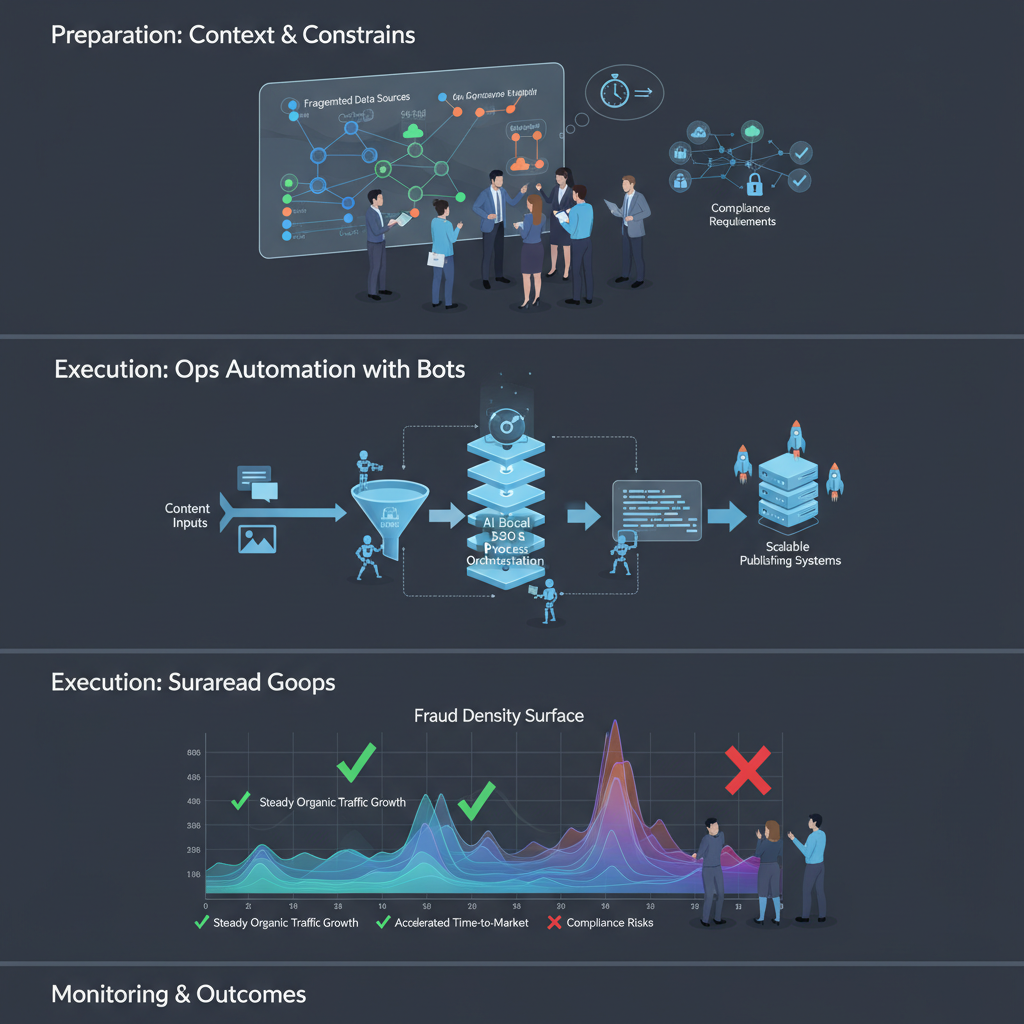
Preparation: Understanding Context and Constraints
Contextualizing the Business and Technical Environment
Consider a mid-sized digital agency managing multiple client websites with diverse CMS platforms and fragmented data sources—ranging from legacy databases to cloud-based marketing tools. The agency aims to automate SEO content publishing workflows using bots, accelerating delivery cycles while ensuring compliance with search engine technical standards.
Key constraints include:
- Fragmented Data Sources: Disparate systems holding content metadata, keyword research, and publishing schedules.
- Compliance Requirements: Strict adherence to technical SEO best practices such as canonicalization, structured data, and crawl budget optimization.
- Operational Complexity: Manual processes prone to errors and delays, limiting scalability.
- Time-to-Market Pressure: Client demands for faster content rollouts to capture organic traffic opportunities.
Defining the MVP Scope and Compliance Baseline
Before automation, the team must define a Minimum Viable Product (MVP) that encapsulates essential SEO compliance controls and operational automation capabilities. This includes:
- Automated metadata injection and validation bots to ensure schema markup and meta tags meet SEO standards.
- Content publishing orchestration bots that handle multi-platform deployments with rollback capabilities.
- Monitoring bots for crawl error detection and sitemap updates.
Establishing this baseline ensures that automation does not introduce SEO regressions, a critical compliance-driven decision to protect organic traffic.
Execution: Building the Ops Automation Architecture with Bots
Architectural Decisions and Trade-Offs
The architecture must integrate seamlessly with existing content management systems and data sources while enabling automation bots to operate reliably. Key decisions include:
- Modular Bot Design: Bots are designed as independent microservices responsible for discrete SEO tasks—metadata validation, content publishing, and monitoring. This modularity supports scalability and fault isolation.
- Event-Driven Workflow Orchestration: Leveraging event queues to trigger bots based on content lifecycle events ensures timely and ordered execution, reducing manual intervention.
- Data Normalization Layer: Implementing a middleware layer to unify fragmented data sources into a consistent schema enables bots to operate on reliable inputs, mitigating data inconsistency risks.
- Compliance Gateways: Automated quality gates embedded in the workflow prevent non-compliant content from publishing, enforcing SEO standards programmatically.
These architectural choices balance automation efficiency with compliance rigor. For example, while event-driven orchestration accelerates workflows, it requires robust error handling to avoid cascading failures that could disrupt SEO performance.
Implementation Path: Stepwise Rollout
The rollout follows a controlled, iterative approach:
- Pilot Bot Deployment: Launch metadata validation bots on a subset of client sites to verify compliance enforcement without impacting live traffic.
- Data Normalization Integration: Develop and deploy the middleware layer to harmonize data feeds, enabling bots to consume consistent inputs.
- Publishing Automation Rollout: Gradually introduce content publishing bots with rollback and audit logging features to maintain operational transparency.
- Monitoring and Alerting Bots: Deploy bots that continuously scan for crawl errors, sitemap freshness, and indexing anomalies, feeding alerts into the operations dashboard.
This phased rollout mitigates risks, allowing the team to validate each component’s impact on SEO compliance and operational efficiency before full-scale adoption.
Validation: Measuring Compliance and Performance Outcomes
Pre- and Post-Implementation Metrics
To assess the architecture’s effectiveness, the team tracks key performance indicators (KPIs) aligned with SEO and operational goals:
- Time-to-Market Reduction: Measure average content publishing cycle times before and after automation.
- SEO Compliance Rate: Percentage of content passing automated SEO quality gates without manual corrections.
- Organic Traffic Growth: Monitor steady increases in organic sessions attributable to faster, compliant content rollouts.
- Error Rate in Publishing: Track rollback incidents and publishing failures to evaluate bot reliability.
In a recent case, the agency observed a 40% reduction in content publishing time and a 25% increase in SEO compliance rate within three months of bot integration, directly correlating with a 15% uplift in organic traffic.
Anti-Patterns and Pitfalls to Avoid
Common mistakes that undermine compliance and scalability include:
- Over-Automation Without Quality Gates: Automating publishing without embedded SEO validation risks propagating errors at scale.
- Ignoring Data Fragmentation: Bots operating on inconsistent data produce unreliable outputs, leading to SEO penalties.
- Lack of Rollback and Audit Trails: Without these, troubleshooting and compliance audits become cumbersome, increasing operational risk.
Addressing these anti-patterns early ensures the architecture remains robust and compliant as it scales.
Monitoring: Sustaining Compliance and Operational Excellence
Continuous Observability and Incident Response
Post-rollout, the architecture incorporates monitoring bots that feed into a centralized dashboard, enabling real-time visibility into SEO compliance and operational health. Alerts for crawl errors, sitemap issues, or publishing anomalies trigger automated incident workflows, minimizing downtime and SEO impact.
This observability layer supports compliance audits and facilitates proactive adjustments, a critical capability for agencies managing multiple client portfolios under stringent SEO requirements.
Periodic Compliance Reviews and Bot Updates
Given the evolving nature of search engine algorithms and technical SEO standards, the automation bots and compliance gateways require regular updates. Scheduled reviews ensure that validation rules remain current, and bots adapt to new content formats or publishing platforms.
Embedding this maintenance cadence into the operational playbook safeguards long-term SEO performance and compliance adherence.
Next Steps: Scaling and Enhancing the Architecture
Expanding Automation Scope
With the MVP successfully deployed, agencies can consider extending automation to include:
- Semantic content analysis bots to optimize keyword usage and internal linking.
- Automated A/B testing orchestration for SEO-driven content experiments.
- Integration with client CRM and analytics platforms for enriched SEO insights.
Each extension should follow the compliance-driven approach established in the MVP phase to maintain SEO integrity.
Aligning Stakeholders and Continuous Improvement
Successful scaling demands ongoing collaboration between SEO specialists, developers, and operations teams. Establishing clear communication channels and shared compliance objectives fosters a culture of quality and accountability.
For teams seeking detailed guidance on aligning stakeholders and managing SEO-safe redesigns, the B2B SaaS and Internal Tooling SEO-Safe Redesign and Migration Implementation Plan offers valuable insights.
Leveraging Expert Services for Controlled Rollouts
Given the complexity of integrating bots within fragmented content ecosystems, engaging specialized services can accelerate MVP definition and controlled rollout. Expert teams bring compliance-driven methodologies and proven architectures that reduce risk and enhance time-to-market.
Explore our comprehensive offerings at /services/ to learn how tailored solutions can support your digital agency or service business in achieving scalable, SEO-compliant content automation.
Case Study: Ops Automation with Bots in a Multi-Client Digital Agency
A digital agency managing 15 client websites faced slow content publishing cycles averaging 10 days, with frequent SEO compliance issues due to manual metadata entry and inconsistent data sources. The agency implemented the described architecture blueprint, focusing on:
- Deploying metadata validation bots integrated with a data normalization middleware.
- Automating content publishing workflows with rollback and audit logging.
- Establishing monitoring bots for crawl error detection and sitemap updates.
Within 90 days, the agency reduced publishing time to 6 days, increased SEO compliance from 70% to 95%, and observed a 12% organic traffic increase across client sites. The controlled rollout minimized disruptions, and the compliance gateways prevented SEO regressions.
This case underscores the importance of a compliance-driven, modular bot architecture combined with data normalization and observability for scalable SEO content systems.
For further technical playbooks on SEO-safe redesign and migration in digital agencies, refer to our AI-Assisted Engineering Workflows and Quality Gates for SEO-Safe Redesign and Migration in Digital Agencies and Service Businesses.
Validation: Measuring Compliance and Performance Outcomes
Detailed Compliance Auditing and Reporting
Beyond initial KPI tracking, establishing a robust compliance auditing framework is essential for sustained SEO success. This involves creating automated audit reports that provide granular insights into metadata accuracy, schema markup validity, and page load performance across all client sites. These reports should be generated on a scheduled basis and include trend analyses to detect gradual drifts in compliance that may not trigger immediate alerts.
For example, a mid-sized agency integrated weekly SEO compliance audits into their operations dashboard, enabling SEO specialists to proactively identify and address emerging issues before they impacted search rankings. This approach reduced reactive firefighting and improved client satisfaction by maintaining consistent SEO health.
Operational Impact Analysis
Measuring the operational impact of bot-driven automation requires tracking not only time savings but also qualitative improvements in team workflows. Teams should document changes in manual workload, error resolution times, and cross-team communication efficiency. Conducting periodic retrospectives with content creators, SEO analysts, and developers helps surface bottlenecks and areas where automation may require refinement.
In one scenario, a digital agency discovered that while publishing bots accelerated content deployment, initial error rates increased due to insufficient training data for metadata validation bots. By iterating on bot logic and incorporating human-in-the-loop feedback, the agency improved bot accuracy and reduced error handling overhead within two months.
Anti-Patterns and Pitfalls to Avoid
Ignoring Incremental Rollouts and Feedback Loops
One common anti-pattern is deploying automation bots across all client sites simultaneously without phased rollouts or feedback mechanisms. This approach risks widespread SEO regressions if bots misinterpret data or fail to handle edge cases. Instead, teams should adopt incremental rollout strategies, starting with low-risk clients or content types, and incorporate continuous feedback loops to refine bot behavior.
For instance, a service business that initially deployed publishing bots across all clients experienced a surge in indexing errors due to unhandled URL parameter variations. By scaling back and introducing a pilot phase with detailed monitoring, they identified the root cause and implemented parameter normalization before full deployment.
Overlooking Cross-Functional Training and Documentation
Automation success depends on cross-functional understanding. Neglecting to train SEO specialists, content teams, and developers on bot capabilities and limitations can lead to misuse or mistrust of automation tools. Comprehensive documentation and regular training sessions ensure all stakeholders understand the operational model, compliance requirements, and escalation paths.
In practice, a digital agency established monthly knowledge-sharing workshops where developers demonstrated new bot features and SEO teams shared compliance insights. This fostered a collaborative culture and reduced friction during bot updates or incident investigations.
Monitoring: Sustaining Compliance and Operational Excellence
Implementing Multi-Tiered Alerting Strategies
Effective monitoring requires multi-tiered alerting that distinguishes between critical SEO issues and informational warnings. For example, crawl errors affecting high-priority landing pages should trigger immediate alerts with escalation protocols, while minor sitemap freshness delays may generate lower-priority notifications for scheduled review.
Designing alert thresholds and escalation paths collaboratively with SEO and operations teams prevents alert fatigue and ensures timely response to impactful issues. Integrating alert summaries into daily standups or weekly reports helps maintain situational awareness without overwhelming teams.
Leveraging Historical Data for Predictive Maintenance
Over time, accumulating monitoring data enables predictive maintenance by identifying patterns that precede SEO compliance degradation. For example, a gradual increase in metadata validation warnings may signal upcoming algorithm changes or content template inconsistencies. Proactively addressing these signals through bot updates or content audits prevents ranking drops.
One agency implemented machine learning models on monitoring data to forecast potential SEO risks, allowing their teams to prioritize remediation efforts effectively and maintain competitive organic visibility.
Next Steps: Scaling and Enhancing the Architecture
Integrating Workflow Orchestration for Complex Content Pipelines
As automation scope expands, managing dependencies between bots and content workflows becomes critical. Introducing workflow orchestration layers enables sequencing tasks such as data normalization, metadata validation, content enrichment, and publishing in controlled pipelines. This reduces race conditions and ensures data consistency.
For example, an agency orchestrated their bots using a centralized scheduler that triggered validation bots only after content ingestion bots completed processing. This eliminated partial data states and improved overall system reliability.
Embedding Compliance Gates into Continuous Integration/Continuous Deployment (CI/CD) Pipelines
Embedding SEO compliance checks into CI/CD pipelines for content and code deployments enforces quality gates early in the release process. Automated tests for metadata presence, schema correctness, and page speed can block deployments that fail compliance, preventing SEO regressions before reaching production.
Implementing these gates requires collaboration between SEO teams and developers to define test criteria and thresholds. Over time, this practice fosters a culture of quality and reduces manual review workloads.
Establishing a Governance Framework for Automation Ethics and Security
Scaling automation introduces governance considerations around data privacy, security, and ethical use of bots. Agencies should define policies governing bot access to client data, audit trail retention, and incident response procedures. Regular security assessments and compliance audits ensure that automation does not expose clients to risks.
For instance, a service business implemented role-based access controls for bot configurations and encrypted sensitive data in transit and at rest. They also established incident response playbooks for bot-related failures, minimizing operational impact.
Case Study: Ops Automation with Bots in a Multi-Client Digital Agency
Following the initial success, the agency expanded their automation architecture to include semantic content analysis bots that evaluated keyword density and internal linking structures. This extension required integrating natural language processing components and retraining validation bots to interpret semantic signals.
During rollout, the agency encountered challenges with inconsistent content taxonomies across clients, which complicated semantic analysis. They addressed this by developing a taxonomy normalization service within their middleware layer, harmonizing content categories before analysis.
This enhancement led to a 10% improvement in targeted keyword rankings and further reduced manual SEO audits by 30%. The agency also formalized a quarterly review process involving SEO, content, and development teams to continuously refine automation strategies and maintain alignment with evolving search engine guidelines.
These experiences highlight the importance of modular, adaptable architectures and cross-team collaboration in achieving scalable, SEO-compliant content systems within digital agencies and service businesses.
Related reads
Relevant offers
If this article matches your task, here are two offers you can use to move from insight to implementation without extra discovery.