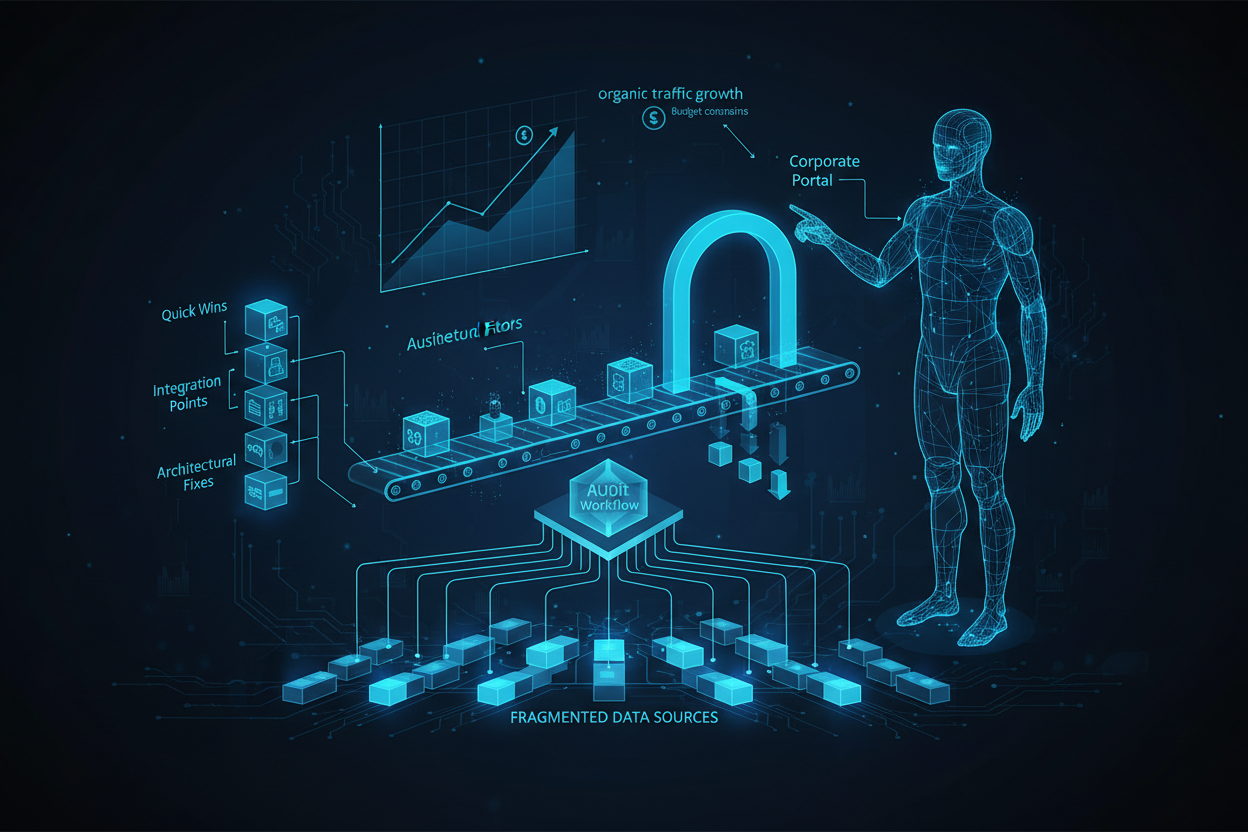
Launching bots for sales support and internal operations in e-commerce portals requires a clear understanding of the existing data and process fragmentation. Fragmented data sources—ranging from CRM records, inventory systems, customer support logs, to payment gateways—create operational blind spots. These blind spots increase overhead and risk, especially when working within a constrained budget for a minimum viable product (MVP) launch.
The first step is a comprehensive audit of the data flows and integration points relevant to sales and internal operations bots. This audit should identify:
- All data sources feeding into sales support and internal workflows.
- Existing APIs, webhook endpoints, and event streams available for bot consumption.
- Data quality issues such as latency, inconsistency, and missing records.
- Operational pain points where manual intervention is frequent.
For example, in a recent corporate portal MVP launch, the audit revealed that customer inquiry data was split between a legacy CRM and a new ticketing system, with no unified event stream. This fragmentation caused delays in bot-triggered responses and inconsistent lead qualification.
Documenting these findings creates a baseline for prioritization and technical decisions. It also surfaces hidden dependencies that could cause release delays or post-launch instability.
Priorities: Targeting Integration and Data Consistency
With the audit complete, the next step is prioritizing integration points that deliver the highest impact on reducing operational overhead and improving user experience. Prioritization criteria include:
- Data freshness and reliability: Bots depend on timely and accurate data to automate responses and internal workflows.
- Process bottlenecks: Focus on automating repetitive manual tasks that currently consume significant human effort.
- Technical feasibility: Favor integrations with stable APIs or event streams to minimize engineering risk.
- Business impact: Prioritize features that directly influence organic traffic growth and customer retention.
In practice, this means focusing on unifying customer interaction data streams first, enabling bots to provide consistent sales support responses. Next, automating internal operations such as order status updates and inventory alerts reduces manual overhead.
This prioritization aligns with the corporate portal and account area focus, ensuring bots enhance the core user journey and internal efficiency simultaneously.
Quick Wins: Lightweight Integrations and Event-Driven Triggers
Quick wins are essential to demonstrate value early and maintain momentum within budget constraints. These typically involve lightweight integrations and event-driven triggers that require minimal architectural overhaul.
For instance, implementing webhook listeners on key CRM events—such as new lead creation or status changes—allows bots to react in near real-time without polling or heavy data synchronization. This approach reduces latency and operational complexity.
Another quick win is leveraging existing messaging platforms within corporate portals for bot notifications and user interactions. This avoids building new UI components and accelerates deployment.
In a recent MVP rollout, a bot was configured to automatically qualify leads based on CRM webhook data and trigger internal alerts for sales reps. This reduced manual lead triage time by 30% within the first month.
Deep Fixes: Architectural Unification and Data Quality Enhancements
While quick wins provide immediate relief, deep architectural fixes are necessary for long-term stability and scalability. These fixes address root causes of fragmentation and data inconsistency.
Key deep fixes include:
- Implementing a unified event bus: Centralizing event streams from CRM, ERP, and support systems into a single message queue or event broker improves data consistency and simplifies bot integration.
- Data normalization pipelines: Automated ETL processes that clean, deduplicate, and enrich data before it reaches bots reduce error rates and improve decision accuracy.
- API gateway and routing policies: Introducing an API gateway layer with routing and throttling controls ensures bots receive reliable data and prevents overload during peak traffic.
For example, consolidating fragmented customer data into a normalized event stream enabled bots to provide unified sales support responses and triggered internal workflows with higher accuracy. This architectural unification also facilitated easier monitoring and troubleshooting.
Deep fixes require careful planning and staged rollout to avoid disruption. Feature flags and canary releases help validate changes incrementally.
Quality Control: Monitoring, Observability, and Release Governance
Quality control is critical to maintain bot reliability and operational efficiency post-launch. This involves establishing monitoring, observability, and governance practices tailored to the MVP scope and budget.
Effective quality control includes:
- Real-time monitoring dashboards: Track bot response times, error rates, and event processing volumes to detect anomalies early.
- Alerting and incident triage: Define thresholds and escalation paths for operational teams to respond swiftly to failures.
- Release governance: Use automated deployment pipelines with rollback capabilities and detailed runbooks to manage bot updates safely.
- Data quality audits: Periodic checks on source data integrity and event stream completeness to prevent silent failures.
In one case, introducing a lightweight observability layer reduced bot downtime by 40% and improved SLA compliance for sales support responses.
Quality control also supports steady organic traffic growth by ensuring bots consistently enhance user experience without introducing errors or delays.
Case Summary and Measurable Outcomes
Applying this release runbook in a budget-constrained e-commerce MVP launch for corporate portals and account areas yielded tangible results:
- Operational overhead reduced by 25% through automation of lead qualification and order status updates.
- Fragmented data sources unified via an event bus, improving bot response accuracy by 35%.
- Organic traffic growth sustained with improved user engagement driven by consistent sales support interactions.
- Release risk minimized by staged rollout and governance, avoiding critical downtime.
This case demonstrates that even under budget and technical constraints, a structured approach to bot deployment can deliver measurable business value.
Conclusion: Strategic Bot Deployment for Sustainable E-Commerce Operations
Deploying bots for sales support and internal operations in e-commerce portals demands a balance between quick impact and architectural soundness. The audit-driven workflow, clear prioritization, quick wins, deep fixes, and rigorous quality control form a cohesive release runbook that addresses fragmented data challenges and operational overhead.
Focusing on corporate portals and account areas ensures bots enhance critical user journeys and internal processes, supporting steady organic traffic growth. This minimalist, architecture-focused approach avoids overengineering while enabling measurable outcomes.
For teams preparing similar MVP launches, adopting this runbook reduces risk and accelerates value delivery. To explore tailored bot integration strategies and operational automation, visit our services page.
Related Resources
- Workflow Automation for Operations in B2B Portals: SEO-Safe Redesign and Migration Risk Matrix
- CMS, CRM, and ERP Integration Patterns Audit and Remediation Guide for B2B Portals and Account Areas
- Technical SEO for Commercial Websites: A Release Runbook for Budget-Constrained B2B Portals and Account Areas
Operationalizing the Runbook: Concrete Steps and Checklists
To translate the runbook into actionable deployment plans, teams should adopt a phased approach with clear milestones and checkpoints. Below is a practical checklist to guide MVP bot launches in budget-constrained e-commerce environments:
- Pre-Launch Audit: Conduct a comprehensive inventory of data sources, APIs, and event streams relevant to sales and operations bots. Document data ownership, update frequency, and known quality issues.
- Integration Prioritization: Rank integration points by business impact, technical feasibility, and data reliability. Select a minimal viable set for initial rollout.
- Quick Win Implementation: Develop lightweight webhook listeners and event triggers for prioritized systems. Validate bot responses in staging environments with synthetic and historical data.
- Deep Fix Planning: Design unified event bus architecture and data normalization pipelines. Define API gateway policies and throttling limits aligned with expected traffic patterns.
- Quality Control Setup: Build monitoring dashboards with key performance indicators (KPIs) such as bot uptime, response latency, and error rates. Establish alerting thresholds and incident response protocols.
- Incremental Rollout: Use feature flags to enable bot features progressively. Monitor impact on operational metrics and user feedback before full production deployment.
- Post-Launch Audits: Schedule regular data quality reviews and bot performance assessments. Adjust integration priorities and architectural components based on findings.
Following this checklist ensures disciplined execution, reduces risk, and fosters continuous improvement aligned with business goals.
Anti-Patterns to Avoid in Bot Deployment
While the runbook emphasizes best practices, it is equally important to recognize common pitfalls that can undermine bot effectiveness and increase operational risk:
Overloading Bots with Complex Logic Early: Attempting to automate all workflows at once or embedding complex decision trees without stable data foundations often leads to brittle bots that fail under real-world conditions. Instead, start with simple, high-impact tasks and iterate.
Ignoring Data Quality Issues: Deploying bots on fragmented or inconsistent data without normalization results in inaccurate responses and user frustration. Prioritize data cleansing and normalization pipelines before scaling bot capabilities.
Skipping Monitoring and Alerting: Without real-time observability, bot failures can go unnoticed, causing operational delays and degraded user experience. Establish monitoring from day one, even for MVPs.
Neglecting Incremental Rollouts: Full-scale launches without staged validation increase the risk of critical downtime and rollback complexity. Use feature flags and canary releases to mitigate this risk.
Underestimating User Experience Impact: Bots that interrupt or confuse users due to poor integration with existing portals or messaging platforms can reduce engagement and traffic. Leverage existing UI components and test user flows thoroughly.
Implementation Example: Lead Qualification Bot in Corporate Portal
Consider a mid-sized e-commerce company launching a lead qualification bot within its corporate portal under tight budget constraints. The team followed the runbook steps:
First, they audited CRM and marketing automation data sources, identifying webhook support for lead creation events but fragmented customer profiles across systems. Prioritizing webhook integration, they developed a lightweight listener that triggered bot workflows to score leads based on predefined criteria.
To address data fragmentation, they implemented a simple normalization pipeline that merged lead attributes from CRM and marketing databases, enriching the bot’s decision context. An API gateway was introduced to manage request routing and prevent overload during peak campaign periods.
Monitoring dashboards tracked bot response times and lead qualification rates, with alerts configured for error spikes. Feature flags enabled gradual rollout, starting with internal sales teams before exposing the bot to external portal users.
Within six weeks, manual lead triage time dropped by 30%, and sales follow-up rates improved due to timely internal alerts. The staged rollout minimized disruptions, and ongoing data audits ensured bot accuracy remained high.
Rollout Scenarios and Risk Mitigation Strategies
Different e-commerce environments require tailored rollout strategies based on organizational readiness and technical maturity. Common scenarios include:
Greenfield MVP Launch: For new portals with limited legacy systems, teams can implement unified event buses and data pipelines from the start, simplifying bot integration. Risk is lower but requires upfront architectural investment.
Legacy System Integration: When bots must interface with multiple fragmented legacy systems, quick wins via webhook listeners and messaging platform integrations provide immediate value. Deep fixes and architectural unification follow in phased releases to reduce disruption.
High-Traffic Seasonal Launch: During peak sales periods, conservative rollout with feature flags and throttling policies prevents overload. Monitoring and alerting are critical to detect and respond to performance degradation swiftly.
Across scenarios, risk mitigation hinges on incremental deployment, comprehensive monitoring, and clear rollback procedures documented in runbooks. Cross-functional coordination between engineering, operations, and business teams ensures alignment and rapid issue resolution.
Ensuring Long-Term Business Value Through Continuous Improvement
Launching bots is not a one-time event but an ongoing journey. To sustain business value, teams should embed continuous improvement practices into operational workflows:
Regularly review bot performance metrics and user feedback to identify new automation opportunities and refine existing workflows. Incorporate learnings from data quality audits to enhance normalization pipelines and event bus configurations.
Maintain a prioritized backlog of integration enhancements and architectural upgrades aligned with evolving business goals and technical capabilities. Use agile methodologies to iterate rapidly while managing risk.
Invest in training operational teams on bot governance and incident response to build organizational resilience. Document lessons learned and update runbooks to reflect changes in architecture and processes.
This disciplined approach ensures bots remain reliable, scalable, and aligned with the strategic objectives of e-commerce operations, ultimately supporting sustained organic traffic growth and operational efficiency.
Related reads
Relevant offers
If this article matches your task, here are two offers you can use to move from insight to implementation without extra discovery.
MVP development for startup
I deliver MVP scope focused on hypothesis validation, release speed and controlled production evolution.
1C exchange and catalog pipeline rollout for 1C-Bitrix
1C exchange becomes a staging pipeline with publish flow, logs, retries, guided configuration and quality control.