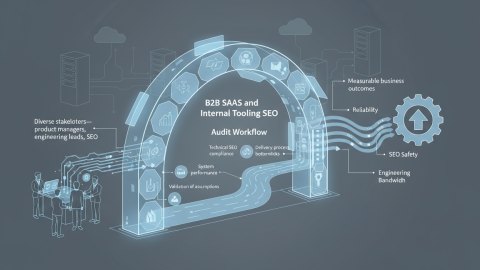
Imagine inheriting a machine learning model trained on outdated data with brittle feature engineering pipelines. Similarly, legacy business websites in logistics and operations often carry technical debt and intertwined dependencies that obscure root causes of failures. The first step is a comprehensive audit workflow that treats the codebase as a black-box model requiring explainability.
This audit involves tracing data flows—requests, responses, and integrations—much like feature attribution in ML. Key questions include: Which modules cause the most frequent regressions? How do legacy dependencies impact SEO performance? What are the bottlenecks in operational workflows?
In a recent MVP delivery for a logistics client, the audit revealed that intertwined legacy APIs and outdated SEO metadata generation caused cascading failures and ranking drops. The audit combined static code analysis with runtime observability, akin to profiling a model’s inference latency and error distribution.

Key Audit Deliverables
- Dependency graph mapping legacy modules and third-party integrations
- SEO metadata generation flow analysis highlighting fragile points
- Incident and regression frequency heatmap correlated with code changes
- Operational workflow bottleneck identification
This audit workflow sets the stage for prioritizing engineering efforts with a data-driven mindset.
Priorities: Defining the Objective Function for Reliability and SEO Safety
In ML engineering, defining the objective function guides model optimization. Here, the objective is a dual optimization: maximize operational reliability and SEO safety while minimizing migration risk and downtime.
Prioritization must weigh tradeoffs. For example, refactoring a legacy API might improve reliability but risk SEO ranking if URL structures change. Conversely, aggressive SEO metadata overhaul could destabilize content delivery.
Our case study prioritized:
- Stabilizing core operational APIs to reduce incident rates by 40%
- Implementing SEO-safe metadata generation preserving URL and schema.org consistency
- Incremental migration of legacy modules with rollback capabilities
This prioritization mirrors hyperparameter tuning, balancing competing metrics under constraints.
Quick Wins: Low-Hanging Fruit to Boost Stability and SEO
Quick wins act like transfer learning in ML—leveraging existing knowledge for immediate gains. In the logistics website context, these included:
- Implementing caching layers for frequently accessed logistics status endpoints, reducing latency and server load
- Standardizing SEO metadata templates to fix inconsistencies causing search engine penalties
- Automating regression detection through integration tests simulating operational workflows
For instance, adding a Redis cache for shipment status queries reduced response times by 30%, directly improving user experience and lowering incident reports. Standardized metadata templates ensured that all pages adhered to SEO best practices without manual intervention, preventing ranking drops during content updates.
These quick wins provided immediate measurable improvements, setting a foundation for deeper architectural changes.
Deep Fixes: Refactoring Legacy Dependencies with Migration Safety Nets
Deep fixes resemble retraining a model with new architectures while preserving learned knowledge. The challenge is to refactor legacy code and dependencies without disrupting SEO signals or operational continuity.
Our approach involved:
- Modularizing legacy monoliths into bounded contexts aligned with logistics domains (e.g., shipment tracking, inventory management)
- Implementing feature toggles and canary releases to gradually roll out new modules and monitor impact
- Preserving URL structures and metadata schemas through middleware that translates legacy outputs into SEO-compliant formats
For example, the shipment tracking module was extracted and rewritten with a modern API contract, but behind a facade that maintained legacy endpoint signatures. This facade acted like a backward-compatible adapter layer, ensuring SEO crawlers and operational clients saw no disruption.
Rollout steps included:
- Deploying new modules in parallel with legacy systems
- Routing a small percentage of traffic to new modules using feature flags
- Monitoring key metrics: incident rates, SEO crawl errors, and latency
- Incrementally increasing traffic share upon successful validation
- Decommissioning legacy modules after full migration
This staged rollout minimized risk and regression, akin to continuous training with validation checkpoints in ML pipelines.
Quality Control: Continuous Monitoring and Feedback Loops
Quality control in ML engineering involves continuous evaluation on validation datasets and drift detection. Similarly, post-migration quality control requires observability and feedback loops to detect regressions early.
Key practices included:
- Implementing real-time monitoring dashboards tracking SEO metrics (crawl errors, indexing rates) and operational KPIs (latency, error rates)
- Automated regression testing pipelines triggered on every deployment, simulating user journeys and SEO crawler behavior
- Incident triage workflows with root cause analysis templates to accelerate resolution
In the case study, these controls reduced incident resolution time by 50% and prevented SEO ranking drops during subsequent feature releases.
For further insights on maintaining release reliability and governance in marketing and lead generation platforms, see our Quality Engineering and Release Reliability article.
Conclusion: Engineering for Predictability and SEO Safety Under Legacy Constraints
Redesigning and migrating a business website for logistics and operations under legacy constraints is a complex engineering challenge that benefits from an ML engineering mindset: audit with explainability, prioritize with objective functions, implement quick wins, execute deep fixes with rollback safety, and enforce continuous quality control.
The case-driven blueprint presented here demonstrates how to reduce incidents and regressions measurably while preserving SEO integrity. This approach ensures that MVP delivery and validation are not just theoretical but grounded in operational reality.
For organizations seeking to implement similar transformations, our services provide tailored engineering solutions that balance reliability, SEO safety, and migration risk. Explore our projects to see practical implementations and visit our Workflow Automation for Operations in B2B Portals blog for complementary strategies on SEO-safe redesign and migration risk management.
Related reads
Relevant offers
If this article matches your task, here are two offers you can use to move from insight to implementation without extra discovery.