In the high-stakes environment of B2B SaaS and internal tooling, preparing for traffic growth without a comprehensive architecture refactor is a recipe for operational failure. The first step is a rigorous audit workflow that embraces a zero-trust perspective—assuming no component or stakeholder alignment is inherently secure or reliable. This mindset compels teams to validate every integration point, data flow, and security control before scaling.
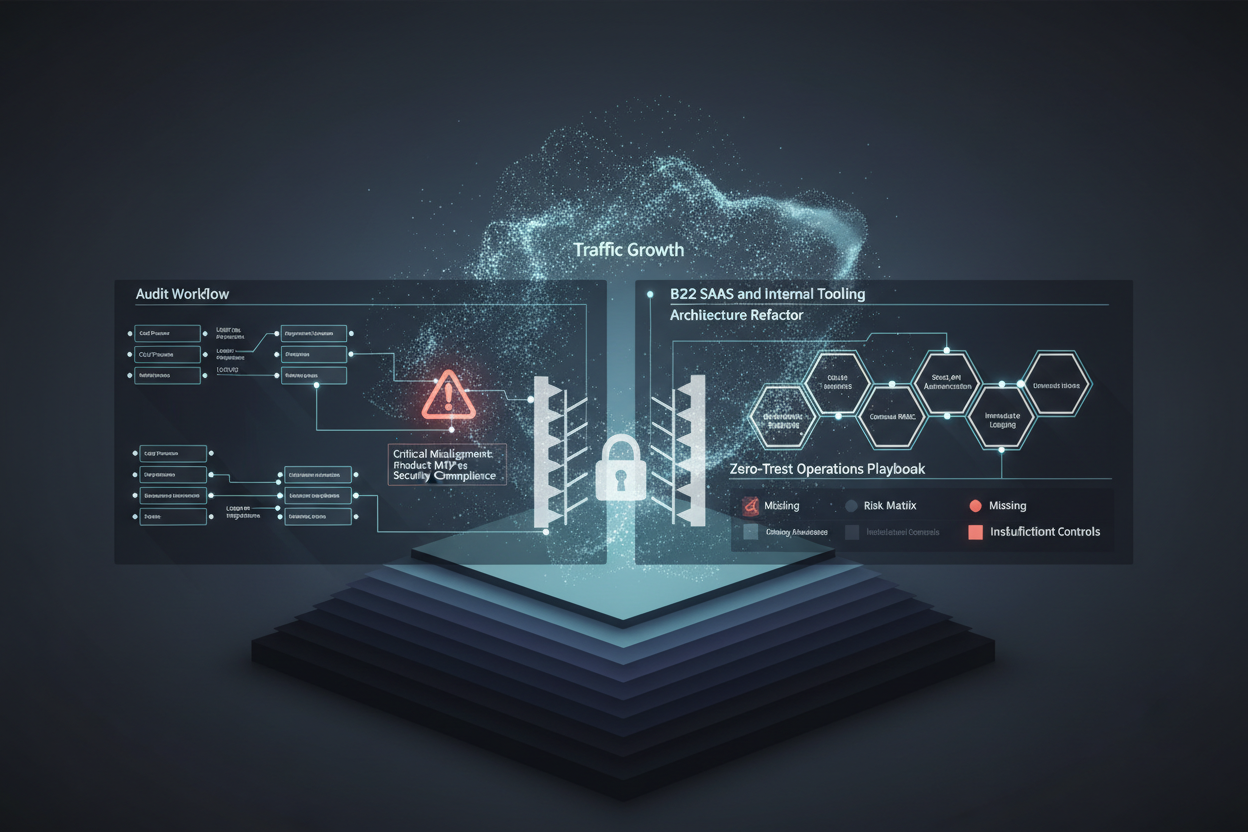
Begin by mapping the current product delivery pipeline, including CI/CD processes, deployment environments, and monitoring systems. Pay special attention to legacy dependencies and undocumented integrations that often become attack vectors or bottlenecks under load. For example, in a recent internal tooling refactor, the audit revealed a critical misalignment between the product team’s MVP scope and the security team’s compliance requirements, which risked delayed release and audit failures.
Next, conduct stakeholder interviews focusing on assumptions and expectations around delivery timelines, security audits, and feature prioritization. This step surfaces conflicting priorities early, enabling proactive scope control rather than reactive firefighting. The audit culminates in a risk matrix highlighting areas where zero-trust controls—such as strict API authentication, granular role-based access, and immutable logging—are missing or insufficient.
Priorities: Aligning Stakeholders Through Controlled MVP Scope
With audit findings in hand, the next challenge is aligning stakeholders on a controlled MVP scope that balances time-to-market with security and auditability. Zero-trust principles dictate that no feature or integration is trusted by default; each must be justified by measurable business value and secured by design.
Prioritization workshops should focus on:
- Security-critical features: Features that directly impact compliance and audit trails must be non-negotiable MVP inclusions.
- Core user journeys: Identify the minimal set of workflows that deliver tangible value to B2B customers without expanding attack surfaces unnecessarily.
- Integration points: Limit third-party or internal system integrations to those with verified security postures and clear SLAs.
In one case, a SaaS provider trimmed their MVP scope by deferring complex partner API integrations until after initial traffic stabilization. This decision reduced the attack surface and simplified audit requirements, enabling a faster, more secure launch.
Quick Wins: Implementing Zero-Trust Controls for Immediate Impact
After scope alignment, focus on quick wins that enforce zero-trust controls and improve delivery velocity. These include:
- Automated security gating in CI/CD: Integrate static code analysis, dependency vulnerability scanning, and policy compliance checks early in the pipeline to catch issues before deployment.
- Immutable audit logs: Ensure all deployment and access events are logged in tamper-proof storage accessible to auditors and security teams.
- Granular access controls: Enforce least privilege principles for development, staging, and production environments to reduce insider risk.
Implementing these controls early not only mitigates risk but also builds stakeholder confidence in the delivery process. For example, a fintech internal tool refactor introduced automated policy gates that reduced security review cycles by 40%, accelerating MVP delivery without compromising audit readiness.
Deep Fixes: Architectural Refactor for Scalability and Auditability
Quick wins set the stage, but deep architectural fixes are essential for sustainable growth and compliance. These fixes address systemic issues uncovered during the audit and quick-win phases, such as:
- Modularizing monolithic codebases: Breaking down tightly coupled components into independently deployable services with well-defined security boundaries.
- Implementing API gateways with strict contract validation: Enforcing zero-trust at the integration layer by validating all inbound and outbound traffic against schema and policy rules.
- Enhancing observability: Deploying distributed tracing and real-time anomaly detection to identify unauthorized access or performance degradation early.
In a recent project, refactoring a legacy internal tool into microservices with an API gateway reduced incident response times by 60% and improved audit trail completeness, directly supporting organic traffic growth goals.
Quality Control: Sustaining Zero-Trust Delivery and Stakeholder Alignment
Quality control is the final, ongoing phase that ensures the architecture refactor and MVP delivery remain aligned with zero-trust principles and stakeholder expectations. This involves:
- Continuous integration of security and compliance tests: Embedding automated regression, penetration, and compliance tests into the delivery pipeline.
- Regular stakeholder syncs: Maintaining transparent communication channels to revisit scope, risks, and delivery progress, preventing scope creep and misalignment.
- Post-release monitoring and feedback loops: Using observability data to validate assumptions about traffic growth impact and security posture, enabling iterative improvements.
For instance, a SaaS provider instituted weekly cross-team reviews combining engineering, security, and product stakeholders, which reduced post-release incidents by 35% and improved organic traffic retention through faster feature iteration cycles.
Checklist: Zero-Trust MVP Delivery for B2B SaaS and Internal Tooling
- Conduct comprehensive architecture and security audit with stakeholder interviews.
- Define MVP scope prioritizing security-critical and core user features.
- Implement automated security gates and immutable logging in CI/CD.
- Modularize architecture and enforce API contract validation.
- Deploy observability tools for real-time monitoring and anomaly detection.
- Establish continuous security testing and regular stakeholder alignment meetings.
Anti-Patterns to Avoid
- Overloading MVP scope: Trying to deliver all features at once increases complexity and security risk.
- Assuming trust in internal components: Neglecting zero-trust controls on internal APIs and data flows invites breaches.
- Ignoring stakeholder misalignment: Failing to reconcile security and product priorities leads to delays and rework.
- Skipping automated security checks: Manual reviews alone cannot scale with traffic growth.
By avoiding these pitfalls, teams can maintain a secure, auditable, and efficient delivery pipeline that supports steady organic traffic growth.
For a deeper dive into AI-assisted engineering workflows that complement this zero-trust operations playbook, see our solution architecture for growing content-driven commercial websites. To understand how to integrate security gating into your release process, explore our MVP delivery architecture blueprint for B2B SaaS. For a comprehensive technical SEO perspective on redesign and migration under legacy constraints, review our technical SEO audit and integration plan.
Ready to secure your B2B SaaS or internal tooling MVP delivery with a zero-trust architecture refactor? Contact our team through our services to design AI-assisted engineering workflows that ensure compliance, accelerate time-to-market, and sustain organic growth.
Related reads
Relevant offers
If this article matches your task, here are two offers you can use to move from insight to implementation without extra discovery.
B2B client portal launch
I design and launch a B2B portal that reduces manual workload and makes client service more transparent.
AI document extraction pipeline
I build an AI pipeline that extracts structured data from files, requests and attachments without manual copy-paste.