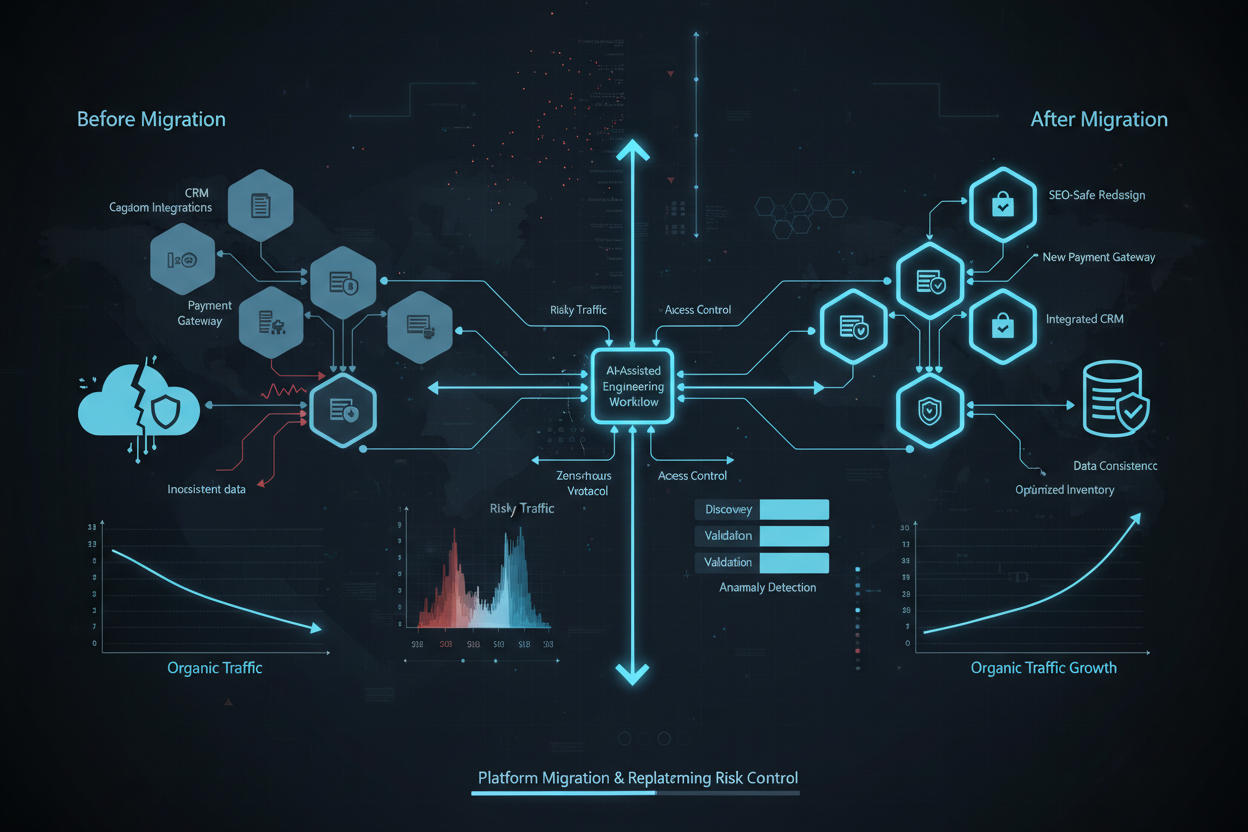
In ecommerce, platform migration is not merely a technical upgrade; it is a high-stakes operation where SEO performance, data integrity, and system reliability converge. When custom integrations—such as bespoke CRM connectors, payment gateways, or inventory management systems—are involved, the complexity multiplies. A zero-trust perspective demands that every component, data flow, and integration point be treated as potentially compromised or unreliable until proven otherwise. This mindset drives a rigorous, AI-assisted engineering workflow that mitigates risk and preserves SEO value throughout the redesign and migration process.
Preparation: Establishing a Zero-Trust Baseline and AI-Assisted Engineering Workflow
Preparation is the foundation of risk control. Begin by mapping all custom integrations and data sources, acknowledging fragmentation as a primary constraint. Each integration must be cataloged with its data contracts, authentication mechanisms, and failure modes. From a zero-trust standpoint, assume no integration is inherently secure or reliable; instead, implement strict access controls, continuous validation, and anomaly detection.
AI-assisted engineering workflows come into play by automating the discovery and validation of integration points. Machine learning models can analyze historical logs and traffic patterns to identify unusual behaviors or data inconsistencies that manual audits might miss. This proactive detection enables early remediation before migration begins.
Key preparatory steps include:
- Comprehensive inventory of all custom integrations and their dependencies.
- Baseline SEO performance metrics and crawlability audits to benchmark pre-migration status.
- Security posture assessment applying zero-trust principles to API endpoints and data flows.
- Design of AI-driven anomaly detection pipelines for real-time monitoring post-migration.
This phase aligns with best practices outlined in our Observability-Driven Incident Prevention and Resilience Architecture blog, emphasizing early detection and continuous validation.
Execution: Controlled Migration with AI-Enabled Quality Gates and Incremental Rollout
Execution demands a surgical approach. The zero-trust mindset dictates that no single migration step be trusted implicitly; instead, every change must pass through automated quality gates powered by AI-assisted validation. These gates verify data integrity, SEO metadata preservation, and integration stability before progressing.
Implement a staged rollout strategy, beginning with a shadow migration environment that mirrors production. This environment allows parallel traffic routing and real-time comparison of old and new platform behaviors without impacting users or search engine crawlers.
Critical execution elements include:
- Automated regression testing of SEO-critical elements such as canonical tags, structured data, and URL redirects.
- AI-driven anomaly detection on API response times, error rates, and data synchronization accuracy.
- Incremental cutover of integrations, starting with low-risk components to validate assumptions and reduce blast radius.
- Strict access control enforcement and continuous authentication checks on all integration endpoints.
This approach is consistent with the methodologies detailed in our MVP Delivery Architecture Blueprint for B2B SaaS and Internal Tooling, which advocates for AI-assisted quality gates to reduce release risk.
Validation: Measuring SEO Integrity and Integration Reliability Post-Migration
Validation is where the zero-trust philosophy proves its value. Post-migration, every data flow and SEO element must be continuously validated against expected baselines. AI models trained during preparation can now detect deviations in organic traffic patterns, crawl errors, or integration failures in near real-time.
Key validation activities include:
- Monitoring organic search traffic and keyword rankings for early signs of SEO degradation.
- Automated crawl simulations to verify URL accessibility, redirect correctness, and metadata consistency.
- Integration health dashboards showing latency, error rates, and data synchronization status.
- Security audit logs reviewed for unauthorized access attempts or anomalous behavior.
These validation steps ensure that the migration does not introduce silent failures or SEO penalties, supporting steady organic traffic growth as a measurable business outcome.
Monitoring: Continuous Observability and Incident Prevention in a Zero-Trust Environment
Post-migration monitoring is not a passive activity but a continuous, AI-augmented process that enforces zero-trust principles. Observability tools must ingest telemetry from all integrations, user interactions, and SEO performance metrics, correlating them to detect incidents before they impact business KPIs.
Implementing a closed-loop feedback system allows engineering teams to respond rapidly to anomalies, rollback problematic changes, or apply targeted fixes. This proactive stance is essential for ecommerce platforms where downtime or SEO ranking drops translate directly into revenue loss.
Monitoring best practices include:
- Real-time alerting on SEO crawl errors, broken links, or metadata inconsistencies.
- Integration performance baselining with AI-driven anomaly detection to flag unusual latency or error spikes.
- Security event correlation to identify potential breaches or unauthorized data access.
- Regular review cycles incorporating AI insights to refine migration and integration strategies.
These practices echo the principles in our AI-Assisted Engineering Workflows and Quality Gates for Content-Driven Commercial Websites, emphasizing continuous improvement and resilience.
Next Steps: Scaling AI-Assisted Engineering for Future Migrations and Integrations
With a successful migration behind you, the next logical step is to institutionalize AI-assisted engineering workflows and zero-trust controls as standard practice. This includes:
- Extending AI models to cover new integrations and evolving SEO requirements.
- Embedding zero-trust principles into development pipelines and release engineering processes.
- Training teams on interpreting AI-driven insights and responding to alerts effectively.
- Planning for incremental platform upgrades with built-in risk control and observability.
By doing so, organizations can maintain steady organic traffic growth and operational reliability despite the inherent complexity of ecommerce platforms with fragmented data sources.
For a tailored approach to AI-assisted engineering workflows and migration risk control, explore our comprehensive offerings at /services/. Our expertise ensures your ecommerce platform migration is secure, SEO-safe, and performance-optimized.
Case Study: Incremental Migration of a Custom-Integrated Ecommerce Platform
A mid-sized ecommerce company faced declining organic traffic and frequent integration failures due to a legacy platform with multiple custom CRM and inventory connectors. Applying a zero-trust, AI-assisted workflow, the engineering team:
- Mapped all integrations and established strict access controls.
- Built AI models to detect anomalies in API responses and SEO metadata.
- Executed a shadow migration with incremental cutover, validating each step through automated quality gates.
- Monitored post-migration SEO metrics and integration health continuously.
Results included a 15% increase in organic traffic within three months post-migration, zero critical integration failures, and improved operational predictability. This case underscores the practical benefits of combining zero-trust principles with AI-assisted engineering workflows.
Execution: Managing Trade-offs and Mitigating Risks During Incremental Rollout
While the incremental rollout strategy minimizes risk, it introduces operational complexity that requires careful orchestration. For example, running parallel systems during shadow migration demands additional infrastructure and monitoring resources. Teams must balance the cost of maintaining dual environments against the benefit of early issue detection. A common pitfall is underestimating the synchronization overhead between legacy and new platforms, which can lead to data inconsistencies and user experience degradation if not managed rigorously.
To mitigate these risks, establish a detailed migration playbook that includes rollback procedures, escalation paths, and communication protocols. For instance, if an AI quality gate flags a spike in API error rates during integration cutover, the playbook should specify immediate actions such as throttling traffic, triggering alerts to on-call engineers, and initiating a rollback to the previous stable state. This ensures that issues are contained quickly without cascading into broader outages or SEO penalties.
Another critical trade-off involves SEO crawl budget allocation during migration. Search engines allocate limited crawl resources per site, so redirect chains or temporary URL changes can exhaust this budget, delaying indexing of new content. To address this, coordinate closely with SEO specialists to implement crawl-delay headers and sitemap updates that prioritize critical pages. AI-assisted monitoring can then verify that search engine bots are accessing intended URLs without encountering excessive redirects or errors.
Validation: Concrete Steps for Ensuring Data and SEO Fidelity
Validation extends beyond automated checks to include manual audits and stakeholder reviews. For example, product managers should verify that migrated product descriptions, pricing, and availability reflect accurate business rules. Marketing teams need to confirm that promotional metadata and structured data markup remain intact to support rich search results.
Implement a multi-tier validation checklist that includes:
- Automated crawl reports highlighting broken links, missing metadata, and redirect chains.
- API contract tests ensuring that integrations return expected data formats and values.
- Manual spot checks of high-traffic pages and key customer journeys.
- SEO performance dashboards tracking keyword rankings, click-through rates, and bounce rates.
For example, during a recent migration, the team discovered that a custom integration responsible for inventory synchronization was truncating product descriptions due to a schema mismatch. Early detection through API contract tests prevented this issue from reaching production, avoiding potential customer confusion and lost sales.
Monitoring: Building a Culture of Proactive Incident Prevention
Continuous observability requires not only tooling but also cultural adoption across engineering, operations, and business teams. Establishing regular incident review meetings where AI-generated alerts are analyzed fosters shared ownership of platform health. Encourage teams to treat alerts as opportunities for learning and process improvement rather than blame assignment.
For example, if monitoring reveals a recurring pattern of SEO crawl errors linked to a specific integration endpoint, cross-functional teams can collaborate to identify root causes, whether they stem from data quality issues, authentication failures, or rate limiting. Documenting these findings and updating migration playbooks ensures that future rollouts benefit from accumulated knowledge.
Moreover, integrating observability data into development pipelines enables shift-left testing, where potential issues are caught earlier in the release cycle. This reduces the mean time to detection and resolution, ultimately preserving SEO rankings and customer trust.
Next Steps: Institutionalizing Best Practices for Sustainable Platform Evolution
Scaling AI-assisted engineering workflows involves embedding them into organizational processes and tooling. For example, integrating AI quality gates into continuous integration/continuous deployment (CI/CD) pipelines automates risk assessment for every code change affecting SEO or integrations. This reduces manual overhead and accelerates safe delivery.
Training programs should focus on interpreting AI insights, understanding zero-trust security principles, and applying migration playbooks effectively. Empowering teams with this knowledge transforms migration risk control from a one-time project into an ongoing capability.
Additionally, plan for incremental platform upgrades by modularizing integrations and decoupling SEO-critical components. This architectural approach simplifies future migrations and reduces the blast radius of changes. For instance, isolating the product catalog service from the checkout system allows independent updates without impacting SEO metadata generation.
Case Study: Operationalizing AI-Assisted Migration in a Complex Ecosystem
In a subsequent phase of the mid-sized ecommerce company’s platform evolution, the team faced the challenge of integrating a new payment gateway with stringent compliance requirements. Leveraging their established zero-trust, AI-assisted framework, they:
- Developed AI models to monitor transaction latency and error patterns specific to the new gateway.
- Implemented fine-grained access controls ensuring that only authorized services could invoke payment APIs.
- Executed a phased rollout starting with internal test accounts before enabling live customer transactions.
- Monitored SEO impact to confirm that checkout page metadata and structured data remained consistent.
This disciplined approach resulted in zero payment failures during rollout and maintained stable SEO performance, demonstrating the scalability and adaptability of the AI-assisted migration methodology.
Related reads
Relevant offers
If this article matches your task, here are two offers you can use to move from insight to implementation without extra discovery.