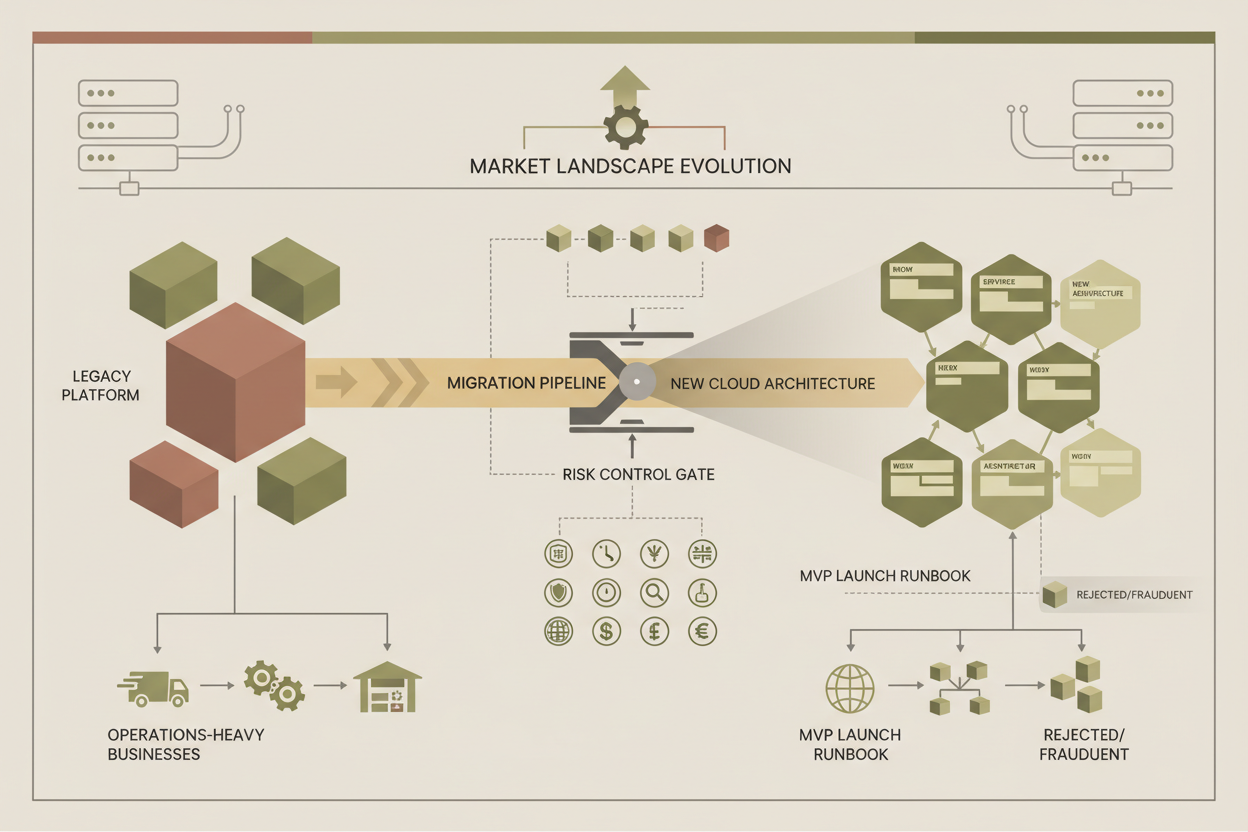
As market demands accelerate, businesses with complex operational backbones—such as logistics, supply chain management, and enterprise services—must evolve their technology platforms rapidly. The impetus to migrate or replatform arises from legacy system limitations, scalability bottlenecks, or the need to integrate modern capabilities. However, these transitions are fraught with risks: downtime, data loss, performance degradation, and budget overruns.
Consider a mid-sized logistics provider aiming to launch a minimum viable product (MVP) for a new order management system. The challenge is to migrate core functionalities from a monolithic legacy platform to a modular, cloud-optimized architecture under tight budget and time constraints. The business outcome sought is a faster go-to-market without sacrificing operational reliability or incurring excessive acquisition costs.
This scenario typifies the market evolution where agility and cost-efficiency must coexist with robust performance and risk mitigation.
Constraints: Budget, Deadlines, and Operational Complexity
Operating under a constrained budget and aggressive deadlines imposes hard limits on resource allocation, testing cycles, and contingency planning. For operations-heavy businesses, the stakes are higher because system failures directly impact service delivery and customer satisfaction.
Key constraints include:
- Limited testing environments: Budget constraints often restrict the availability of full-scale staging environments, increasing the risk of undetected issues.
- Data migration complexity: Legacy data formats and inconsistent schemas complicate seamless data transfer and reconciliation.
- Operational continuity: Zero or minimal downtime is expected, especially during peak business hours.
- Resource availability: Skilled personnel may be limited, necessitating streamlined processes and automation.
These constraints necessitate a risk control framework that balances thoroughness with efficiency, ensuring quality gates without bloated overhead.
Architecture: Designing for Controlled Risk and Incremental Delivery
Architectural decisions underpin the success of migration and replatforming efforts. For operations-heavy businesses launching budget-constrained MVPs, the architecture must enable incremental rollout, observability, and rollback capabilities.
Incremental Migration Strategy
Rather than a big-bang cutover, adopting a phased migration reduces risk exposure. This involves:
- Strangling the monolith: Gradually replacing legacy components with new microservices or modular APIs.
- Feature toggles and canary releases: Deploying new features behind flags to control exposure and monitor impact.
- Data synchronization layers: Implementing dual-write or event-driven replication to maintain consistency during transition.
Observability and Monitoring
Embedding comprehensive telemetry—metrics, logs, and traces—into both legacy and new platforms is critical. This enables early detection of performance regressions or errors, facilitating rapid response.
Rollback and Recovery Mechanisms
Designing for failure means ensuring that any problematic release can be reverted without data loss or service disruption. This includes:
- Database snapshotting and incremental backups aligned with migration checkpoints.
- Automated rollback scripts integrated into CI/CD pipelines.
- Clear cutover points with well-defined fallback procedures.
Such architectural guardrails are essential to maintain operational reliability amid change.
Implementation Steps: A Practical Runbook for Risk Control
Translating architecture into action requires a disciplined, stepwise approach that aligns with business priorities and resource realities.
1. Pre-Migration Assessment and Planning
Begin with a detailed audit of existing systems, data schemas, and operational workflows. Identify critical dependencies and integration points. Establish success criteria and risk thresholds collaboratively with stakeholders.
2. Define Quality Gates and Acceptance Criteria
Set measurable benchmarks for performance, data integrity, and error rates. For example, define acceptable latency increases, maximum allowable data reconciliation discrepancies, and error budget thresholds.
3. Develop Automated Testing and Validation Suites
Automate regression tests, data validation scripts, and load tests to maximize coverage within limited timeframes. Continuous integration pipelines should enforce these tests before any deployment.
4. Execute Incremental Migration with Feature Flags
Roll out components in controlled stages, toggling features on for limited user segments or environments. Monitor system health closely and gather feedback.
5. Implement Real-Time Monitoring and Alerting
Leverage dashboards and alerting mechanisms to track key performance indicators and error conditions. Ensure on-call readiness for rapid incident response.
6. Conduct Post-Migration Validation and Optimization
After each migration phase, perform thorough validation against acceptance criteria. Address any issues promptly and optimize configurations for performance and reliability.
7. Final Cutover and Decommissioning
Once the MVP is stable and meets business goals, plan the final cutover with minimal disruption. Decommission legacy components systematically, ensuring no residual dependencies remain.
Pitfalls: Common Anti-Patterns and How to Avoid Them
Despite best intentions, platform migration projects often stumble due to predictable pitfalls. Recognizing these anti-patterns early can save time and resources.
Big-Bang Migration Without Phased Rollout
Attempting a full switch-over in one go increases risk exponentially. Without incremental validation, issues can cascade, causing prolonged outages.
Neglecting Data Consistency Checks
Failing to implement robust data reconciliation leads to silent corruption or loss, undermining trust and operational accuracy.
Insufficient Observability
Without real-time monitoring, detecting and diagnosing issues becomes reactive and slow, prolonging downtime and customer impact.
Overlooking Rollback Planning
Not preparing rollback procedures or backups can turn minor glitches into major incidents, forcing costly emergency fixes.
Underestimating Resource Constraints
Ignoring budget and personnel limits leads to overambitious plans that cannot be executed effectively, resulting in rushed, error-prone deployments.
Outcomes: Measurable Benefits and Market-Driven Advantages
When executed with disciplined risk control, platform migration and replatforming yield tangible benefits aligned with evolving market demands.
Faster Time-to-Market: Incremental delivery and automated validation accelerate MVP launches, enabling quicker customer feedback and iterative improvement.
Reduced Operational Disruption: Phased rollouts and rollback capabilities minimize downtime, preserving service continuity and customer satisfaction.
Cost Efficiency: Streamlined processes and targeted automation optimize resource use, lowering acquisition costs and maximizing ROI.
Improved System Reliability: Enhanced observability and quality gates ensure stable performance under load, supporting business growth.
Scalable Foundation: Modular architecture facilitates future enhancements and integrations, future-proofing the platform amid market evolution.
Mini-Case: Logistics MVP Migration Under Budget Constraints
A logistics firm faced with legacy system rigidity adopted a strangler pattern to migrate order processing to a microservices-based MVP. By implementing feature toggles and dual-write data synchronization, they achieved a phased rollout over six weeks. Automated testing and real-time monitoring detected data inconsistencies early, enabling quick fixes. The migration concluded with zero downtime and a 30% reduction in operational costs, validating the risk control approach.
Conclusion and Next Steps
Platform migration and replatforming in operations-heavy businesses demand a nuanced balance of speed, reliability, and cost control. By embracing incremental architectures, rigorous quality gates, and observability, organizations can navigate market evolution confidently.
For teams seeking expert guidance on solution architecture and delivery planning tailored to budget-constrained MVP launches, our services offer comprehensive support from assessment through execution. Explore related insights in our release and migration risk reduction implementation plan, deepen your understanding with our AI-assisted engineering workflows playbook, and refine your launch strategy via the MVP launch and product validation acceptance checklist.
Governance and Stakeholder Engagement
Effective governance structures are vital to maintain alignment between technical teams and business stakeholders throughout the migration lifecycle. Establishing a cross-functional steering committee ensures that risk decisions, resource allocations, and milestone approvals reflect organizational priorities and operational realities.
Regular communication rhythms—such as weekly migration status reviews and risk assessment workshops—help surface emerging issues early and foster shared ownership of outcomes. This collaborative approach mitigates the risk of siloed decision-making that can derail timelines or compromise quality.
Additionally, defining clear roles and responsibilities for migration activities prevents ambiguity. For example, assigning a dedicated migration lead accountable for coordinating testing, monitoring, and rollback readiness streamlines execution and accelerates issue resolution.
Data Governance and Compliance Considerations
Operations-heavy businesses often handle sensitive or regulated data, making compliance a critical dimension of platform migration. Early engagement with compliance officers and legal teams is essential to identify data residency, privacy, and audit requirements that may influence migration design.
Implementing data masking or anonymization during migration phases can reduce exposure risks, especially when testing environments replicate production data. Furthermore, maintaining detailed migration logs and audit trails supports traceability and post-migration verification, which are indispensable for regulatory reporting.
Failing to integrate compliance checkpoints into the migration workflow can lead to costly remediation efforts or regulatory penalties, underscoring the importance of embedding governance into technical processes.
Security Risk Management During Migration
Platform transitions introduce new attack surfaces and potential vulnerabilities. A comprehensive security risk assessment should be conducted prior to migration, focusing on authentication flows, data encryption in transit and at rest, and access control policies.
Implementing security scanning tools within CI/CD pipelines helps detect misconfigurations or code vulnerabilities early. Additionally, segregating network environments for legacy and new platforms during migration reduces lateral movement risks in case of compromise.
Operational teams must be trained on incident response procedures specific to migration phases, as attack patterns may differ from steady-state operations. Proactive security monitoring integrated with observability dashboards ensures rapid detection and containment of threats.
Performance Tuning and Capacity Planning
Incremental migration often results in hybrid environments where legacy and new systems coexist, potentially creating bottlenecks or resource contention. Continuous performance profiling during migration phases is necessary to identify and address latency spikes, throughput degradation, or resource exhaustion.
Capacity planning should account for peak operational loads, including seasonal or event-driven surges, to avoid service degradation. Load testing scenarios must simulate realistic traffic patterns across both platforms to validate scalability.
Optimization efforts may include database indexing, query tuning, and caching strategies tailored to the new platform’s architecture. These refinements contribute to maintaining user experience standards and operational SLAs throughout the transition.
Change Management and Training
Successful platform migration extends beyond technical execution to encompass organizational change management. Preparing operational staff for new workflows, tools, and support procedures reduces resistance and accelerates adoption.
Developing comprehensive training materials, including step-by-step guides and troubleshooting playbooks, empowers teams to manage the new platform confidently. Hands-on workshops and simulation exercises prior to cutover build familiarity and uncover knowledge gaps.
Moreover, establishing a feedback loop from frontline users during incremental rollout phases enables continuous improvement of processes and documentation, fostering a culture of learning and resilience.
Post-Migration Continuous Improvement
Migration is not a one-time event but a foundation for ongoing platform evolution. Instituting a continuous improvement framework ensures that lessons learned inform future releases and operational practices.
Key activities include conducting post-mortem analyses of migration phases, tracking KPIs against business objectives, and prioritizing backlog items for technical debt reduction or feature enhancements.
Embedding this mindset supports agility and responsiveness to market changes, enabling operations-heavy businesses to sustain competitive advantage while maintaining platform stability.
Mini-Case: Financial Services MVP Migration with Compliance and Security Focus
A mid-sized financial services provider undertook a platform migration to modernize its customer onboarding system under stringent regulatory constraints. The project team prioritized embedding compliance and security controls from the outset.
They implemented data anonymization for test environments and integrated automated compliance checks into their CI/CD pipeline. Security scanning tools flagged vulnerabilities early, allowing remediation before production deployment.
Incremental rollout with feature flags enabled controlled exposure, while real-time monitoring dashboards tracked both performance and security metrics. Training sessions equipped operational teams to handle new authentication mechanisms and incident response protocols.
The migration concluded with zero compliance violations and improved onboarding throughput by 25%, demonstrating how disciplined risk control delivers both operational and business value.
Checklist: Key Considerations for Budget-Constrained MVP Platform Migration
- Conduct comprehensive system and data audits to identify dependencies and risks.
- Engage stakeholders early to define success criteria and risk tolerance.
- Establish governance structures with clear roles and communication plans.
- Integrate compliance and security requirements into migration design and testing.
- Develop automated testing suites covering functional, performance, and data integrity aspects.
- Implement feature flags and phased rollout strategies to control exposure.
- Embed observability with real-time monitoring and alerting for rapid issue detection.
- Prepare rollback plans with automated scripts and data backups aligned to migration checkpoints.
- Plan and execute comprehensive training and change management activities.
- Conduct post-migration validation and continuous improvement cycles.
Adhering to this checklist helps ensure that budget constraints do not compromise the quality, security, or reliability of the MVP launch.
Related reads
Relevant offers
If this article matches your task, here are two offers you can use to move from insight to implementation without extra discovery.
ANTIFRAUD TRACKER risk-ops rollout
I roll out anti-fraud operations with incident queues, escalation rules and measurable traffic-quality control.
Website speed optimization and render performance
I optimize frontend and backend performance to improve speed, conversion and SEO without feature loss.