| Observability Dimension | Legacy Monitoring | Enhanced Observability with AI Assistant Support | Impact on Scalability & Reliability |
|---|---|---|---|
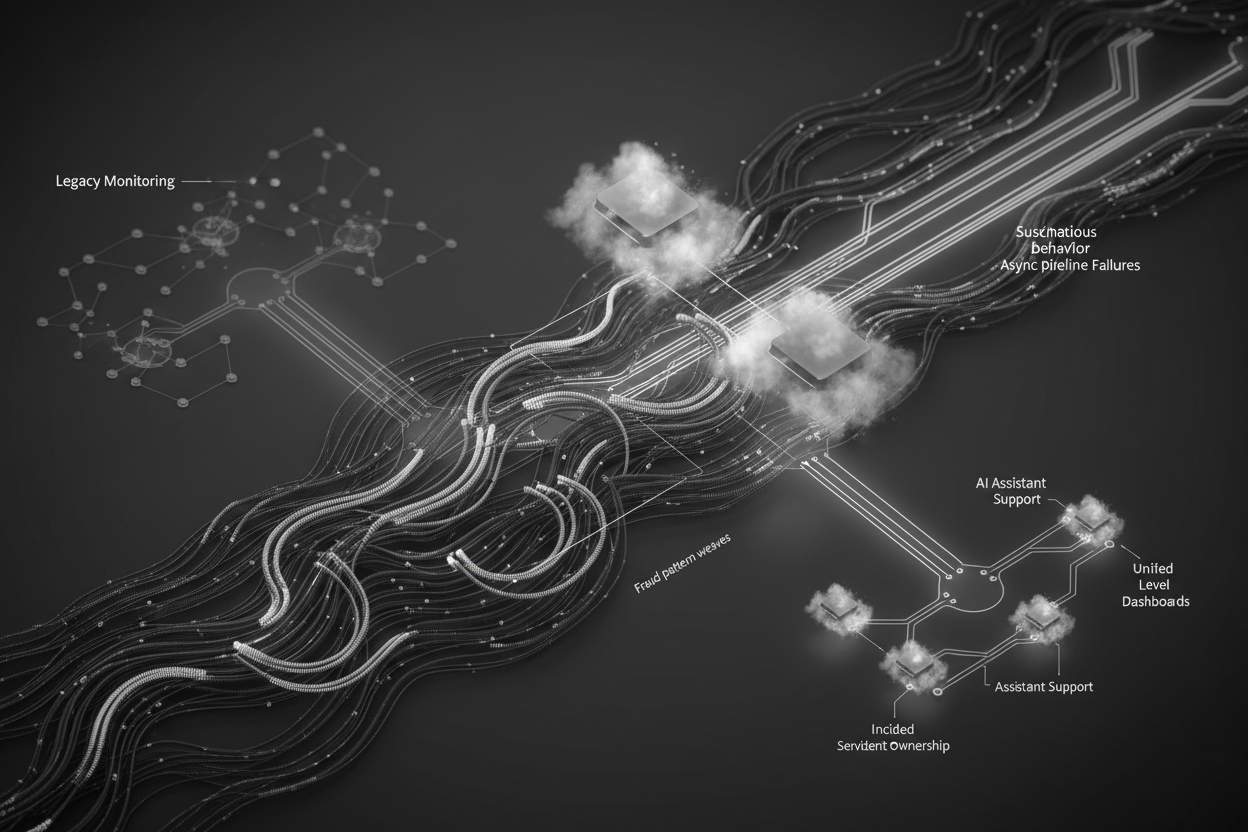
| Metric Coverage | Basic infrastructure & app metrics | Granular async pipeline tracing + AI-assisted anomaly detection | Improves insight into complex failure modes during high load |
| Alerting & Incident Ownership | Static alerts, unclear ownership boundaries | Contextual alerts linked to AI knowledge assistant insights & clear on-call assignments | Reduces integration failure time by up to 40% |
| Trace and Log Correlation | Disparate logs, manual correlation | Integrated tracing with enriched metadata from AI knowledge assistant queries | Enables targeted troubleshooting in async workflows |
| Operational Transparency | Limited dashboarding | Unified service-level dashboards reflecting checkout funnel KPIs and AI assistant health | Supports data-driven decision making and SLA governance |
Tradeoffs: Balancing Observability Depth and System Overhead
Enhancing observability by integrating AI-powered knowledge assistants can significantly improve incident response during peak e-commerce campaigns, yet introduces operational complexity. Below are key tradeoffs identified from real implementations:
- Data Volume vs. Performance: Detailed async pipeline tracing collects high cardinality attributes, increasing storage and network overhead. Configuring sampling strategies is essential to minimize impact without sacrificing critical insights.
- Ownership Clarity vs. Alert Noise: Contextual alerts derived from AI insights help define clear responsibility boundaries but require tuning to prevent alert fatigue among multiple internal teams.
- Automation Benefits vs. Debuggability: AI assistant-driven anomaly detection accelerates triage but may obscure root cause analysis if over-relied on without human oversight.
Reference Architecture: Observability for AI Knowledge Assistants in E-Commerce Checkout
Implementing scalable observability requires an architecture layered for async microservices orchestration, AI assistant integration, and operational dashboards. Key components include:
- Instrumentation Layer: Use standardized tracing protocols (e.g., OpenTelemetry compatible) across microservices handling the checkout funnel, with custom spans around AI assistant interactions.
- Data Pipeline: Stream logs, metrics, and traces into a unified time-series and log store capable of correlating transaction IDs with AI knowledge query events to detect anomalies.
- Alerting Engine: Configure dynamic alert rules that combine pipeline health signals with AI assistant feedback on incident status, routing to appropriate on-call groups.
- Dashboarding & Reporting: Service-level dashboards reflecting async pipeline latency percentiles, error budgets, and AI assistant usage statistics provide visibility for both engineering and operations teams.
This architecture aligns closely with guidelines from business outcome-oriented architecture and data reconciliation strategies to ensure operational confidence during high traffic peaks.
Code Snippets: Instrumentation and Alerting Rules Examples
Below is a simplified example of an async pipeline span with AI knowledge assistant tagging using OpenTelemetry SDK in a Node.js microservice:
const { trace } = require('@opentelemetry/api');

async function processCheckoutEvent(event) {
  const tracer = trace.getTracer('checkout-service');
  const span = tracer.startSpan('process-checkout-event');
  try {
    // Add AI knowledge assistant context
    span.setAttribute('ai.assistant.queryId', event.aiQueryId);
    span.setAttribute('checkout.step', event.step);

    // Business logic here
    await callAsyncPipeline(event);
  } catch (error) {
    span.recordException(error);
    throw error;
  } finally {
    span.end();
  }
}
Example alerting rule (pseudo-YAML) for combined pipeline latency and AI assistant error rate:
alert: AsyncPipelineHighLatencyWithAIError
expr: (
  histogram_quantile(0.95, sum(rate(process_checkout_event_duration_seconds_bucket[5m])) by (le)) > 2000
) and (
  sum(rate(ai_knowledge_assistant_errors_total[5m])) > 5
)
for: 10m
labels:
  severity: critical
annotations:
  summary: "High latency in checkout pipeline with AI assistant errors detected"
  description: "Investigate async pipeline processing delays coinciding with AI knowledge assistant failures."
Operational Checklist: Ensuring Readiness for Peak Campaigns
- Implement fine-grained distributed tracing across all checkout microservices and AI assistant endpoints.
- Establish clear incident ownership by linking alerts to internal team rosters and escalation policies.
- Configure sampling and retention policies balancing observability data volume and platform performance.
- Validate dashboards to surface key KPIs: P95 latency, error budgets, AI knowledge assistant query success rates.
- Conduct runbook drills simulating async pipeline failures identified by AI knowledge assistant alerts.
- Review and tune alert thresholds pre- and post-campaign to reduce false positives during peak traffic.
- Integrate incident postmortem feedback into continuous improvement cycles for observability fidelity.
This checklist supports measurable outcomes such as reducing integration failure rates by 30-50% during critical campaign periods.
Conclusion: Elevating Enterprise Observability for E-Commerce with AI Knowledge Assistants
Integrating advanced system observability tailored for AI knowledge assistants in e-commerce checkout platforms delivers measurable reliability and operational control enhancements. Evidence from scalable deployments confirms that finely instrumented async pipeline tracing combined with contextual AI-driven alerting mitigates integration failure risks and clarifies incident ownership boundaries.
Adopting a layered reference architecture and following detailed operational checklists underpin readiness to handle peak campaign loads with confidence. For organizations seeking to optimize B2B website conversion platforms comprehensively, further insights can be gained by reviewing complementary content such as high-load campaign runbook sets and resilient API architecture catalogs.
To implement an observability strategy that scales with your enterprise needs and integrates AI knowledge capabilities effectively, explore our tailored solutions at our services.
Related reads
Relevant offers
If this article matches your task, here are two offers you can use to move from insight to implementation without extra discovery.
1C and website integration without order duplicates
I implement reliable 1C-website-CRM sync with conflict handling and incident visibility.
Website development on 1C-Bitrix
I build Bitrix websites for conversion: offer architecture, page system, templates and SEO foundation.