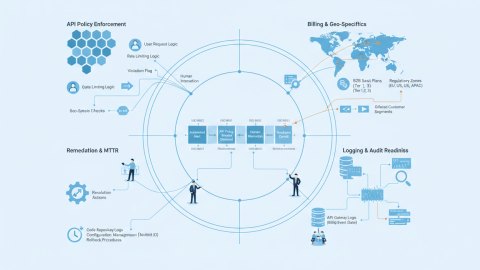
Business outcome-oriented architecture (BOOA) focuses on aligning system design and operational practices directly with measurable business goals. For e-commerce checkout and conversion platforms that have undergone rapid cloud scaling, a common challenge is sustaining fast, reliable user experiences while controlling cloud costs and maintaining compliance — all with decentralized teams and no shared operational playbooks.
This compendium explores a compliance-driven knowledge base governance framework that ensures business outcomes around latency, error budgets, and roadmap velocity despite inherent constraints and technical debt.

1. Compliance-Driven Architecture: Using Regulatory Needs to Shape System Behavior
Understanding the Regulatory and Compliance Context
E-commerce platforms often face a patchwork of data protection, transaction security, and audit requirements based on geography and industry standards. Compliance is not just a legal need but a driver for business resilience and customer trust.
- Transaction Integrity: Systems must guarantee atomicity and idempotency in payment processing under real-world load and failure scenarios.
- Data Privacy and Localization: Checkout data might require geo-validation to ensure storage or processing only occurs within approved jurisdictions.
- Incident Traceability: Every user interaction, especially conversions and checkouts, requires log trails adhering to audit standards for dispute resolution and regulatory inquiries.
Architectural decisions—from data partitioning to API security—must embed compliance requirements as key drivers, not afterthoughts.
Practical Implementation Checklist
- Catalog all regulatory constraints relevant to checkout and conversion flows, including PCI DSS, GDPR, CCPA, and local e-commerce mandates.
- Embed compliance rules as validation gates in data ingestion and payment workflows to prevent violations at source.
- Apply automated geo-validation logic tied to IP and billing address data to enforce data residency requirements.
- Version and document APIs handling sensitive data with explicit compliance annotations.
2. Geo Validation Rules: Mapping Compliance into Real-Time Checkout Processing
Ensuring transactions meet geo-based compliance requires integrating geo validation as a first-class architectural element. Without centralized runbooks or ownership, embedding these rules inside the code or infrastructure configurations reduces oversight risk.
Steps to Integrate Geo Validation
- Define Geo-Compliance Matrix: Map out jurisdictions and their constraints (e.g., which payment gateways or shipping providers are allowed).
- Implement Geo-Validation Services: Central microservices should validate IP, billing, and shipping addresses via a trusted geo-database.
- Fail-Fast Patterns: Transactions breaching geo rules should fail upfront to reduce unnecessary processing and latency.
- Audit Flagging: Non-compliance attempts are logged with context for downstream analysis.
- Decentralized Enforcement: Enforce these validations uniformly across checkout components despite different team ownerships by embedding in CI/CD pipelines and governance checks.
Anti-Patterns to Avoid
- Hardcoding geo rules inline in multiple service codebases leading to divergence and drift.
- Manual approval processes post-transaction increasing latency and customer friction.
- Lack of automated alerts on compliance violations delaying remediation.
3. Logging Requirements: Enabling Audit-Ready Observability Without Performance Penalties
Logging in checkout and conversion flows must balance exhaustive audit trails against the risk of inflating latency or cloud costs. A compliant architecture uses structured, contextual, and sampled logging strategies for scalable observability.
Best Practices for Logging
- Use Structured Logs: Embed transaction IDs, geo-validation outcomes, and latency metrics as discrete fields for automated queries.
- Context Propagation: Ensure logs contain user session and request context to trace end-to-end transaction flow.
- Sampling and Filtering: Apply dynamic sampling to high-frequency events to contain storage and I/O costs without sacrificing root cause visibility on anomalies.
- Immutable Log Storage: Archive logs in tamper-proof storage to meet audit and forensic requirements.
- Automated Alerting: Integrate anomaly detection on latency spikes, errors, and compliance events to maintain error budget health.
Implementation Details
Adopt centralized logging platforms with APIs for quick ingestion and retrieval, incorporate log enrichment middleware in checkout APIs, and automate log rotation with retention policies aligned to compliance mandates.
4. Audit Readiness: Enforcing Governance Across Distributed Ownership
Rapid scaling frequently means distributed ownership without shared runbooks or consistent governance. Building audit readiness and knowledge base standards into architecture and workflows closes this operational gap and accelerates roadmap deliverables.
Steps to Build Audit-Ready Governance
- Implement a Central Knowledge Base: Document architectural decisions, compliance checklists, and operational runbooks for checkout and conversion platforms accessible organization-wide.
- Define Clear Ownership Boundaries: Assign compliance and observability responsibilities explicitly yet allow cross-team collaboration around shared operational tooling.
- Automate Compliance Gates: Integrate compliance and logging validations into CI/CD pipelines and release workflows to prevent regressions.
- Regular Compliance Reviews and Drills: Conduct audits and incident simulations to validate governance across distributed teams.
- Error Budget Monitoring: Track latency and error budget depletion in dashboards with alerts to enforce SLA adherence.
Common Pitfalls
- Relying on tribal knowledge with undocumented governance leading to slow incident response.
- Manual compliance checks in release cycles that delay time-to-market.
- Lack of tooling integration causing blind spots in ownership boundaries.
5. Conclusion: Delivering Faster Roadmap Execution Amid Technical Debt with Outcome-Focused Governance
Business outcome-oriented architecture for e-commerce checkout and conversion platforms involves embedding compliance and governance into the fabric of the system. This reduces p95 latency while controlling cloud cost growth, even when ownership is distributed and legacy technical debt exists.
The keys to success include:
- Embedding compliance and geo-validation logic as non-negotiable architectural components.
- Implementing audit-ready logging that balances rich observability with performance.
- Operationalizing compliance gates and knowledge base governance frameworks to unify distributed teams.
- Proactively monitoring error budgets and SLA metrics to sustain reliability.
For organizations facing these challenges, adopting this compliance-driven knowledge base governance framework not only strengthens audit readiness but empowers faster, more predictable roadmap delivery.
Explore our cloud cost optimization strategies and delivery process audit templates for complementary operational excellence insights. Also consider our API gateway release management checklists tailored for policy-driven routing crucial to checkout stability.
Ready to optimize your architecture for measurable business outcomes? Contact us via our services to design scalable, compliant, and cost-effective checkout and conversion platforms that accelerate growth without compromise.
Related reads
Relevant offers
If this article matches your task, here are two offers you can use to move from insight to implementation without extra discovery.