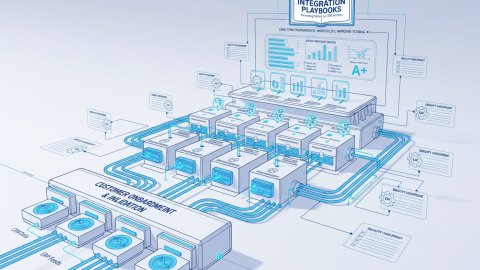
High-load e-commerce platforms often rely on complex integrations between ERP (Enterprise Resource Planning) systems and warehouse logistics providers. Migrating an API gateway to a policy-driven routing model to improve security and performance introduces risks. This article outlines a practical checklist to manage this transition, minimizing disruption and ensuring continuous operation, especially addressing checkout abandonment due to integration failures.

1. Defining the Scope and Granularity of API Migrations
Before any changes are made, it's necessary to gain clarity of the system dependencies.
Questions to address:
- Which specific API endpoints are used in the current ERP warehouse logistics integrations?
- What is the data flow between the systems?
- Which policies are most critical for the migration (e.g., rate limiting, authentication, payload transformation)?
Real-world scenario: A large e-commerce retailer experienced intermittent failures during peak shopping seasons after an API gateway migration. Root cause analysis revealed incomplete documentation of data transformations performed by the old gateway. The solution involved reverse-engineering the transformation logic and implementing equivalent policies on the new gateway *before* switching traffic.
2. Policy Design and Configuration: Testing and Validation
Before implementing the new policies, it's a useful idea to first simulate the actual production environment. Use that data to inform the policy configuration.
Implementation Checklist:
- Implement policies in a non-production environment.
- Use shadow traffic to validate configuration without affecting end-users.
- Automate tests to verify each policy's behavior and performance.
- Define measurable acceptance criteria. Are you familiar with the problems of integration test automation debt? This scenario is why it occurs.
Anti-pattern: Deploying updated APIs without comprehensive testing. Comprehensive tests are critical to verify the proper behavior of your new integration, and can significantly prevent outages and disruption of service.
3. Incremental Release Strategy and Rollback Mechanism
Phased rollouts are an industry best practice for minimizing risk. The rollback strategy is the safety net. Without a solid, automated rollback, you are introducing unnecessary risk.
Implementation Steps:
- Canary Deployment: Route a small percentage of traffic to the new API gateway.
- Monitoring: Closely monitor key performance indicators (KPIs) such as latency, error rates, and transaction success rates.
- Automated Rollback: Implement automated rollback triggers based on pre-defined thresholds for monitoring. If error rates exceed the stated thresholds, the system should revert to the previous configuration automatically.
- Gradual Traffic Increase: Incrementally increase the traffic routed to the new gateway.
Example: If the error rate exceeds 0.1% or the average latency increases by more than 20% compared to the baseline during testing, the system automatically rolls back. This could save the production system from the risks related to ERP and warehouse migrations which can cause revenue loss and bad PR.
4. Observability and Proactive Issue Detection
With robust monitoring, you can rapidly identify and isolate issues before they lead to widespread disruptions. Consider the value of Enterprise App Observability.
Essential Metrics:
- API response times
- Error rates
- Transaction volume
- Infrastructure resource utilization (CPU, memory, network I/O)
- Dependency health (ERP, warehouse system availability)
Actionable Insight: Configure alerts and dashboards to provide real-time visibility into the system's health. Implement tracing to identify bottlenecks and pinpoint the source of failures.
5. Communication and Collaboration
During complex API migrations, transparent communication and collaboration are critical. Keeping all stakeholders informed minimizes confusion and accelerates issue resolution.
Communication Plan:
- Regular update meetings
- Dedicated communication channels for immediate incident reporting
- Documentation of all changes and configurations
Real-world scenario: A global e-commerce company established a war room with representatives from the development, operations, and business teams during their ERP integration. This setup facilitated rapid communication and decision-making, reducing downtime when an unforeseen issue arose.
6. Conclusion
Migrating an API gateway to support policy-driven routing for e-commerce ERP warehouse logistics integrations presents unique challenges. By adhering to a well-defined release management checklist that includes phased rollouts, automated rollback procedures, robust observability, and open communication, you can substantially minimize risk and ensure a successful transition. This approach fosters customer trust and sustains a seamless service experience, even in high-load scenarios.
Need help optimizing your e-commerce integrations and release management processes? Contact us today to learn how our expertise can improve your platform's stability and scalability.
Related reads
Relevant offers
If this article matches your task, here are two offers you can use to move from insight to implementation without extra discovery.
AI knowledge assistant
I connect an AI assistant to the team knowledge base so staff can find precise answers and procedures faster.
Antifraud rules for checkout and payment forms
I deploy a practical antifraud layer in checkout to reduce disputed payments and manual review overhead.