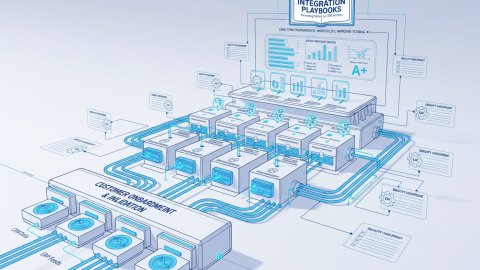
A resilient API gateway is the cornerstone of modern B2B integrations. However, as integrations multiply and complexity increases, the risk of downtime and security vulnerabilities rises sharply. Applying a systematic approach to observability is crucial for mitigating these risks, especially when dealing with critical admin operations and partner ecosystems. This guide provides a practical framework for designing and implementing an observability coverage matrix, tailored for API gateway role-model hardening.
Our approach helps minimize the impact of technical debt on feature development velocity by preemptively identifying and addressing potential issues. By implementing a robust observability framework, we aim to reduce downtime risk in critical B2B funnels and ensure seamless integration with partner services. In this context, "Role-Model Hardening" is where we prioritize admin operations with elevated privileges by applying stricter rules.

The Challenge: Technical Debt and API Versioning
One of the biggest hurdles to achieving robust observability is often technical debt, particularly in the form of inconsistent API versioning. Without a clear versioning strategy, tracing issues across different API versions and partner integrations can become a nightmare. Our primary constraint here is the absence of an API versioning standard.
This lack of standardization amplifies the need for proactive monitoring and comprehensive logging. An effective observability strategy becomes essential in identifying breaking changes and performance bottlenecks before they impact production systems. Let's consider that our target business outcome is lowering downtime risk.
Phase 1: Data Science Angle - Defining Observability Scope
Before diving into implementation, we need to define the scope of our observability efforts. This involves identifying the critical admin operations we need to monitor, the service tiers responsible for their execution, and the key performance indicators (KPIs) we need to track.
Identifying Critical Admin Operations
Start by mapping out the critical admin operations facilitated by your API gateway. These might include:
- User account management (creation, deletion, permission changes)
- Partner onboarding and offboarding
- API key management (generation, revocation)
- Configuration changes (routing rules, rate limiting)
- Security policy updates
Prioritize these operations based on their potential impact on the business. Operations affecting a large number of users or partners should be given higher priority.
Defining Service Tiers
Next, identify the service tiers involved in executing these admin operations. This might include:
- API Gateway: Receives incoming requests, authenticates users, and routes traffic to backend services.
- Authentication Service: Handles user authentication and authorization.
- Configuration Management Service: Stores and manages API gateway configuration.
- Backend Services: Implement the core functionality of the admin operations.
Understanding the dependencies between these tiers is crucial for effective troubleshooting.
Phase 2: Feature Extraction - Identifying Key Metrics and Logs
Once we've defined the scope, we need to identify the metrics and logs that will provide insights into the performance and health of each service tier.
Key Metrics
Focus on metrics that reflect the overall health and performance of the system. Some key metrics to consider include:
- Request Latency: The time it takes to process a request.
- Error Rate: The percentage of requests that result in errors.
- Throughput: The number of requests processed per second.
- Resource Utilization: CPU, memory, and network usage.
These metrics should be captured at each service tier to provide a complete picture of the system's performance. Metrics should be carefully chosen to align with organizational KPIs and defined SLAs to measure the impact of any potential failures.
Essential Logs
Logs provide detailed information about individual requests and events. Capture the following information in your logs:
- Request ID: A unique identifier for each request.
- Timestamp: The time the request was received.
- User ID: The ID of the user making the request.
- Operation Type: The type of admin operation being performed.
- Status Code: The HTTP status code returned by the backend service.
- Error Messages: Any error messages generated during the request processing.
Structured logging is highly recommended, enabling efficient querying and analysis. Implement proper logs redaction to avoid leaking Personally Identifiable Information (PII).
Phase 3: Model Training - Building Observability Dashboards
Now that we have our metrics and logs, we need to build dashboards that visualize this data and provide actionable insights. Create dashboards for each service tier, focusing on the key metrics and logs identified earlier.
Designing Effective Dashboards
Here's a checklist for building effective observability dashboards:
- Use clear and concise labels.
- Group related metrics together.
- Highlight anomalies and trends.
- Provide drill-down capabilities to investigate individual requests.
- Set alerting thresholds based on historical data and expected performance.
Consider service-level agreement (SLA) definitions when creating dashboards. This will help guarantee your architecture's adherence.
Implementing Alerting
Alerting is crucial for proactively identifying and addressing issues. Configure alerts based on critical metrics, such as error rate, latency, and resource utilization. Ensure that alerts are routed to the appropriate teams for investigation and resolution. Consider using anomaly detection algorithms to automatically identify unexpected behavior.
For hardened admin operations, alerting thresholds should be set more aggressively to minimize potential damage. Consider creating custom alerts tied directly to account changes for administrators and critical system accounts.
Phase 4: Evaluation Metrics - Measuring Observability Effectiveness
It's essential to measure the effectiveness of your observability efforts. This involves defining metrics that reflect the value of your observability investments. We must analyze whether the observability solutions chosen are worth the cost.
Key Evaluation Metrics
Consider tracking the following metrics:
- Mean Time To Detect (MTTD): The average time it takes to detect an issue.
- Mean Time To Resolve (MTTR): The average time it takes to resolve an issue.
- Downtime: The total amount of time the system is unavailable.
- Number of Incidents: The number of incidents that occur over a given period.
Track these metrics over time to identify trends and measure the impact of changes to your observability setup. Also measure the operational overhead required for platform support.
Continuous Improvement
Use the insights gained from your evaluation metrics to continuously improve your observability strategy. Identify areas where you can reduce MTTD and MTTR, and optimize your dashboards and alerts to provide more actionable insights. Regular audits are essential.
Addressing the root causes of recurring incidents can significantly improve system stability and reduce operational overhead. Consider implementing automated remediation for common issues. Check out /blog/general/security-by-design-architecting-trust-b2b-systems/ for related reading.
Phase 5: Drift Detection - Monitoring API Contract Changes
In the absence of a consistent API versioning policy, monitoring for API contract changes is critical. Changes to API contracts can lead to unexpected errors and integration issues. This is where automated drift detection becomes indispensable. We're proactively preventing integration issues with partner API changes.
Implementing Drift Detection
Implement automated checks to detect changes to API contracts. This can involve:
- Comparing API schemas: Automatically compare the current API schema to the previous schema to identify changes.
- Monitoring for unexpected errors: Track error rates for each API endpoint and alert when there are significant increases.
- Validating request and response payloads: Validate incoming requests and outgoing responses against the API schema to identify violations.
When changes are detected, notify the appropriate teams for investigation and remediation. If contracts frequently change, automate API contract tests by service tier.
Addressing API Drift
When API drift is detected, take the following steps:
- Identify the root cause of the change: Determine why the API contract changed and who made the change.
- Assess the impact of the change: Determine which integrations are affected by the change.
- Coordinate with partners: Work with partners to update their integrations to accommodate the change.
- Implement temporary workarounds: Implement temporary workarounds to mitigate the impact of the change while partners update their integrations.
Proper API gateway configuration is key to detecting contract errors upstream. Consider using a canary deployment strategy to test new API versions before releasing them to production. See /blog/general/secure-api-integration-enterprise-systems-practical-guide/ for more ideas.
Conclusion: Streamlining B2B Operations with Enhanced Observability
Establishing a robust observability coverage matrix is essential for ensuring the reliability, security, and performance of your API gateway and partner integration ecosystem. By systematically monitoring critical admin operations and implementing role-model hardening, you can significantly reduce the risk of downtime and security vulnerabilities, particularly in environments where standardized API versioning is lacking. This strategy provides an approach to reducing technical debt and lowering the runtime risk in B2B funnels.
Remember to continuously evaluate and improve your observability strategy based on the insights gained from your metrics and logs. Regular audits and automated drift detection are crucial for maintaining a healthy and resilient B2B integration platform. Consider implementing observability solutions that enhance the end-to-end traceability of transactions across the platform. Standardized schema contracts also play a role, see /blog/general/bitrix24-plus-telephony-and-messaging-integrations-conversion-uplift-in-b2b-lead-funnel-pages-cross-system-schema-contract-guideline/ for examples.
Ready to take your B2B integration observability to the next level? Our team of expert architects can help you design and implement a tailored observability strategy that meets your specific needs. Learn more about our services at /services/.
Related reads
Relevant offers
If this article matches your task, here are two offers you can use to move from insight to implementation without extra discovery.
Content hub for categories and services
I build a content hub where informational and commercial pages reinforce each other instead of competing.
GeoIP API for websites
I integrate GeoIP API into forms, auth and backend validation to improve traffic quality and lead routing.