In complex B2B systems, API failures can trigger cascading issues, impacting core business functions. Successfully transitioning from a reactive to a proactive stance demands establishing robust technical due diligence and enforcing release discipline. This hinges on cataloging potential failure modes and their interactions. We’ll explore how creating a rigorous failure-mode catalog, coupled with a service dependency map, serves as a cornerstone for assessing and enhancing API resilience, particularly in multi-region traffic scenarios with unstable network behavior. We are focusing on lowering the defect leakage into production – improving operational efficiency and preventing SLA breaches.
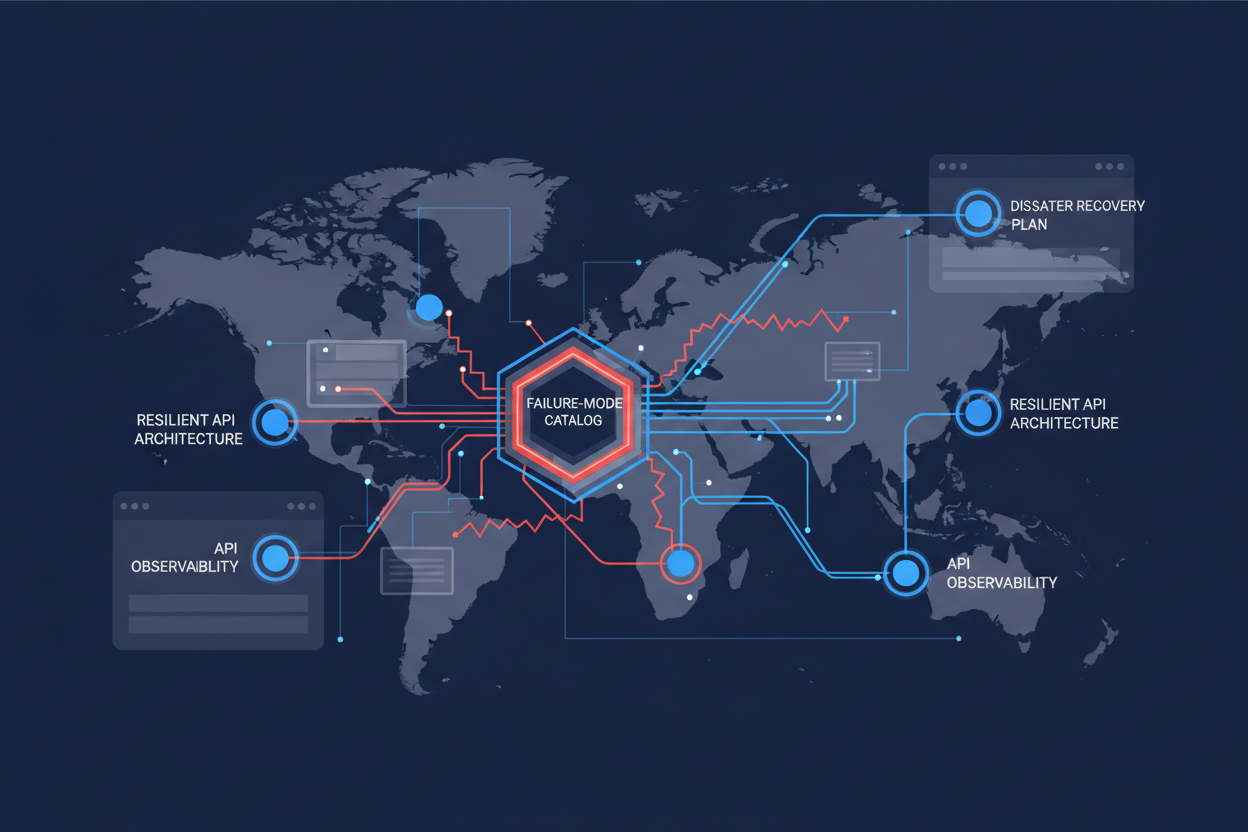
The Need for a Failure-Mode Catalog and Service Dependency Map
A failure-mode catalog documents potential API failure scenarios and their ripple effects. This catalog isn't just a theoretical exercise but rather a collection of real-world occurrences, near-misses, and projected risks tailored to your specific infrastructure. The service dependency map visualizes how different services and APIs rely on one another. By overlaying the failure-mode catalog onto the service dependency map, you gain a clear view of vulnerabilities.
These tools combined empower you to:
- **Pinpoint single points of failure:** Identify APIs or services whose failures can cause widespread disruptions.
- **Understand cascading failures:** Trace how a failure in one API can trigger failures in downstream systems.
- **Prioritize remediation efforts:** Focus on addressing the most critical vulnerabilities.
- **Improve incident response:** Equip teams with the knowledge to quickly diagnose and resolve API failures.
Failure Analysis: Building a Robust Failure-Mode Catalog
The first step involves a comprehensive failure analysis. This process should be collaborative, involving developers, operations engineers, and even business stakeholders.
Steps to building the Catalog:
- **Identify Critical APIs:** Start by focusing on APIs that are essential for core business functions (e.g., authentication, payment processing, data retrieval).
- **Brainstorm Potential Failures:** For each API, brainstorm all possible failure scenarios. Consider factors like network issues, server outages, database errors, code defects, and security vulnerabilities.
- **Document Failure Characteristics:** For each failure mode, document the following:
- **Description:** A clear and concise description of the failure.
- **Likelihood:** An estimate of how likely the failure is to occur (e.g., high, medium, low).
- **Impact:** The potential impact of the failure on the system and business (e.g., data loss, service disruption, financial loss).
- **Detection Method:** How the failure can be detected (e.g., monitoring alerts, error logs, user reports).
- **Resolution:** Steps to resolve the failure.
Here's an example of an entry in a failure-mode catalog:
{
 "API": "Payment Processing API",
 "Failure Mode": "Database Connection Failure",
 "Description": "The API is unable to connect to the database due to network issues or database server outage.",
 "Likelihood": "Medium",
 "Impact": "Inability to process payments, leading to revenue loss and customer dissatisfaction.",
 "Detection Method": "Monitoring alerts for database connection errors.",
 "Resolution": "Switch to a backup database, restart the database server, or investigate network connectivity issues."
}
Symptoms: Recognizing the Signs of API Failure
Early detection of API failures is crucial for minimizing their impact. This requires establishing robust monitoring and alerting systems. Key symptoms to watch out for include:
- **Increased Latency:** API response times exceeding acceptable thresholds.
- **Error Rates:** A spike in HTTP error codes (e.g., 500, 502, 503).
- **Request Failures:** A significant number of API requests failing to complete successfully.
- **Resource Exhaustion:** High CPU usage, memory consumption, or disk I/O on API servers.
- **Database Errors:** Database connection errors, slow query performance, or deadlocks.
Implementing comprehensive logging and monitoring is essential to capture these symptoms. Consider using tools that provide real-time dashboards and automated alerts. Set up alerts based on specific error codes and latency thresholds tailored to each API.
Root Cause Isolation: Tracing Failures Back to Their Source
Once an API failure is detected, the next step is to isolate the root cause. This often involves a combination of techniques, including:
- **Log Analysis:** Examining API logs, server logs, and database logs for error messages and other clues.
- **Tracing:** Using distributed tracing tools to track requests as they flow through different services.
- **Profiling:** Profiling CPU usage, memory consumption, and network activity to identify performance bottlenecks.
- **Code Inspection:** Reviewing API code for potential defects.
A structured approach to root cause analysis is beneficial. The "5 Whys" technique, where you repeatedly ask "why" to drill down to the underlying cause, can be effective. It's recommended to define clear roles and responsibilities for incident response. The article on Data Observability may provide additional insight.
Geo Anomalies: Addressing Multi-Region API Resilience
In multi-region deployments, network instability can be a significant source of API failures. To address this, consider the following strategies:
- **Traffic Shaping:** Use traffic shaping techniques to route requests to healthy regions and avoid congested networks.
- **Redundancy:** Deploy APIs across multiple regions to provide failover capabilities.
- **Content Delivery Networks (CDNs):** Use CDNs to cache API responses and reduce latency for geographically dispersed users.
- **Health Checks:** Implement regular health checks to monitor the availability and performance of APIs in each region.
Checklist for Geo-Specific Resilience:
- **Region Selection:** Choosing appropriate geographic regions considering factors like latency, regulatory compliance, and data sovereignty.
- **Data Replication:** Ensuring data consistency across regions through synchronous or asynchronous replication.
- **DNS Configuration:** Properly configuring DNS records to route traffic to healthy regions.
- **Monitoring and Alerting:** Setting up region-specific monitoring dashboards and alerts.
Patch Implementation: Applying Fixes and Mitigations
Once the root cause of an API failure has been identified and a solution developed, the next step is to implement a patch or mitigation. This might involve:
- **Code Changes:** Fixing bugs or implementing performance improvements in the API code.
- **Configuration Updates:** Adjusting API configurations to improve resilience or performance.
- **Infrastructure Changes:** Scaling up resources, adding redundancy, or modifying network configurations.
Implement a well-defined change management process to ensure that patches are applied safely and effectively. This process should include:
- **Testing:** Thoroughly testing patches in a staging environment before deploying them to production.
- **Rollout Plan:** Developing a detailed rollout plan that includes monitoring and rollback procedures.
- **Communication:** Communicating changes to stakeholders.
For critical issues, consider implementing a blue/green deployment strategy to minimize downtime. Also, consider the rollback strategies outlined in this article: API release management automation.
Safeguards: Preventing Future API Failures
The final step is to implement safeguards to prevent future API failures. This involves a combination of preventive measures and continuous improvement efforts.
Preventive Measures:
- **Code Reviews:** Conducting thorough code reviews to identify potential defects.
- **Automated Testing:** Implementing comprehensive automated testing, including unit tests, integration tests, and end-to-end tests.
- **Static Analysis:** Using static analysis tools to detect code vulnerabilities and style issues.
- **Security Audits:** Conducting regular security audits to identify and address security risks. The Delivery process audit report template can be found here.
Continuous Improvement:
- **Post-Incident Reviews:** Conducting post-incident reviews to analyze the causes of API failures and identify areas for improvement.
- **Performance Monitoring:** Continuously monitoring API performance and identifying bottlenecks.
- **Capacity Planning:** Planning for future capacity needs and scaling resources accordingly.
Regularly review and update the failure-mode catalog to reflect new risks and vulnerabilities. Foster a culture of continuous learning and improvement within the engineering team.
Conclusion
Building a resilient API architecture requires a proactive approach centered around meticulous planning, thorough analysis, and continuous improvement. By establishing a detailed failure-mode catalog coupled with a comprehensive service dependency map during technical due diligence, you can proactively identify and mitigate potential weaknesses. This, complemented by robust monitoring, streamlined incident response, and carefully implemented safeguards, results in a robust architecture, that minimizes disruptions, and ensures consistent performance, and ultimately protects your business from the potentially severe issues that can arise from API failures. This is the operational best practice for maintaining high service availability.
Is your system's reliability under scrutiny? Contact us today to discuss how our architecture consulting services can help you build more resilient and reliable B2B APIs.
Related reads
Enhancing Observability for Faster Root Cause Analysis
Observability is crucial for identifying and addressing API failures quickly. Traditional monitoring often focuses on surface-level metrics, leaving gaps in understanding the underlying causes. Enhancing observability involves implementing a comprehensive system that captures a wide range of data points, enabling faster root cause analysis.
Key Observability Pillars:
- Metrics: Collect system-level metrics (CPU usage, memory consumption, network latency) and application-level metrics (request rate, response time, error rate). Define Service Level Objectives (SLOs) and Service Level Indicators (SLIs) based on these metrics.
- Logs: Implement structured logging to capture detailed information about API requests, responses, and internal operations. Use correlation IDs to trace requests across different services.
- Traces: Utilize distributed tracing to track the path of a request as it flows through multiple services. This provides insights into the interactions between services and helps pinpoint performance bottlenecks.
Implementation Example: Distributed Tracing
Consider an e-commerce platform where a user places an order. The request may go through the following services:
- API Gateway
- Order Management Service
- Payment Service
- Inventory Service
Without distributed tracing, if the order processing is slow, it will be difficult to determine which service is causing the delay. With distributed tracing, each service adds a trace ID to the request, allowing you to visualize the entire transaction flow and identify the bottleneck. For example, if the Payment Service is slow, you can quickly identify it as the root cause and investigate further.
Checklist for Enhancing Observability:
- Define Key Metrics: Identify the metrics that are most critical to API performance and reliability (e.g., request latency, error rate, throughput).
- Implement Structured Logging: Use a consistent logging format that includes relevant information such as request ID, timestamp, user ID, and error code.
- Enable Distributed Tracing: Integrate distributed tracing tools into your API architecture to track requests across services.
- Create Dashboards and Alerts: Set up dashboards to visualize key metrics and configure alerts to be notified of potential issues.
- Regularly Review Alerts: Ensure that alerts are actionable and that the team responds promptly to any issues.
API Gateway Patterns for Resilience
An API Gateway acts as a central point of entry for all API requests, providing a layer of abstraction and control. Implementing specific patterns within the API Gateway can significantly enhance resilience.
Common API Gateway Resilience Patterns:
- Circuit Breaker: Prevents cascading failures by stopping requests to a failing service.
- Retry: Automatically retries failed requests to handle transient errors.
- Rate Limiting: Limits the number of requests from a client to prevent abuse and protect the API from being overwhelmed.
- Bulkhead: Isolates different parts of the API by allocating dedicated resources to each part. This prevents a failure in one part of the API from affecting other parts.
- Caching: Caches API responses to reduce the load on backend services and improve response times.
Implementation Example: Circuit Breaker
Imagine a scenario where a user tries to access a profile page that relies on an external user service. If this user service becomes unavailable, repeatedly sending requests to it will only exacerbate the problem and potentially cause the API gateway itself to become unstable. A circuit breaker pattern prevents this. The circuit breaker monitors the user service and, if it detects a certain number of failures within a given time period, it "opens" the circuit breaker. While the circuit is open, the API gateway will immediately return an error response without even attempting to call the user service. After a specified timeout, the circuit breaker enters a "half-open" state, allowing a few test requests to pass through to the user service. If these requests succeed, the circuit breaker "closes" and normal traffic resumes. If they fail, the circuit breaker remains open, protecting the system.
Anti-Pattern: Ignoring Error Budgets
An anti-pattern to avoid is failing to define and track error budgets. Teams must have a shared understanding of how many errors are acceptable within a given timeframe while still meeting SLOs. Ignoring error budgets can lead to unintended consequences, such as over-aggressive retry policies that amplify problems during incidents. A balanced approach with defined error budgets helps teams make informed decisions about resilience strategies.
Disaster Recovery Planning for API Architectures
Disaster recovery (DR) planning is an essential component of a resilient API architecture. DR planning ensures that your APIs can continue to operate in the event of a major outage, such as a data center failure or natural disaster.
Key Considerations for DR Planning:
- Recovery Time Objective (RTO): The maximum acceptable time for restoring API services after an outage.
- Recovery Point Objective (RPO): The maximum acceptable data loss in the event of an outage.
- DR Strategies: The specific techniques used to restore API services, such as backups, replication, and failover.
Common DR Strategies:
- Backup and Restore: Regularly backing up data and application configurations and restoring them in a DR environment.
- Active-Passive Replication: Maintaining a standby DR environment that is synchronized with the production environment. In the event of an outage, the DR environment is activated.
- Active-Active Replication: Running multiple active copies of the API in different geographic regions. Traffic is distributed across the active copies, and if one region fails, traffic is automatically rerouted to the other regions.
Checklist for Disaster Recovery Planning:
- Define RTO and RPO: Determine the acceptable recovery time and data loss for each API service based on business requirements.
- Choose a DR Strategy: Select the appropriate DR strategy based on the RTO, RPO, and cost considerations.
- Create a DR Plan: Document the detailed steps for restoring API services in the event of an outage.
- Test the DR Plan: Regularly test the DR plan to ensure that it is effective and that the team is familiar with the procedures.
- Automate DR Processes: Automate as many DR processes as possible to reduce the risk of human error and speed up recovery.
Relevant offers
If this article matches your task, here are two offers you can use to move from insight to implementation without extra discovery.
Deal desk automation
I automate the deal desk flow so complex deals do not stall between sales, management and finance.
Traffic analytics module rollout for 1C-Bitrix
Transparent visit, bot, GEO and suspicious-IP analytics inside Bitrix with a clear foundation for future risk workflows.