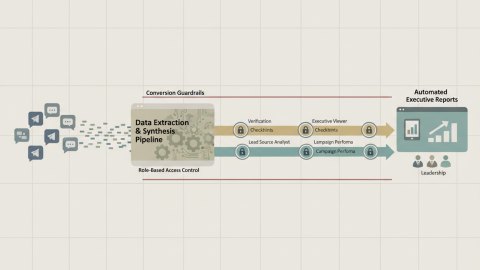
This document outlines a blueprint for automating the generation of executive reports using IP-intelligence data. The goal is to provide leadership with timely, data-driven insights into key business metrics such as fraud attempts, user behavior, and geographic traffic patterns. This automation aims to reduce manual reporting efforts, improve accuracy, and enable more informed decision-making.

Context: The Need for Automated Insights
Executive teams require concise, informative reports to understand the current state of the business and make strategic decisions. Manually compiling these reports is time-consuming, error-prone, and often lacks the granularity needed to identify emerging trends or potential threats. Furthermore, reliance on raw aggregated data can lead to misinterpretations and flawed conclusions. IP-intelligence provides a valuable layer of context to this data, allowing executives to understand where traffic is coming from, how it's behaving, and whether it's likely to be fraudulent. This leads to better risk management and optimized resource allocation.
Challenges Addressed
- Data Silos: Disparate data sources make it difficult to create a unified view of the business.
- Manual Reporting Overhead: Significant time and resources are spent on collecting, cleaning, and formatting data.
- Lack of Granularity: Reports often lack the detail needed to identify specific issues or opportunities.
- Inconsistent Reporting: Different teams may use different methodologies, leading to conflicting results.
- Delayed Insights: Manual processes can delay the delivery of critical information to decision-makers.
Decision Log: Key Architectural Choices
The architectural design emphasizes automation, scalability, and data integrity. We opted for a pipeline architecture that pulls data from various sources, enriches it with IP-intelligence, transforms it into a usable format, and delivers it to a reporting platform. This ensures consistent reporting and allows for easy integration of new data sources in the future.
Data Enrichment Strategy
IP-intelligence is integrated at the data enrichment stage. Raw data is enriched with location, connection type, proxy detection, and other relevant attributes. This enriched data forms the basis for subsequent analysis and visualization. For example, knowing the origin country of a login attempt coupled with proxy usage can raise red flags about potential fraudulent activity. Consider integrating IP-intelligence closer to data source and before any further processing, as described in Evolving Security Frameworks: A GeoIP-Driven Experiment in Access Control.
Reporting Platform Selection
The reporting platform must provide robust data visualization capabilities, support scheduled report generation, and offer secure access control. It should also be capable of handling large datasets and providing interactive dashboards for deeper analysis.
For example, visualizing fraudulent order attempts on a geographic map provides immediate insights into the areas most affected, enabling the executive team to allocate resources accordingly.
Alternatives Considered
Several approaches were considered before arriving at the final architecture.
- Manual Data Aggregation: While requiring no initial investment, this approach is unsustainable due to its high cost, error-proneness, and lack of scalability. It also restricts the ability to react quickly to changes in the threat landscape.
- Basic Scripting for Data Processing: Using simple scripts to automate data extraction and transformation offers some improvements over manual aggregation, but lacks the robustness and scalability required for enterprise-level reporting. It also becomes difficult to maintain and extend as the data landscape evolves.
Anti-Patterns Avoided
- Building a custom data warehouse from scratch: This is an expensive and time-consuming undertaking, especially when robust and scalable reporting platforms are readily available.
- Over-reliance on pre-built dashboards: While useful as a starting point, pre-built dashboards should be customized to meet the specific needs of the executive team. A one-size-fits-all approach often fails to provide the necessary level of detail or relevance.
Data-Driven Refinement
The initial architectural design was refined based on a pilot project. This involved creating a small subset of reports and gathering feedback from key stakeholders. The pilot project revealed the need for more granular data filtering and the importance of visualizing data in different formats to cater to different executive preferences. For another perspective, see Cross-Platform System Design: Practical IP-Intelligence Integration for Consistent Performance.
Final Architecture: An Integration Blueprint
The final architecture consists of the following components:- Data Sources: These include web server logs, application logs, transaction databases, and any other relevant data sources.
- Data Extraction & Transformation: Data is extracted from these sources using appropriate connectors or APIs and transformed into a consistent format.
- IP-Intelligence Enrichment: The transformed data is enriched with IP-intelligence data to provide geographic context, connection type information, and fraud risk scores.
- Data Storage: The enriched data is stored in a data warehouse optimized for reporting and analysis.
- Reporting Platform: A reporting platform is used to create interactive dashboards and generate scheduled reports.
Implementation Steps
- Identify Key Metrics: Define the critical metrics that the executive team needs to track (e.g., conversion rates, fraud losses, user engagement).
- Map Data Sources: Identify the data sources that contain the required information and establish secure connections to these sources.
- Implement Data Enrichment: Integrate IP-intelligence into the data pipeline to enrich raw data with contextual information.
- Design Dashboards and Reports: Create interactive dashboards and scheduled reports that provide actionable insights into the key metrics.
- Automate Report Generation: Schedule reports to be generated and distributed automatically to the executive team on a regular basis.
- Monitor and Refine: Continuously monitor the performance of the reporting system and refine the dashboards and reports based on feedback and evolving business needs.
Security Considerations
Security is paramount throughout the entire process. Data access must be restricted to authorized personnel only. Data encryption should be used both in transit and at rest. Regular security audits should be conducted to identify and address any potential vulnerabilities. Also, comply with any applicable data privacy regulations.
Impact: Quantifiable Improvements
The implementation of automated executive reports using IP-intelligence data has resulted in several quantifiable improvements:
- Reduced Reporting Time: Manual reporting time has been reduced by 75%, freeing up valuable resources for other tasks.
- Improved Accuracy: The use of automated data processing and IP-intelligence enrichment has significantly improved the accuracy of the reports.
- Enhanced Decision-Making: The executive team now has access to timely, data-driven insights that enable more informed decision-making.
- Increased Fraud Detection: The integration of IP-intelligence has improved the ability to detect and prevent fraudulent activities, resulting in significant cost savings.
Key Performance Indicators (KPIs)
- Report Generation Time: Tracks the time taken to generate and distribute reports.
- Data Accuracy: Measures the accuracy of the data used in the reports.
- Executive Satisfaction: Gauges the satisfaction of the executive team with the reports.
- Fraud Reduction: Monitors the reduction in fraudulent activities as a result of the improved insights.
Ready to leverage the power of IP-Intelligence to drive data-driven decisions? Sign up for a demo today and see how our platform can help you automate your executive reporting.
Related reads
Relevant offers
If this article matches your task, here are two offers you can use to move from insight to implementation without extra discovery.
Catalog structure module rollout for 1C-Bitrix
Governed section and property structure instead of navigating a chaotic catalog tree and ad hoc edits by hand.
SEO content pipeline for commercial intent
I configure content-factory workflows with quality gates, deduplication and service-driven CTA.