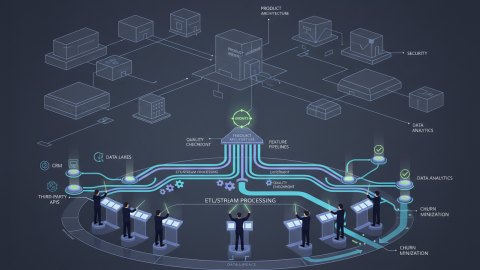
In the competitive landscape of digital products, a robust and well-optimized architecture isn't just a technical requirement; it's a cornerstone of growth and, crucially, user retention. Think of it as the foundation upon which your entire user experience is built. A sluggish, error-prone platform will quickly drive users away, regardless of how innovative your core features might be. I've seen firsthand how seemingly minor architectural flaws can snowball into major roadblocks for even the most promising products. Let's delve into some performance-focused strategies designed to avoid that fate.

Red Team Perspective: Simulating Real-World Attacks
One of the most effective ways to fortify your product's architecture is to adopt a 'red team' mindset. This involves proactively simulating real-world attack scenarios to identify vulnerabilities and performance bottlenecks before they impact your users. This isn't just about security; it's about resilience under stress. For example, consider this: simulating a sudden surge in user traffic, or a distributed denial of service (DDoS) attack, can reveal critical weaknesses in your scaling strategy and expose areas where your infrastructure might crumble under pressure.
Planning the Attack: Defining Scope and Objectives
The initial step is meticulously planning the attack simulation. What systems are within scope? What are your objectives? Common objectives are to identify single points of failure, measure latency under load, and assess the system's ability to automatically recover from failures. I usually start with a core set of critical user journeys. For example, if you have an e-commerce platform, simulate the "add to cart" and "checkout" flows with varying levels of concurrent users. This will tell you where the transaction pipeline starts exhibiting performance degradation.
Execution: Controlled Chaos
The execution phase calls for careful monitoring and logging. Use application performance monitoring (APM) tools to track key metrics such as response times, error rates, CPU utilization, and memory consumption. It's vital to have detailed logs of every transaction to pinpoint the exact source of the problem. Also, documenting environmental factors (network latency, database locks, etc) is important if you're trying to isolate root causes.
Detection Signals: Identifying Performance Anomalies
The next crucial step is to instrument your systems to detect performance anomalies before they escalate into full-blown outages. This involves establishing a robust monitoring and alerting system that can provide real-time insights into the health and performance of your application.
Key Performance Indicators (KPIs)
Identify critical KPIs that reflect the overall health of your system. These often include:
- Average Response Time: How long does it take for a user request to be processed?
- Error Rate: What percentage of requests result in errors?
- CPU Utilization: How much processing power is being used?
- Memory Consumption: How much memory is being consumed?
- Database Query Latency: How long do database queries take to execute?
Setting Thresholds and Alerts
Establish clear thresholds for each KPI and configure alerts to notify you when these thresholds are breached. Use percentile based metrics – for example, p95 response time rather than average response time. When I'm setting up new monitoring, I always include synthetic transactions that check key service features regularly from global locations.
Checklist for Alerting Configuration:
- Define critical KPIs.
- Establish baseline performance metrics.
- Set appropriate warning and critical thresholds.
- Configure alerting channels (email, Slack, etc.).
- Test alerting system to ensure it's functioning correctly.
- Regularly review and adjust thresholds based on system performance.
Countermeasures: Responding to Performance Degradation
Once you've identified a performance issue, the next step is to implement countermeasures to mitigate the impact and restore the system to a healthy state. This requires a well-defined incident response plan and a toolkit of proven strategies.
Scaling Strategies
Scaling is often the first response to performance bottlenecks. This can involve either vertical scaling (increasing the resources of a single server) or horizontal scaling (adding more servers to the cluster). Horizontal scaling is generally preferred for its ability to distribute load across multiple machines and provide redundancy. Cloud platforms make horizontal scaling easier. Remember to apply the principles outlined in Scalable SaaS: An Architectural Journey for B2B Growth.
Code Optimization
Inefficient code is a major source of performance problems. Profile your application to identify hotspots and optimize code accordingly. This can involve rewriting inefficient algorithms, reducing unnecessary function calls, or optimizing database queries. A well-optimized codebase will not only improve performance but also reduce resource consumption.
Caching Strategies
Caching is a powerful technique for reducing latency and improving performance. Implement caching at different layers of your application, including:
- Browser Caching: Cache static assets in the user's browser.
- Content Delivery Network (CDN): Distribute static content across multiple servers to reduce latency for geographically dispersed users.
- Server-Side Caching: Cache frequently accessed data in memory.
Database Optimization
Slow database queries are a common performance bottleneck. Optimize your database schema, indexes, and queries to improve performance. Consider using database connection pooling to reduce the overhead of establishing new connections. Review your query execution plans.
Code References: Practical Implementation Details
Let's look at some concrete examples of how to implement these countermeasures in practice. These snippets are intentionally kept vendor-neutral to emphasize the architectural concepts.
Example: Database Connection Pooling
A database connection pool manages a set of database connections, allowing applications to reuse existing connections rather than repeatedly creating new ones. This dramatically reduces the overhead associated with establishing and closing connections.
// Pseudo-code for connection pooling
class ConnectionPool {
 private List<Connection> availableConnections;
 private List<Connection> usedConnections;

 public Connection getConnection() {
 if (availableConnections.isEmpty()) {
 // Create a new connection if none are available
 Connection newConnection = createConnection();
 availableConnections.add(newConnection);
 }
 Connection connection = availableConnections.remove(0);
 usedConnections.add(connection);
 return connection;
 }

 public void releaseConnection(Connection connection) {
 usedConnections.remove(connection);
 availableConnections.add(connection);
 }
}
Example: Asynchronous Task Processing
For time-consuming tasks that don't require immediate user feedback, use asynchronous processing to offload work to background queues. This prevents the main application thread from becoming blocked and improves responsiveness.
// Pseudo-code for asynchronous task processing
class TaskQueue {
 private Queue<Task> queue;

 public void enqueue(Task task) {
 queue.add(task);
 }

 public void processTasks() {
 while (!queue.isEmpty()) {
 Task task = queue.remove();
 task.execute(); // Execute the task in a separate thread
 }
 }
}
Lessons Learned: Building a Resilient Architecture
After each performance incident and attack simulation, it's crucial to conduct a thorough post-mortem analysis to identify lessons learned and improve your architecture. What went wrong? What could have been done better? Document your findings and create action items to address any identified weaknesses. Continuous improvement is key to building a resilient and high-performing system. The principles of Building digital trust: an operational playbook for IP-Intelligence integration also apply to system performance and resilience.
Anti-Patterns to Avoid:
- Ignoring Performance Monitoring: Failing to monitor your system's performance is akin to driving a car without a speedometer.
- Premature Optimization: Optimizing code before identifying bottlenecks can waste time and effort. Profile first, optimize later.
- Neglecting Database Maintenance: Regularly maintain your database by running updates, optimizing indexes, and purging unnecessary data.
- Lack of Scalability Planning: Failing to plan for scalability can lead to catastrophic performance failures during periods of high traffic.
Mini-Case: Optimizing a B2B SaaS Platform
I recently worked with a B2B SaaS platform that was experiencing significant performance issues, leading to user churn. After conducting a thorough analysis, I discovered that the main bottleneck was inefficient database queries. By optimizing these queries and implementing caching at the application layer, I was able to reduce the average response time by 70% and significantly improve the user experience. The result was a noticeable decrease in churn and a boost in new user sign-ups.
Conclusion: Performance as a Strategic Imperative
In conclusion, product architecture for growth and retention is inextricably linked to system performance. By adopting a proactive approach to performance monitoring, attack simulation, and code optimization, you can build a resilient and high-performing system that delivers a superior user experience and drives long-term business success. Ignoring performance is no longer an option; it needs to be a strategic imperative. Let me help ensure your product architecture can handle whatever comes next. Explore my services to discover how I can assist you in crafting the perfect architecture.
Related reads
Relevant offers
If this article matches your task, here are two offers you can use to move from insight to implementation without extra discovery.
1C exchange and catalog pipeline rollout for 1C-Bitrix
1C exchange becomes a staging pipeline with publish flow, logs, retries, guided configuration and quality control.
Release-readiness audit before launch
I assess whether a product or website is truly ready for launch so release day is not a lottery.