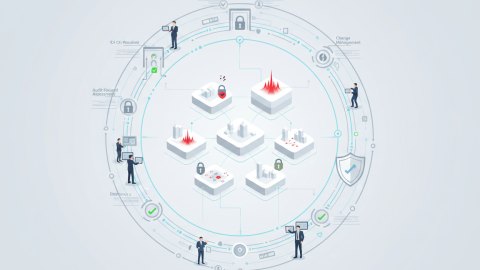
In today's interconnected business landscape, secure API integration is paramount. A compromised API can expose sensitive data and undermine critical business functions. After multiple requests from clients to review their integrations, I developed an audit-centric approach to API security architecture. This approach isn't just about ticking boxes; it's about embedding security deeply within the integration lifecycle. This article outlines key steps to fortify your enterprise systems, reduce risks, and ensure continuous monitoring and reporting. Let's explore how and why a systematic approach is vital.

Control Objectives: Defining the Security Scope
The first step is to define clear control objectives. These are the 'what' and 'why' of your security strategy. What are you trying to protect, and why is it important? Examples of control objectives include:
- Data Confidentiality: Ensuring sensitive data transmitted through APIs remains protected from unauthorized access.
- Data Integrity: Preventing unauthorized modification or tampering of data during transmission or storage.
- Authentication and Authorization: Verifying the identity of API clients and ensuring they have the appropriate permissions.
- Availability: Maintaining API accessibility and performance to avoid service disruptions.
- Non-Repudiation: Ensuring actions performed through APIs can be traced back to specific users or systems.
These objectives must be measurable and actionable. For example, a 'Data Confidentiality' objective might state: "All Personally Identifiable Information (PII) transmitted via the Customer API must be encrypted at rest and in transit." Establishing your controls is a key factor that is critical to Product architecture for sustainable growth: Performance-Centric strategies, which demands continuous attention and iterative improvement.
Risk Mapping: Identifying Vulnerabilities
Once control objectives are established, I map potential risks to each objective. This involves identifying vulnerabilities in your API architecture and assessing their potential impact. Consider the following risk areas:
- Injection Attacks: SQL injection, XML injection, and other attack vectors that exploit vulnerabilities in API input validation.
- Broken Authentication/Authorization: Flaws in authentication mechanisms allowing unauthorized access.
- Data Exposure: Unintentional exposure of sensitive data through API responses.
- Denial of Service (DoS) Attacks: Overloading the API with excessive requests, causing service disruptions.
- Man-in-the-Middle (MitM) Attacks: Interception of API traffic by malicious actors.
For each risk, estimate the likelihood and impact. Use a risk assessment matrix (e.g., High/Medium/Low) to prioritize mitigation efforts. It's often valuable to revisit past incidents described in /blog/building-digital-trust-operational-playbook-ip-intelligence to consider potential integration risks.
Technical Validation: Implementing Security Measures
With risks mapped, I move to technical validation. This involves implementing specific security measures to address identified vulnerabilities. Below are several security controls I’m seeing being used broadly across integration:
- Input Validation: Implement strict input validation to prevent injection attacks. Sanitize and validate all data received from API clients.
- Authentication and Authorization: Enforce strong authentication mechanisms, such as OAuth 2.0 or API keys. Implement role-based access control (RBAC) to restrict access to sensitive resources.
- Encryption: Encrypt all sensitive data at rest and in transit using TLS/SSL. Use strong encryption algorithms.
- Rate Limiting: Implement rate limiting to prevent DoS attacks. Restrict the number of API requests from individual clients within a defined time window.
- API Gateway: Use an API gateway to centralize security controls and policies. The gateway can handle authentication, authorization, rate limiting, and other security functions.
Example: Securing a Customer Data API
Imagine a Customer Data API that exposes customer information. A technical validation checklist might include:
- Implement OAuth 2.0 for authentication.
- Encrypt customer data at rest using AES-256.
- Use HTTPS for all API traffic.
- Implement input validation to prevent SQL injection.
- Implement rate limiting to prevent DoS attacks.
Reporting: Monitoring and Logging
Comprehensive reporting and logging are crucial for detecting and responding to security incidents. Implement centralized logging to capture all API activity. Monitor logs for suspicious patterns, such as failed authentication attempts or unusual API usage.
Key reporting requirements include:
- Real-time Monitoring: Implement real-time monitoring of API traffic to detect anomalies.
- Alerting: Configure alerts to notify security personnel of potential security incidents.
- Auditing: Regularly audit API logs to identify security gaps and ensure compliance with security policies.
As I review observability deployments, I'm seeing teams increasingly focus on telemetry data and how it can correlate security events, as featured across many /blog/ topics.
Outcome: Secure and Reliable API Integrations
By adopting an audit-centric approach to API security, you can significantly reduce the risk of security breaches and ensure the reliability of your enterprise systems. Continuous monitoring, comprehensive reporting, and proactive risk management are essential. Here's a checklist to remember:
- Define clear control objectives.
- Map potential risks.
- Implement technical security measures.
- Establish reporting process.
- Validate and iterate frequently.
Need help securing your API integrations? Contact us to learn more about our API security assessment and architecture services. I have helped several other clients develop robust security roadmaps tailored to their specific enterprise environments. Let's work together to build a secure and resilient API ecosystem.
Related reads
Relevant offers
If this article matches your task, here are two offers you can use to move from insight to implementation without extra discovery.
GeoIP API for websites
I integrate GeoIP API into forms, auth and backend validation to improve traffic quality and lead routing.
SEO relaunch sprint after traffic drop
I run an emergency SEO sprint after traffic loss, from root-cause diagnosis to the first recovery wave.