Building the catalog SEO module for 1C-Bitrix portcore.seo
Industry
1C-Bitrix, catalogs, SEO, migrations, organic growth
Period
Case format: building a product SEO module for sections, products, redirects and re-indexing
Role
Design and development of a catalog SEO layer as a standalone product module
Tech stack
Buffer/head injection; meta/H1/OG templates for root, sections and products; canonical/robots/hreflang/schema.org; redirect manager, sitemap and IndexNow queue
Problem
The starting situation was awkward both for SEO and for engineering: different templates carried their own logic, URL migrations required manual oversight and every structural change in the catalog risked breaking metadata and canonical consistency.
I compared continued spot fixes, a bundle of internal tools and a full product module. The first two approaches were too project-specific, so the decision was made in favor of a dedicated SEO module with unified rules and repeatable integration.
When I joined "Building the catalog SEO module for 1C-Bitrix portcore.seo", the pattern was familiar: local fixes existed, but there was no shared model connecting business goals to technical execution. That gap kept incidents recurring and manual overhead growing.
I decomposed the issue into controllable layers: input signals, decision rules, handoff points and post-release quality control. This immediately clarified where performance was being lost and why previous fixes did not hold.
Approach and solution
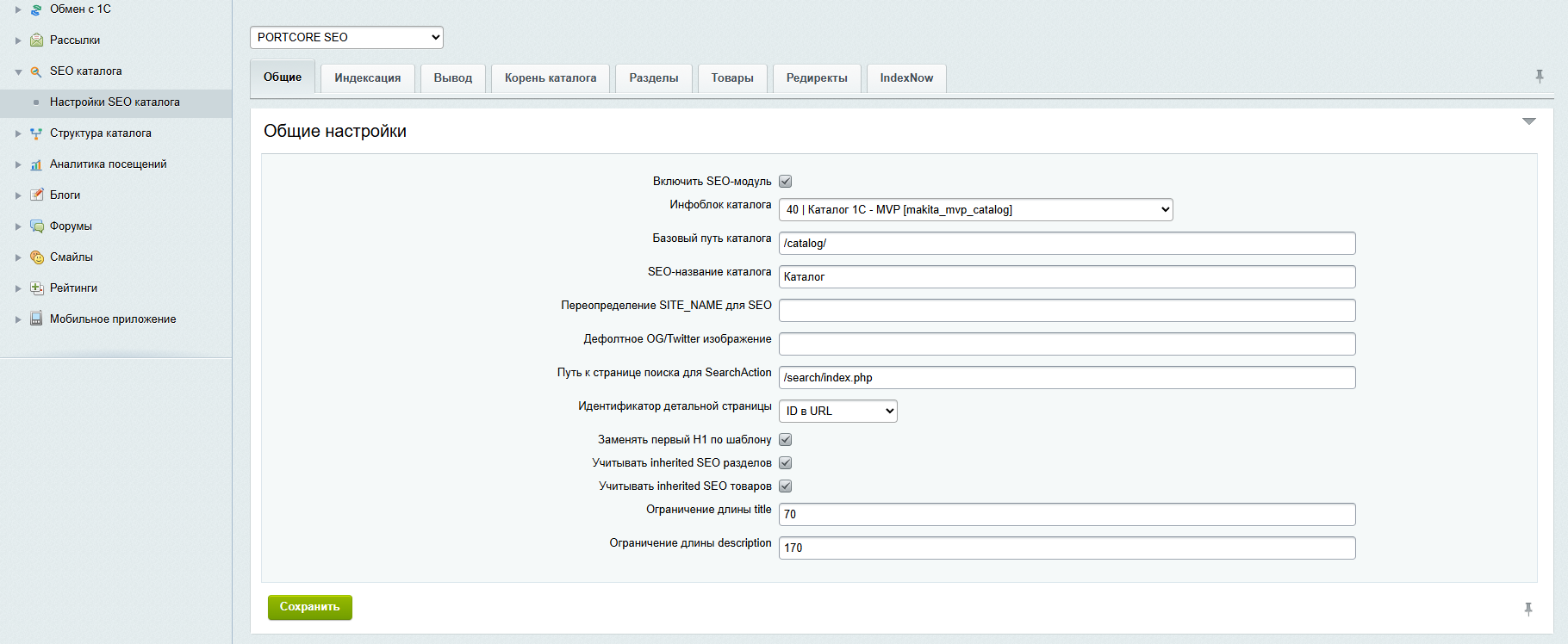
In the final implementation, the module gained templates for root, sections and products, canonical/robots logic, JSON-LD, a redirect manager, sitemap manager and an IndexNow queue. This brought the catalog SEO layer into one place and removed duplicated logic across the project.
Several product-oriented features were shaped along the way: fallback logic, inherited SEO, smarter redirect rules, batch URL submission and workflows that let the SEO team govern the layer centrally instead of through endless template patches.
Instead of patching symptoms, I implemented a phased model: acceptance criteria first, minimum viable core second, and scale expansion only after stability was proven. This created measurable progress at each stage.
Operational governance was part of the implementation itself: ownership boundaries, deviation handling and explicit escalation logic. That made the outcome repeatable rather than person-dependent.
Architecture
The implementation moved from baseline page-data and metadata output toward more advanced parts: redirects, sitemap, IndexNow, migration scenarios and behavior testing across different catalog page types. Special attention went into rule-conflict debugging and validating how the module behaves as the catalog grows.
The build story matters because it shows the transition from manual SEO maintenance to a product architecture that can keep evolving and be deployed again elsewhere.
Architecturally, the key principle was "observability before complexity". It allowed the team to see real impact of each change and keep control while scaling.
The stack (Buffer/head injection; meta/H1/OG templates for root, sections and products; canonical/robots/hreflang/schema.org; redirect manager, sitemap and IndexNow queue) was treated as an enabler, not a goal: every decision was evaluated by impact on delivery speed, stability and support cost.
Outcome
The final output was not a pile of SEO fixes, but a standalone module that can be deployed into Bitrix catalogs as a ready-made solution. For product discovery, the case creates the right bridge into the portcore.seo detail page, where the full feature set and usage scenarios are shown.
Business impact was not limited to isolated metric gains. The team received a practical operating model with clearer priorities, faster decisions and lower regression risk.
I documented outcomes in a before/after format tied to practical KPIs, so leadership could directly map engineering work to commercial value.
Metrics
- Title, description, keywords, H1, OG and Twitter templates for catalog root, sections and products.
- Canonical, robots, hreflang, schema.org, redirect rules, smart-match and migration redirect logging.
- IndexNow queue, sitemap generation and event-based queueing of changed sections and products.
- Team response speed to deviations and incidents.
- Manual overhead share before vs after rollout.
- Stability of critical user flow under load.
- Release predictability and regression frequency.
- Input quality: less noise, higher useful outcome.
Deliverables
- Head/output SEO engine with templates, macros and page-data logic.
- Redirect manager, sitemap manager and IndexNow manager for migrations and indexing workflows.
- Admin UI for indexing, output, templates, redirects and IndexNow queue management.
- Warranty support on the license and a direct communication channel for rollout and follow-up SEO-layer tuning.
- Target architecture map with implementation priorities.
- Phased rollout plan with acceptance criteria.
- Operational runbook and escalation model.
- Post-release quality checklists.
- 30/60-day optimization backlog.
Unique solution in this case
In this case, the differentiator was component-driven Bitrix domain model, SEO structure mapped to commercial intent with quality gates, risk-aware traffic filtering with explainable decision rules, bot orchestration for inbound scenarios with SLA routing, AI workflow with safe rollout and quality validation. The delivery was not a one-off patch: architecture constraints were fixed first, then a production workflow was rolled out so the team can scale without losing control.
Comparison: before vs after systems rollout
| Aspect | Before | After |
|---|---|---|
| Delivery model | Local fixes without unified architecture | Systems-first rollout with clear architecture logic |
| Operational control | Manual and context-dependent execution | Transparent rules, checklists and quality control |
| Business impact | The task was to solve a common Bitrix-catalog problem: SEO logic spread across templates, difficult URL migrations and fragmented control over metadata, canonical rules and indexing. | The result was portcore.seo, a module that unifies the catalog SEO layer and turns metadata, redirects, sitemap and IndexNow into a deployable product. |
How-to: how to replicate this result in your project
- Define business objective and success metric before implementation.
- Map current flow and identify losses in data, time and quality.
- Scope minimum viable rollout with explicit acceptance criteria.
- Launch phased rollout with observability and trace logging.
- Lock support, escalation and iteration workflow.
Practical implementation checklist
- Baseline metrics captured before rollout.
- Integration points and data contracts verified.
- Failure modes and fallback scenarios tested.
- Post-launch quality controls enabled.
- Operational runbook prepared for the team.
- 30/60-day optimization plan documented.
Related services, offers and products
Need a similar case delivered?
Describe your task and I will suggest architecture, scope and delivery format.