Internal operations panels are the nerve center of many B2B platforms. Often, they grant privileged access to manipulate customer data, billing configurations, and entitlements. Migrating the underlying architecture of such panels to utilize message queues (MQ) or event buses introduces significant risks, particularly related to multi-tenant isolation. Imagine an automated script inadvertently triggering actions on the wrong tenant’s account because of a misconfigured queue listener. The goal is to migrate internal operations functionality to message-driven architecture without introducing vulnerabilities that would bypass existing authorization checks. This means not only preventing cross-tenant data breaches but also ensuring billing accuracy and avoiding service disruptions that lead to customer churn.
This article offers a migration blueprint that focuses on validating isolation and ensuring audit readiness while optimizing the product engineering workflow. Let’s explore the specific requirements, constraints, system blocks, API schema, and security considerations involved in this migration paradigm, all emphasizing automated validation wherever possible. If you need help implementing this for your business, consider exploring our services.
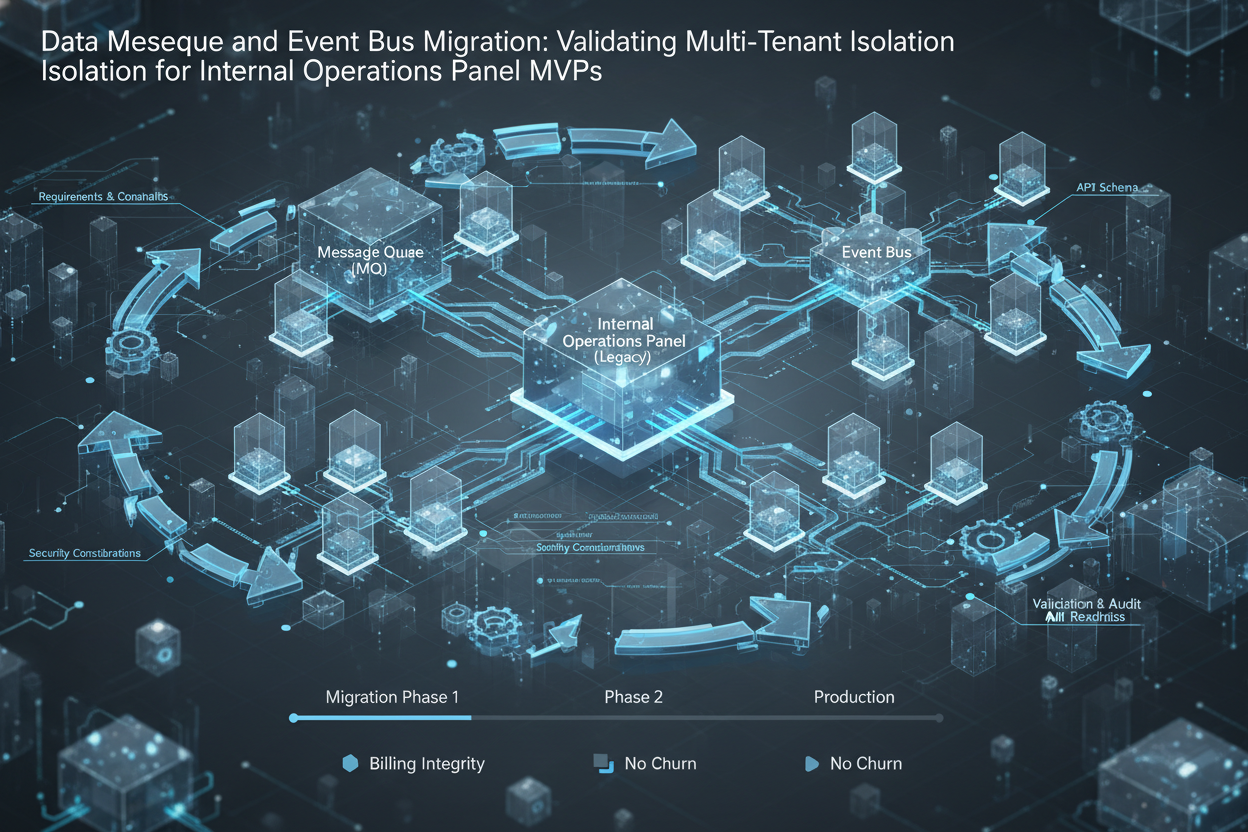
Design Document: Multi-Tenant Isolation Validation for Internal Operations Panel Migration
This document outlines the design and validation process for migrating parts of an internal operations panel to a message queue and event bus architecture, focusing on multi-tenant isolation. The primary goal is to minimize the risk of unintended actions affecting incorrect tenants while rebuilding billing limits and entitlements logic.
Requirements
- Multi-Tenant Isolation Enforcement: All messages processed by the system must be correctly scoped to the specific tenant. Actions triggered by these messages, such as updates to billing limits, must only affect the intended tenant.
- Audit Trail Generation: Every message consumed and the resulting action taken must be logged with sufficient detail to reconstruct the entire event flow, including the user who initiated the action and the tenant affected.
- Billing Integrity: Migration must not introduce errors in billing calculations or entitlement assignments. Existing billing guardrails should be maintained or improved.
- Performance: Message processing should occur with acceptable latency to avoid impacting the responsiveness of the internal operations panel.
- Rollback Strategy: A clear and actionable rollback strategy needs to be defined to revert to the previous system state in case of critical failures discovered after deployment.
- Automated Testing: Develop a range of automated tests designed to actively validate tenant isolation across all message types and use cases.
Constraints
- Zero Downtime Migration: The migration should be conducted without any planned downtime or service interruption for internal users.
- Existing Infrastructure: The new message queue and event bus infrastructure should integrate with the existing authentication and authorization systems. No new fundamental authentication schemes should be introduced without a deep review.
- Security Hardening: All communication channels involving message queues and event buses must be encrypted and secured to prevent unauthorized access.
- Rate Limiting: Implement and enforce rate limits on message processing to prevent abuse or accidental overload, particularly from automated scripting.
System Blocks
- Producer Service: This service is responsible for producing messages onto the message queue or event bus. This will typically be the internal operations panel itself or a backend service triggered by operations panel actions.
- Message Queue/Event Bus: The chosen messaging system (e.g., RabbitMQ, Kafka) acts as the central transport for messages.
- Consumer Service: This service consumes messages from the queue/bus and performs the necessary actions. This includes updating billing limits, modifying entitlements, or triggering other internal operations.
- Authentication/Authorization Service: Verifies the identity of the user initiating the action and ensures they have the necessary permissions to perform the requested operation on the specified tenant.
- Audit Logging Service: Records all message processing events, including the message payload, user identity, tenant ID, and the outcome of the action.
- Monitoring Service: Tracks key metrics such as message processing latency, queue depth, and error rates to identify potential performance bottlenecks or failures.
API Schema
The message schema is pivotal for maintaining consistency and enabling automated validation. Each message should contain, at a minimum, the following:
tenant_id: The unique identifier of the tenant affected by the message.user_id: The unique identifier of the user who initiated the action.action: A string describing the action to be performed (e.g., "update_billing_limit", "grant_entitlement").payload: A JSON object containing the data required for the action. Ensure that sensitive data is encrypted appropriately.message_id: A unique identifier for each message, used for tracking and deduplication.timestamp: The time the message was produced.
Here’s an example message in JSON:
{
 "tenant_id": "tenant-123",
 "user_id": "user-456",
 "action": "update_billing_limit",
 "payload": {
  "limit_type": "api_requests",
  "new_limit": 10000
 },
 "message_id": "msg-789",
 "timestamp": "2024-10-27T10:00:00Z"
}
Multi-Tenant Isolation Validation Checklist
This checklist provides a structured approach to ensure multi-tenant isolation during and after the migration:
- Tenant Context Propagation:
- Verify that the
tenant_idis consistently passed from the producer service to the consumer service via the message queue/event bus. - Implement automated tests that simulate a user from one tenant attempting to perform actions on another tenant's resources. These tests should always fail.
- Verify that the
- Authorization Enforcement:
- The consumer service must always authenticate the
user_idcontained in the message and verify their permissions against thetenant_id. - Use automation to validate that users only have access to data and operations within their assigned tenant.
- The consumer service must always authenticate the
- Data Isolation:
- The consumer service should use the
tenant_idto isolate data access. This might involve using separate database schemas, row-level security, or other tenant-specific data segregation techniques. - Run queries against the data store before and after message processing to ensure changes are isolated to the intended tenant.
- The consumer service should use the
- Billing Validation:
- After performing actions that affect billing limits or entitlements, verify that the changes are reflected correctly for the specified tenant and that other tenants are unaffected.
- Automated billing reconciliation processes should compare the new billing data against the pre-migration baseline and alert on any discrepancies.
- Audit Logging Verification:
- Ensure that all message processing events are logged with the correct
tenant_id,user_id,action, andpayload. - Implement automated log analysis to detect suspicious activity, such as a user attempting to perform actions on multiple tenants within a short period.
- Ensure that all message processing events are logged with the correct
- Error Handling:
- Define how errors are handled if a message cannot be processed due to authorization failures or other issues. Messages should be moved to a dead-letter queue for investigation, and alerts should be raised.
- Implement automated monitoring to detect and alert on errors related to tenant isolation.
Automated Isolation Test Examples
The key to successful migration lies in automating validation. Here are some practical automated test examples:
1. Cross-Tenant Access Attempt
Simulate a user from Tenant A attempting to update the billing limit for Tenant B. This test should verify that the authorization check fails, and the action is prevented.
# Python example using a mocked authorization service
def test_cross_tenant_access_attempt():
 # Prepare a message with Tenant B's ID but using User A's credentials
 message = {
  "tenant_id": "tenant-b",
  "user_id": "user-a",
  "action": "update_billing_limit",
  "payload": {
  "limit_type": "api_requests",
  "new_limit": 10000
  }
 }

 # Mock the authorization service to simulate an authorization failure
 with patch('authorization_service.authorize', return_value=False):
  # Attempt to process the message
  result = consumer_service.process_message(message)

  # Assert that the processing failed and an error was raised
  assert result == "FAILED: Unauthorized"

  # Assert that no changes were made to Tenant B's billing limits
  billing_limit = get_billing_limit("tenant-b", "api_requests")
  assert billing_limit == ORIGINAL_BILLING_LIMIT_B

 # Run the test with pytest
2. Billing Limit Update Sanity Check
Verify that updating a billing limit for Tenant A only affects Tenant A's data and leaves other tenant data untouched.
# Python example using a mocked database
def test_billing_limit_update_tenant_a():
 # Prepare a message to update Tenant A's billing limit
 message = {
  "tenant_id": "tenant-a",
  "user_id": "user-a",
  "action": "update_billing_limit",
  "payload": {
  "limit_type": "api_requests",
  "new_limit": 10000
  }
 }

 # Process the message
 consumer_service.process_message(message)

 # Assert that Tenant A's billing limit was updated correctly
 billing_limit_a = get_billing_limit("tenant-a", "api_requests")
 assert billing_limit_a == 10000

 # Assert that Tenant B's billing limit remains unchanged
 billing_limit_b = get_billing_limit("tenant-b", "api_requests")
 assert billing_limit_b == ORIGINAL_BILLING_LIMIT_B
 # Run the test with pytest
Security Review
- Message Encryption: Sensitive data within the message payload (e.g., API keys, credentials) must be encrypted at rest and in transit.
- Authentication & Authorization: The consumer service must rigorously authenticate the user and authorize their actions against the specified tenant. Leverage existing, established authentication mechanisms when feasible.
- Input Validation: Thoroughly validate all message inputs to prevent injection attacks or other forms of malicious input.
- Rate Limiting & Throttling: Implement rate limits and throttling mechanisms to prevent abuse or accidental overload of message processing.
- Regular Security Audits: Schedule regular security audits and penetration tests to identify and address potential vulnerabilities in the message queue/event bus infrastructure and related services.
- Least Privilege Principle: Ensure that all services and users have only the minimum level of access required to perform their tasks.
Anti-Patterns to Avoid
- Implicit Trust of Tenant IDs: Never assume that the
tenant_idin a message is legitimate without proper validation. - Sharing Connections Across Tenants: Avoid sharing database connections or other resources across tenants. This can create opportunities for data leakage or corruption.
- Ignoring Error Handling: Failing to handle errors gracefully can lead to data inconsistencies or security vulnerabilities. All errors must be logged and addressed promptly.
- Insufficient Logging: Insufficient logging makes it difficult to audit and troubleshoot issues related to tenant isolation. Log all message processing events with sufficient detail.
- Manual Deployment Only: Manual configuration introduces drift and operational risk. The architecture must be automated with infrastructure-as-code tools.
Migration Steps
- Phased Rollout: Deploy the new architecture to a small subset of tenants first (e.g., internal test tenants) to validate isolation.
- Shadow Mode: Process messages in the new architecture without actually taking any action, while comparing the results to the existing system.
- Feature Flags: Use feature flags to enable or disable the new message processing logic on a per-tenant basis.
- Monitoring and Alerting: Implement detailed monitoring and alerting to detect any issues with tenant isolation or performance.
- Rollback Plan: Have a rollback plan in place to revert to the previous system state if necessary.
Conclusion: Automating Trust with Validated Isolation
Migrating to a message queue and event bus architecture for internal operations panels offers numerous benefits in terms of scalability, flexibility, and resilience. However, it also introduces significant risks related to multi-tenant isolation. Rigorous validation, automated testing, and adherence to security best practices are paramount to ensure that the migration does not compromise data security or billing integrity, or lead to customer churn. By implementing the checklist, security review process, and automated tests outlined in this document, organizations can significantly reduce the risks associated with this type of migration. Ensure you check out our article on High-Availability microservices: the performance vs. resilience tradeoff, and also Business process automation & analytics: an executive's playbook for performance.
Remember that the most effective migrations are those that validate continuously. We need to evolve from reactive to proactive security. By automating tenant isolation validation, we enable increased confidence and faster iteration cycles. A message-driven architecture, combined with strong automation, paves the way for truly resilient and secure internal operations. You can implement these automation patterns as suggested by the Automated CRM/ERP data sync: AI moderation system migration handbook for stable legacy connector replacement.
Ready to transform your internal systems with bullet-proof security and next-gen automation? Contact us to learn how we can help you architect and implement a secure and scalable solution.
Related reads
Relevant offers
If this article matches your task, here are two offers you can use to move from insight to implementation without extra discovery.