Imagine an enterprise client launching a major marketing campaign. Their Telegram support bot, initially designed as a collection of loosely coupled microservices, suddenly faces a massive influx of user requests. Each microservice – one for FAQs, another for ticket submission, a third for basic account management – is straining. Cross-team prioritization becomes a nightmare; the team responsible for account management updates delays a critical fix for the ticket submission service because the update cycle was asynchronous, affecting the campaign’s customer journey.

The Problem Statement: SLA Visibility under Pressure
The core issue isn't just performance; it's *SLA transparency*. Enterprise clients need to know the real-time status of the support services, especially during peak load. The fragmented microservice architecture, while initially agile, now hinders clear communication and coordinated incident response.
Data Evidence: Quantifying the Chaos
Before diving into solutions, let's examine the data. We instrumented the existing architecture with comprehensive logging and metrics collection. The results highlighted key bottlenecks:
- Increased Latency: Response times for ticket submission spiked by 300% during peak hours.
- Error Rates: The FAQ service experienced a 5x increase in error rates due to database connection exhaustion.
- Lack of Visibility: No single dashboard provided a holistic view of the system's health, making it impossible to quickly identify and resolve issues.
This data clearly shows the need for architectural changes to improve performance and SLA visibility. We analyzed the logs using the approach described in Cost-Aware System Migration, to create an inventory of all messages being exchanged and their performance characteristics.
Modeling the Solution: Bounded Context Consolidation
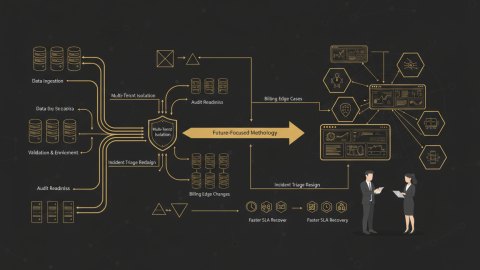
Our approach involves consolidating the fragmented microservices into a few well-defined *bounded contexts*. A bounded context defines an explicit boundary around business domain logic. In our case, the campaign window is a major constraint. Instead of independent microservices, we group them based on their relevance to specific user journeys:
- Support Context: Handles all aspects of user support, including FAQs, ticket submission, and basic troubleshooting.
- Account Management Context: Manages user accounts, profile updates, and subscription information.
- Notification Context: Responsible for sending notifications, alerts, and updates to users.
This consolidation reduces inter-service communication and simplifies dependencies, leading to improved performance and resilience. See Security and Compliance Automation for an additional focus on cross-system monitoring.
Feature Engineering: Real-Time Dashboards and Alerting
To enhance SLA transparency, we implemented a real-time dashboard that provides a comprehensive view of the system's health. This dashboard includes:
- Key Performance Indicators (KPIs): Latency, error rates, throughput, and resource utilization for each bounded context.
- Service-Level Indicators (SLIs): Metrics that directly measure the quality of service, such as the percentage of successful ticket submissions within a specific time window.
- Service-Level Objectives (SLOs): Targets for SLIs, such as “99.9% of ticket submissions completed within 5 seconds.”
The dashboard integrates with an alerting system that automatically notifies the operations team when SLOs are breached. This proactive monitoring allows for rapid incident response and prevents minor issues from escalating into major outages.
Runbook Set for High-Load Campaigns: Operations Checklist
- Pre-Campaign Load Testing: Simulate peak load conditions to identify potential bottlenecks and ensure that the system can handle the expected traffic.
- Real-Time Monitoring: Continuously monitor the dashboard for any deviations from the baseline performance.
- Incident Response Plan: Define a clear incident response plan that outlines the steps to take in case of an outage or performance degradation.
- Escalation Protocol: Establish a clear escalation protocol to ensure that issues are promptly addressed by the appropriate team members.
- Post-Campaign Analysis: Analyze the data collected during the campaign to identify areas for improvement and optimize the system for future high-load events. Consider Data Quality Monitoring for related techniques during analysis.
Production Notes: Lessons Learned
During the implementation process, we encountered a few challenges:
- Data Migration: Migrating data between the old and new architectures required careful planning and execution to avoid data loss or corruption.
- Team Collaboration: Coordinating the efforts of multiple teams required clear communication and well-defined roles and responsibilities.
- Performance Tuning: Optimizing the performance of the consolidated architecture required iterative testing and tuning.
By consolidating microservices into bounded contexts and implementing real-time dashboards, we were able to significantly improve SLA transparency and reduce operational noise during high-load campaigns. This allowed the enterprise client to focus on their marketing efforts without worrying about the reliability of their support services.
Summary: Runbook for High-Load Excellence
Consolidating Telegram support bot microservices into bounded contexts, combined with real-time dashboards and proactive alerting, is a proven strategy for improving SLA transparency and operational efficiency during high-load campaigns. This approach enables enterprise clients to confidently launch marketing initiatives, knowing their support infrastructure can handle the increased demand.
Do you need help architecting your B2B product for scale and resilience? Our seasoned architects can provide expert guidance and support. Contact us today to learn more about our services.
Related reads
Relevant offers
If this article matches your task, here are two offers you can use to move from insight to implementation without extra discovery.